




Cairo Design Week Turns Five Egyptian Textile Traditions Into Fashion
Curator Karim Mekhtigian turns the Fashion Design District into a research lab, pairing five Egyptian textile traditions with contemporary designers at Cairo Design Week.
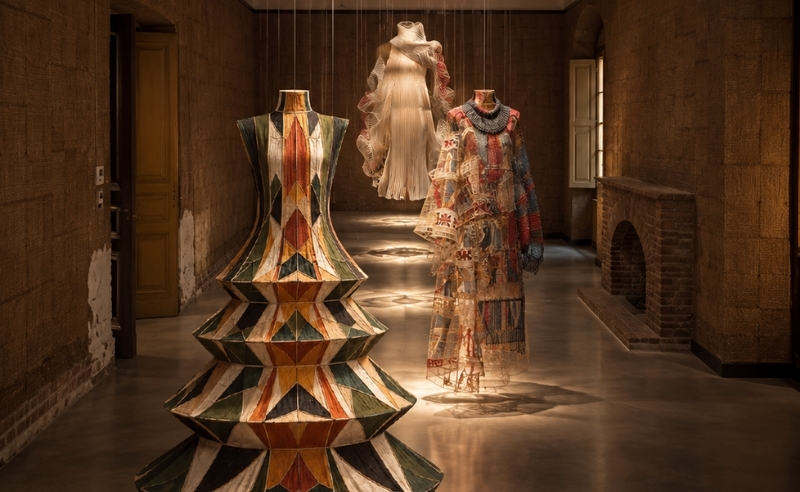
A hand-worked pleat, a strip of embroidered writing or a piece of geometric appliqué can carry centuries of Egyptian textile history.
Cairo Design Week is set to turn those details into starting points for contemporary fashion when it returns from November 19 to 28, with this year's Fashion Design District built around five textile traditions from across Egypt.
The theme, "The City Wears Its Stories", treats heritage as material designers can work with. Visitors will move between historical references and new pieces shaped by linen, Akhmim weaving, tiraz, Coptic textiles and khayamiya.
Karim Mekhtigian, founder of Alchemy Design Studio and Downtown Cairo cultural space Tamara Haus, developed the concept. Maison Pyramide and curator Mai Galal lead the district’s curation, continuing a partnership that has shaped the Fashion Design District since Cairo Design Week began in 2022.
Galal works with participating designers on their concepts, sketches and final direction.
The format asks for pieces that can hold their own as exhibition objects.
"It is a museum concept. People come, stand in front of the pieces and look at them. There must be something amazing," Galal says.
 Mekhtigian approached the district as a place for designers to study before they make.
"I wanted to make the fashion district a lab of research," he says.
The starting point is a concern that techniques embedded in Egyptian craft are disappearing as production becomes increasingly industrialised.
"We have a lot of interesting and beautiful techniques, and we are losing them little by little over time, because of the industrialisation of the business," Mekhtigian says.
The exhibition turns those techniques into a route through Egypt.
Linen and hand-pleating associated with ancient Egyptian dress provide the first reference point. Designers translate their lightness, folds and structure into fluid fabrics, layered forms and sculptural silhouettes.
The route then moves to Akhmim, whose long history of hand-weaving provides a vocabulary of geometric patterns, repeated colour, stripes and woven structure.
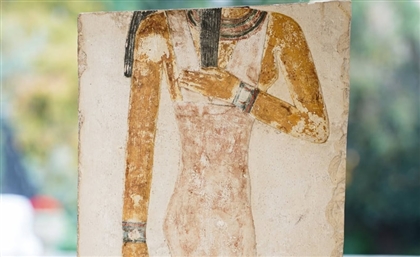
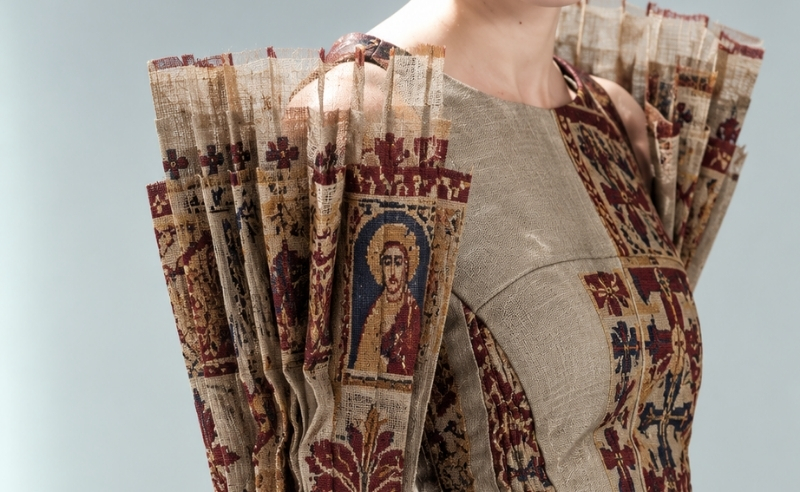
Tiraz brings writing directly onto cloth. Its embroidered inscriptions and ornamental bands become starting points for typography and abstracted calligraphic forms.
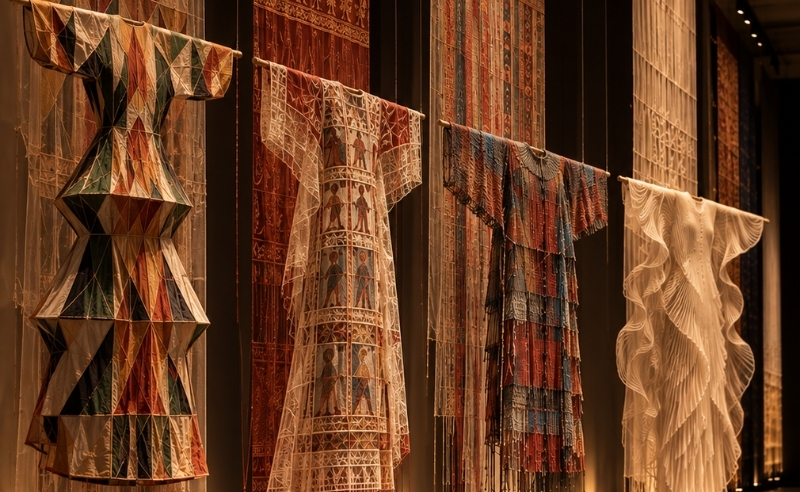 Coptic textiles introduce figures, plant motifs, colour and intricate woven imagery, which designers can reinterpret through embroidery, fragmented motifs and experiments in construction.
Khayamiya brings the route back to Cairo through layered appliqué, symmetry, bold geometry and saturated colour. Its construction methods reappear through cut-outs, built-up fabrics and geometric surfaces.
"They are already there. We know that there are some people who still work with these methods, so I can inspire the new generation with something that already exists," Mekhtigian says.
The exhibition is arranged to keep those references visible.
Visitors begin with a mixture of historical fabrics and contemporary pieces before moving through rooms dedicated to individual designers. Their work is presented alongside the textile traditions or techniques that informed it.
"I’m not showing the designers’ pieces alone. I’m showing the state of everything together," Mekhtigian says.
The approach also reflects how he works at Tamara Haus, where different designers share space with new collaborations and his own brands, including handmade homeware label Analogue and Kyme Toys.
The Fashion Design District expands that thinking across a larger group of designers, asking them to look at what already exists around them before deciding what comes next.
"If I don’t make use of my own heritage, I am losing a lot," Mekhtigian says.
"So why not use everything I have to create something new, with new logic, with modernity?"
He points to designers including Issey Miyake, whose pleating became central to his work in Japan, and Antonio Marras, whose collections draw on his native Sardinia, as examples of designers building contemporary work from techniques and references rooted in place.
-1e73e467-6804-4c58-bb35-e2c997f6f0f1.jpg) "They work with the same techniques and the same way of using their own heritage and history, and they come up with something completely contemporary that you can wear at any time," Mekhtigian says.
The finished garments are only one part of what Mekhtigian wants visitors to see.
"The most important part is the process of the concept, and how it is treated by different fashion designers," he says.
Across five textile traditions, the Fashion Design District gives designers a collection of Egyptian techniques, forms and materials to pull apart, rebuild and wear again.
"There is a lot to tell that comes out of this environment," Mekhtigian says. "That’s why I called it ‘The City Wears Its Stories.'"
- Previous Article Riyadh Metro Named Among World’s Top Four Transport Projects