




Why Egypt's New Military Headquarters Is Shaped Like an Octagon
A new military landmark in Egypt’s New Capital, The Octagon defines its command architecture through geometry and AI.

Military headquarters have long doubled as statements of national ambition. From the sprawling geometry of the Pentagon in Virginia to Russia's imposing Ministry of Defence complex and Beijing's monumental defence headquarters, these buildings are designed to project as much as they operate.
Rising within Egypt's New Capital, the Strategic Command Centre, known as The Octagon, was officially inaugurated on July 4th, 2026 by President Abdel Fattah El Sisi in his capacity as Supreme Commander of the Armed Forces. According to the State Information Service (SIS), the Octagon is designed to oversee military command, strategic planning and national crisis management, with advanced digital systems and artificial intelligence systems that accelerate decision-making and maximise national readiness against any challenges. But its architecture tells a story of its own.
The headquarters sits within a Ministry of Defence campus in the New Capital covering approximately 22,000 acres, making it the largest complex of its kind in the Middle East. The wider development includes places of worship, hotels, schools, healthcare facilities, residential areas, sports facilities and civil service buildings.
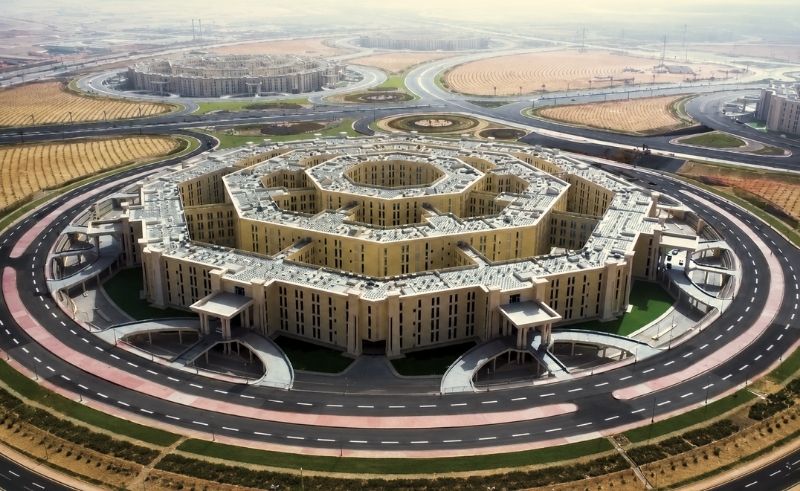
The vast headquarters takes its name from a composition of eight octagonal buildings arranged around a central core, where two additional structures sit at the heart of the complex. The layout leaves room for future expansion, both within the centre and across the generous swathes of land woven between its outer rings.
The number eight guided the architectural concept. According to an official presentation ahead of the launch, the plan references the eight-pointed star, a geometric motif widely used in Islamic architecture and associated with balance and order. It also draws on the geometry of the Great Pyramid of Khufu, the subtly concave faces of which can appear as eight sides when viewed from certain engineering perspectives. Large columns and colonnades reference ancient Egyptian architecture, bringing Pharaonic and Islamic influences into a contemporary institutional building.
More than a striking geometric exercise, the masterplan mirrors the organisational structure of Egypt’s armed forces. The outer buildings are allocated across the military’s main branches - the Army, Navy, Air Force, and Air Defence Forces - turning the institution’s hierarchy into a physical landscape of command. The geometry has also been described during the official presentation as contributing to the building's defensive design, although technical details have not been made public.
At the centre of the complex are two main buildings responsible for coordinating state data, communications, public utilities, emergency management and weather monitoring. Additional facilities provide underground storage for strategic data centres, supporting the headquarters' role in military coordination and national decision-making.
From above, the complex reads like something lifted from a science fiction movie. Rising out of the desert east of Cairo, the project began taking shape in 2016, transforming an otherwise empty stretch of land into one of the most distinctive military compounds in the world.
Each octagonal block follows a similar configuration and is linked to the central core through a network of connections, creating a highly integrated campus. By spreading functions across multiple interconnected buildings rather than concentrating them in a single structure, the complex gains a degree of operational resilience. The repetition of buildings assigned to each military branch also introduces a level of redundancy, while the layered organisation within each octagon helps compartmentalise activities. Together, these strategies create a headquarters designed not only for scale and visibility, but also for continuity and adaptability.
- Previous Article SceneNoise x Amsterdam Dance Event Present CROSSFADE: Egypt
- Next Article Private Investors Sought for USD 135 Million Madinah Ferris Wheel
Related Articles

Trending This Week
-

-
-
 Sep 28, 2026
 -