


How Palestine’s Taybeh Brewery Started a Beer Revolution
Taybeh Brewery is exporting high-quality craft beer internationally and selling locally, painting a different picture of Palestine.
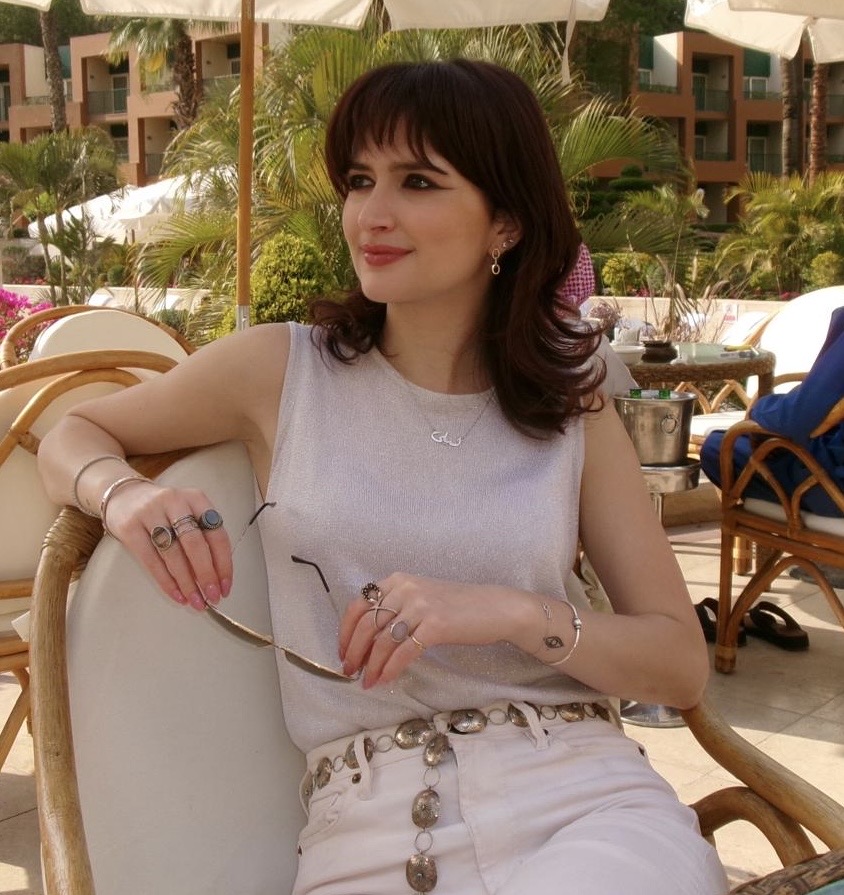
Taybeh Brewery is home to many superlatives, holding the titles of The First Microbrewery in the Middle East, The First Palestinian Beer, and The First Female Brewer in the Region. Her name is Madees Khoury.
As you make your way up the driveway of Taybeh Brewery, the first thing you’ll notice is the sprawling hilly landscape that Palestine is famous for, covered in olive trees. Taybeh—a word that also means delicious in Arabic—sits on one of the highest points of elevation in the West Bank and is often recognized as the last fully Christian village in the area.
Usually, the door is wide open, and a step inside, Madees welcomes visitors into the brewery. She begins her tour with an abbreviated version of her family story, explaining her journey from her birthplace of Boston, Massachusetts, to Taybeh, Palestine.
A Tour of Taybeh, From Boston to Palestine
The timeline begins in 1982 with her father Nadim Khoury’s beer-making experiment in his college dorm room in Boston. He brought beer kits back to Palestine in the summers to brew it for his father, Canaan Khoury. In 1993, Israeli Prime Minister Yitzhak Rabin and PLO Chairman Yasser Arafat signed the Oslo Accords, promising a path to Palestinian statehood and establishing a government in the West Bank. It was in this renewed hope that Canaan encouraged his two sons—David and Nadim—to return home to Palestine from Boston and open the first Palestinian and Middle Eastern microbrewery. Construction began in 1994 with Yasser Arafat’s personal blessing, who had also just returned to the West Bank.
Madees moved to Palestine at the age of 9, attended high school in Ramallah, and then returned to Boston for college. In 2007, she made her way back to Taybeh to take over operations at the brewery full-time—becoming the first female brewer in the Middle East. Madees is the General Manager, but all three of her siblings and cousins are part of the family business, even the spouses.
Taybeh Brewery has expanded production to wine in the past 12 years, bottles of which are on display at the visitor’s center by the front door, along with local products like tatreez embroidery, za’atar, sumac, homemade jam, olive oil soap, and the olive oil itself. On the tour, Madees walks through the production process—from fermentation to labelling. She leads the group through rows of tall stainless steel tanks, past kegs, and bottles that move through packaging like a parade—5,000 bottles an hour that are exported to 17 countries.
Madees picks up a classic golden lager, Taybeh’s best-selling, flagship beer, displaying the art on the label—the rolling hills of Palestine in the background, a sun rising in the distance to symbolise a hopeful future, barrels from their brewhouse, and an overflowing glass of beer.
She ends the tour back at the entrance, explaining that over the past two years, since October 7th, business has gone down. “But we took advantage of the slow business to expand the brewery,” Madees continues, sliding open a huge door to reveal the new brewery that has double, or maybe triple, the capacity of the original. “Once the situation calms down, we’ll be ready to make more beer and enter new markets.”
“It's one thing doing business under occupation before October 7th, and it's another after October 7th.”
Headlines that once celebrated Taybeh’s yearly Oktoberfest at the brewery, with an international attendance of thousands, have now shifted to reports of Israeli settler attacks, storming the village, setting cars on fire, and spray painting graffiti on homes. Recently, settlers destroyed all the grapevines on a 25-year-old vineyard the brewery buys from for their wine; they also damaged one of the village’s main water sources, the Samia Spring—the sole water source for 19 Palestinian villages.
The same forces behind the genocide in the Gaza Strip have wrought havoc on the West Bank in the past few years, just a hypothetical one to two-hour drive away from each other. Israeli forces tightened an already suffocating grip on the occupied West Bank—restricting movement almost completely, providing violent settlers with impunity as they destroy homes and kill civilians, and escalating lethal military raids, all while continuing to annex Palestinian land for illegal settlement construction.
“We live in a prison now. And the thing is, in prison, you would know how long you're going to be in prison, or when your release date is,” Madees says. “But here, we don't know what's happening tomorrow. We don't know the future of Palestine.”
It is in this context that business has taken a hit. First, “people don’t have the spirit to celebrate or have fun with tens of thousands of Palestinians being killed in Gaza,” Madees says, but also, many people don’t have the extra cash to spend on having fun and going out.” Unemployment has skyrocketed to a near third of the population, from about 13 percent before October 7th. On top of that, it can be difficult to reach Taybeh Brewery with the constant road closures, flying checkpoints and threat of settler attacks. The Associated Press reported that Israel has erected nearly 1,000 barriers in the West Bank during the genocide. “People are too scared to move around,” she added.
Transportation disruptions often delay Taybeh’s deliveries and international exports, an already complicated process that requires a number of Israeli permits and coordinated plans that the occupation tries to foil. It could be a five-hour wait at the checkpoint, a new kind of “security check,” a soldier in a bad mood, or a last-minute permit that expires in a couple of days. Madees says they always have plans A, B, C and D to make sure their beer can leave the West Bank through a checkpoint into Israel and reach Haifa Port. “Palestinians are very creative,” Madees smiled. “They’ll always find a way.”
What it Means to “Taste The Revolution”
“Palestine is one of the most liberal Arab countries, regardless of what people see and hear on the news,” Madees explains. “We're all respectful to each other. We're all Palestinians at the end of the day.”
Exporting Taybeh abroad connects the name ‘Palestine’ with a high-quality product, which also expands people's understanding of the place, what it means to be Palestinian.
“Internationally, people don't know that Palestinians have the first microbrewery, or that we drink alcohol, or that there's a female brewer, or an Oktoberfest,” Madees adds. “So when they see the beer, they want to know more about the business, our success stories, our challenges.
And not just about the beer, but also about Palestine and Palestinians.”
This, Madees says, is the “beer revolution in the Middle East” Taybeh is leading. It's not just introducing the region to craft beer; it is also connecting the world with Palestine, inviting them to understand the country’s culture, history, and people.
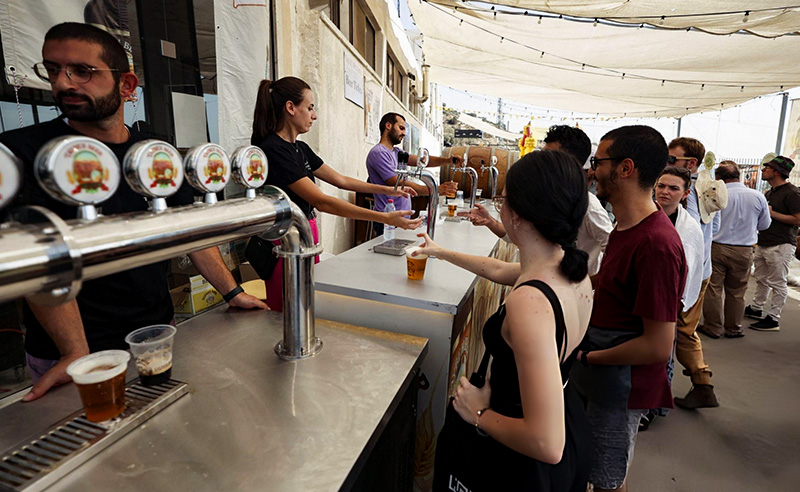
Taybeh’s annual Oktoberfest drew visitors to the brewery from all over the world. The yearly tradition began in 2005 as an “open day” for the town at about 1,000 people. It grew every year, until it reached 10,000 visitors in a village of 1,200 residents—a huge boost for the local economy. During the day, families enjoyed the clown, face painting, and kids’ games. And at night, Oktoberfest turned into a huge party. Well-known Palestinian artists like The Synaptik, Lina Makoul, and Tamer Nafar headlined the last festival, just two weeks before October 7th.
“What is so fun about Oktoberfest is that it doesn't matter if you drink or you don't drink, if you speak Arabic or you don't speak Arabic, or whatever your political views are, or whatever your religion is,” Madees says. “Everyone comes together, and they're just having a great time, enjoying the food, the music, the weather, and Taybeh.”
Taybeh’s UK Beer Collaboration is “Brewed in Solidarity”
Taybeh has recently partnered with UK beer brand Brewgooder for their first collaboration ever. The beer, Sun & Stone, has entered 1,600 stores across the UK. All proceeds will go towards supporting Palestinian communities, including those in Gaza, through the Disasters Emergency Committee, complete with a label designed by Lebanese illustrator Nourie Flayhan. It is already flying off the shelves. Madees hopes this collaboration inspires other Palestinian and international companies to collaborate and support each other—giving Palestinians the platform they deserve.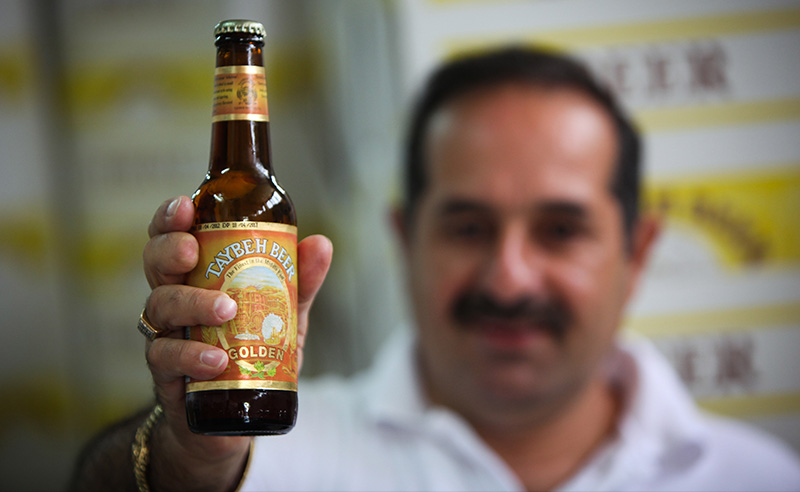 What can someone do to support Taybeh Beer?
Madees said that beyond following the brewery on social media, they should ask for Taybeh beer wherever and whenever they can. “Even if you don't find it, just ask for it. You create the demand, you create the buzz,” she says.
But the most important thing to remember is that the Taybeh Brewery doors are always open.
“We welcome everyone to come and visit us, to visit the brewery and visit Palestine.”