






Burial Jewellery & Objects Discovered Beneath Tomb in Ancient Heliopol
One faience vessel held six miniature ritual jars two with gold fittings while earlier finds include a red painted coffin with remains a Roman coin and limestone blocks with hieroglyphs.

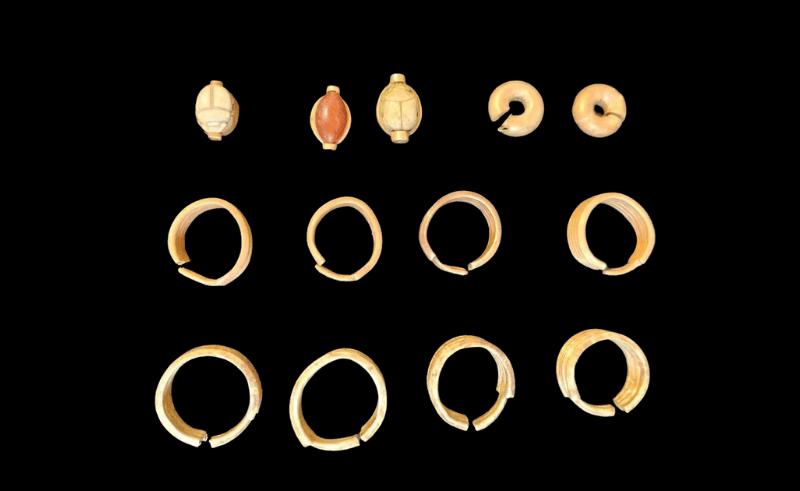
A collection of burial jewellery objects has been uncovered beneath a mudbrick tomb in Cairo’s Ain Shams district, within the Banhsi Cemetery that forms part of the wider necropolis of Ancient Heliopolis. The Egyptian team from the Supreme Council of Antiquities reported that the deposit included a copper mirror, two alabaster vessels with traces of their contents, and a black obsidian vessel. Excavators also found two blue faience vessels, one of which contained six miniature ritual jars, with two jars decorated with fittings believed to be gold.
Archaeologists recovered a series of amulets, among them forms of a duck and the Atef Crown. Four decorative stones were identified nearby, including pieces thought to be agate; one featured a red design mounted in a gold setting. Five pairs of earrings, likely made of gold and measuring between 1.5 and 2.5 centimetres in diameter, were also found.
The latest discoveries follow earlier finds this season at the cemetery, which include mudbrick and limestone burial structures, fragments of two coffins, and a Roman-period coin. One coffin, decorated with red-painted motifs, contained skeletal remains that researchers believe may belong to a military figure.
Limestone blocks bearing hieroglyphic inscriptions have also been recovered from the site.
Researchers said the cemetery remained in use from late Roman times to early Christian times. Ancient Heliopolis, known as Iunu in ancient Egypt, was the centre of the cult of the sun god Ra.
- Previous Article SceneNoise x Amsterdam Dance Event Present CROSSFADE: Egypt
- Next Article Daily Dose and Miyāh Farms Just Dropped Three New Matcha Flavors
Related Articles
Trending This Week
-
 Oct 06, 2026
 -

-
-