






Rare Roman-Era Tomb Found in Minya Reveals Burial Rituals
The discovery at El-Bahnasa includes mummies, coffins and rare ritual objects.

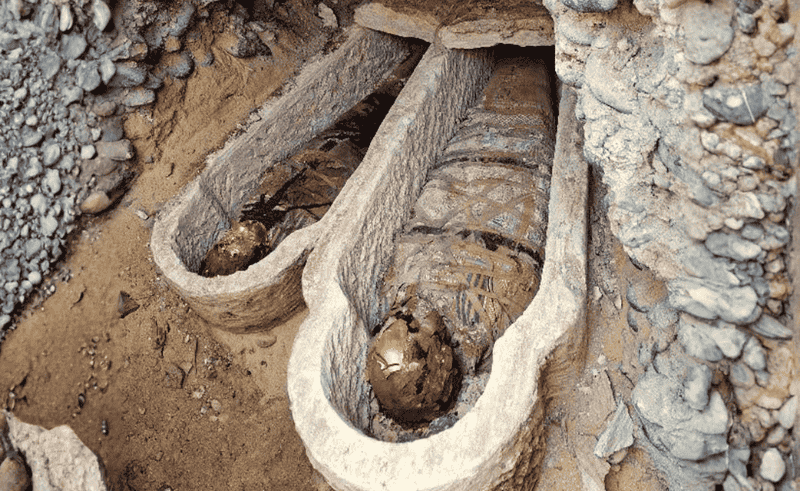
A Roman-era tomb containing mummies and ritual artefacts has been unearthed at El-Bahnasa, offering new insights into funerary practices from the Greek and Roman periods.
The discovery was made by a Spanish archaeological mission from the University of Barcelona and the Institute of the Ancient Near East, led by Maite Mascort and Esther Pons Mellado, according to the Ministry of Tourism and Antiquities.
Finds at the site include wooden coffins and several mummies, some wrapped in decorated linen featuring geometric patterns.
Archaeologists also identified three golden tongues and one copper tongue—objects placed in the mouths of the deceased as part of burial rituals—along with traces of gold leaf on some mummies.
Sherif Fathy, Minister of Tourism and Antiquities, said the discovery adds to the archaeological record of Minya, which continues to yield significant finds.
Hisham El-Leithy, Secretary-General of the Supreme Council of Antiquities, noted the discovery of a rare papyrus inside one mummy bearing a passage from Homer’s Iliad, specifically from Book Two.
Excavations east of Ptolemaic Tomb No. 67 uncovered a trench containing three partially preserved limestone chambers.
One chamber held a stone slab and a jar containing cremated remains of an adult, an infant’s bones and the head of a feline, each wrapped in textiles.
Another chamber contained cremated remains of two individuals along with animal bones of the same species. Additional discoveries south of the site included terracotta and bronze figurines, featuring depictions of Harpocrates and a small statue of Cupid.
In Tomb No. 65, archaeologists documented further Roman-period mummies, painted wooden coffins and additional golden and copper tongues inside a hypogeum, which also showed evidence of ancient looting.
- Previous Article Moxy Lazoghly Lets You Check Into Downtown Cairo’s Energy
- Next Article The Ancestral Resilience of Omar El Farouk’s Fayoum Home
Related Articles


Trending This Week
-
 Oct 06, 2026
 -

-

-