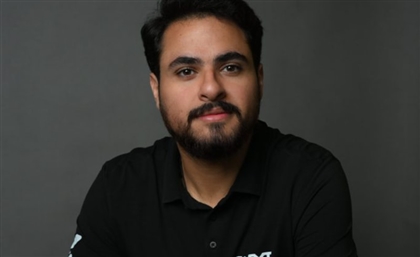




Inside Shahed Ezaydi's The Othered Woman
A feminism sold as universal was never built to hold Muslim women. Shahed Ezaydi’s The Othered Woman puts them at the centre and counts the cost of being read before you’re known.
Every Muslim woman learns the look before she learns the word for it. It lands in a shop, on the metro, in a classroom, and decides who she is before she has said anything at all.
Covered or uncovered, loud or quiet, she has already been read.
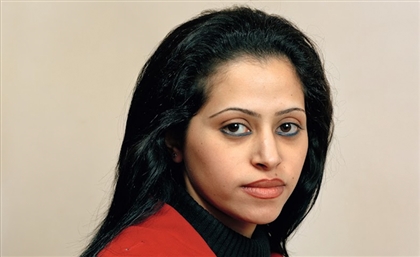
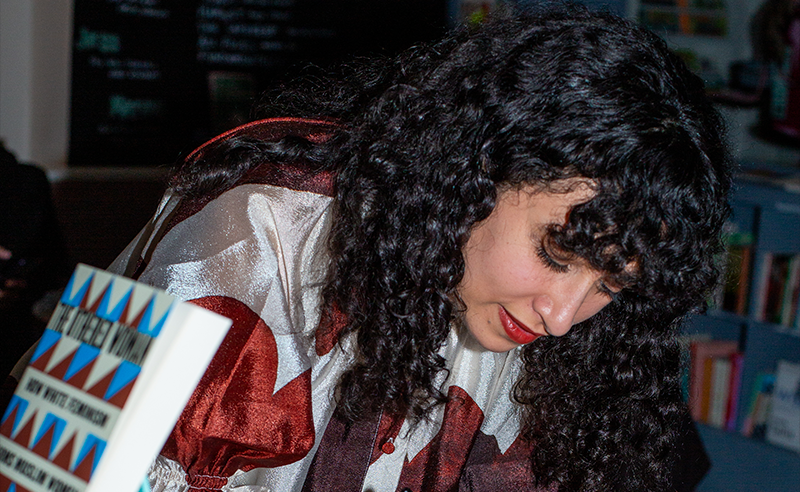
British-Libyan journalist Shahed Ezaydi grew up inside that look in England, and her first book, The Othered Woman: How White Feminism Harms Muslim Women, is what happens when someone stops accepting the reading and starts interrogating who wrote it.
The image came first, and it was never ours. It shifts depending on who is looking: oppressed or threatening, silent or in need of saving. It has never fully belonged to the women themselves, but to the political, cultural and feminist narratives that have long spoken for them, and it so often arrives before the woman herself does.
The critique itself isn't new. Black, postcolonial and intersectional feminists spent decades challenging a movement that dressed the experiences of white, middle-class women up as universal. Muslim women sat uneasily inside those conversations, present but seldom the starting point. Too often, our experiences have entered these conversations only as illustrations of broader arguments about race, colonialism and intersectionality, rather than as the place those arguments begin. Ezaydi recentres that critique, making Muslim women the subject rather than a supporting example.
Her definition of white feminism doesn’t hold back. It is, she writes, "a type of feminism that focuses exclusively on white middle-class women and prioritises issues that primarily affect them. It's a feminism that prioritises achieving equality for white women, insisting that their equality will open doors for all other women." The promise was always that the door would open for everyone. The book is a careful accounting of who got left standing outside it.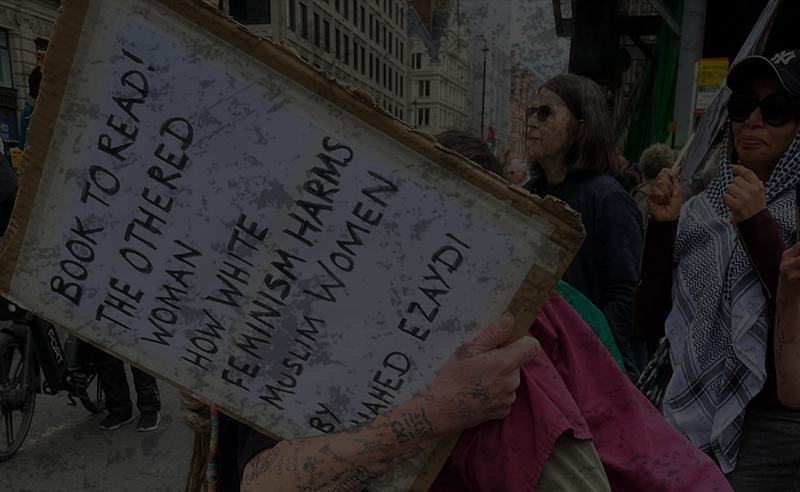 Her method refuses the split between the personal and the political. Drawing on growing up in England to immigrant parents, on her journalism, and on conversations with Muslim women from different backgrounds, Ezaydi builds a case that lives in memoir, reportage and analysis all at once.
She often returns to being reduced to a "brown Arab Muslim," three words that stop describing her and start filtering her, until religion, ethnicity and politics fold into one another and the woman underneath disappears altogether. That misreading runs on a loop, following a pattern set long before she was born.
The Islamophobia of her childhood was ordinary, like being told to "go back to your country" was ordinary. Questioning her own faith under the weight of what everyone assumed about it.
"It takes a lot of unlearning to get to the point where you can stop and think about how you're approaching such topics; I know it did for me," she told Cairo Scene.
"It's only now, looking back on my school days, that I see just how widespread Islamophobic views and attitudes were, even amongst people I had called good friends, and how much I had internalised this Islamophobia."
That process of unlearning sent her searching for a book that reflected her experience. She found pieces of it scattered across other people’s arguments, Muslim women appearing for a chapter or two, on loan to someone else’s thesis, never the centre. So she wrote the centre herself. That distinction seems small, but it remakes everything. Muslim women stop functioning as supporting figures and become the argument itself.
From there, the book takes apart the myth that Muslim women experience oppression through gender alone, tracing instead the tangle of race, religion, class and geopolitics that shapes their lives.
Ezaydi’s sharper move is to track what those perceptions actually do. An image becomes a headline, a policy, a comment from a stranger, a law. The politics of the veil, the racialisation of Muslim men, the far right borrowing feminist language when it suits them, state violence carried out in the name of 'saving' Muslim women, the silence around Palestine as a feminist question: each is the same refusal wearing a different outfit, the refusal to let a Muslim woman narrate her own life.
Having spent a book arguing that Muslim women are spoken for, Ezaydi is careful not to speak over them. She brings other Muslim women into the text and prints the full interview transcripts in the appendix so the reader hears them without her standing in the way. The conversation that usually happens about Muslim women becomes one that happens with them.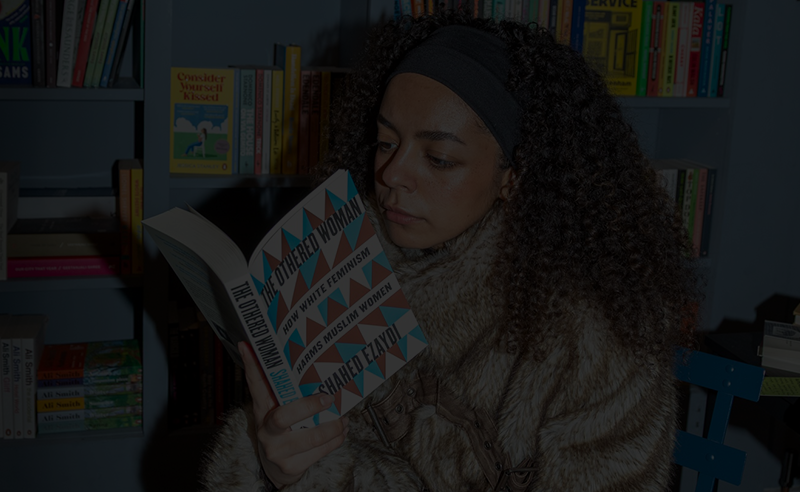 "All of these complexities within identity are lost on white feminism, which views sexism as the single most important form of oppression in our society, and flattens the experiences of other women, including perhaps especially Muslim women," she argues.
A marginalised woman lives at several intersections at once, racialised, classed, shaped by diaspora and culture, all of it simultaneously.
White feminism sees the word ‘woman’ and stops there. For Muslim women, that stopping-short swaps a life for a picture, until the picture is the easier thing to believe.
The reach goes past the West, because the frameworks do too. They justified military intervention from Afghanistan to Iraq, and that same framework decided whose suffering counts and runs underneath how the world does and does not talk about Palestine.
Ezaydi says it bluntly: "There has been a complete neglect and silence around Palestine as a feminist issue, even though it is one. This has been completely ignored because it's Muslims who are the victims, and aren't afforded this kind of status of victimhood anymore."
In the appendix she is even more blunt about it: "Palestine has outed white feminism for what it is. Contradictory and hypocritical."
Much of the harm never makes a sound. White feminism has propped up a very particular Muslim woman, one who “is completely covered, silent, obeys her husband and does not leave the home unless with her husband."
Ezaydi traces this image to scholars like Jack Shaheen, whose work documented how the oppressed-wife stereotype set like concrete across decades of books, television and film. It travels well beyond Western screens and even appears in our own canon too, though this is a link she leaves for the reader to make.
Once an image becomes culturally familiar, it has a habit of resurfacing in very different traditions. It's an image that shows up closer to home too, though it's not a comparison Ezaydi makes herself.
Naguib Mahfouz's Amina, in The Cairo Trilogy, is nearly the exact template, entirely devoted, rarely leaving her house, never challenging her husband. Mahfouz wrote her with real tenderness, a tenderness that does not make the image any less limiting.
What makes the stereotype dangerous is the authority it picks up over time. A character's cultural afterlife rarely ends with the novel itself. Once a literary image settles into the cultural imagination, it can become surprisingly difficult to separate the woman from what she has come to represent, until the image hardens into the standard against which Muslim women are judged.
"Muslim women are both invisible – their voices completely ignored – and hyper-visible – they have become a symbol of oppression," she says. Spoken for, shut out, until the symbol carries more weight than the people it claims to represent.
That image doesn't affect every Muslim woman in the same way.
Muslim women, Ezaydi writes, have been verbally abused, spat at, had their hijabs ripped off, and been physically assaulted, some almost daily.
Black Muslim women carry more still, their experiences of racism and colourism inside and outside their own communities routinely passed over. Many migrant Muslim women in the UK live under "no recourse to public funds" visa restrictions, shut out of housing, employment and healthcare.
For Ezaydi the harm wears an everyday face, the small hesitation before speaking Arabic in public, carried since childhood and never fully put down. "It's in my slightest reluctance to speak Arabic in public out of fear that I may be harassed again or reported to the police," she says.
She was on the phone to her mother once, slipping into Arabic mid-conversation, when a man nearby told her that if she wanted to live in the UK, she should speak English.
"We don't want any of your funny language in this country," he said. She hung up and walked off in tears.
The person she worries about most is her mother, a hijab-wearing woman legible as Muslim on sight, and therefore an easy mark for anyone hunting one.
Friends in London stand back from the edge of Tube platforms just in case. This is the kind of exhausting, low-level calculations white feminism tends to know nothing about.
The book's most unexpected chapter is also its longest, and it belongs to Muslim men.
"It's my biggest chapter, and I did it by accident," Ezaydi laughs. The Western imagination keeps a fixed idea of them: violent by nature, misogynistic by faith, dangerous in a way it insists is theirs alone.
The misogyny is never treated as a product of the same patriarchal structures that runs everywhere else on earth. Instead, it's treated as inherently Islamic, as though the religion invented it.
"The patriarchy is the patriarchy," Ezaydi says. "We all live under the same one."
What sharpened the chapter was noticing how rarely Muslim men are afforded victimhood, in war, in coverage, in feminism, a conversation she doubts the movement is ready to have.
The Committee to Protect Journalists’ (CPJ) recent removal of eight Palestinian journalists from its list of those killed in Gaza, after they were reclassified as combatants, serves as a stark reminder of how readily Muslim men can be stripped of civilian victimhood, even in death.
Nobody walks away from this narrative intact. It flattens Muslim women into a single image and denies Muslim men the complexity of being human. The book ultimately argues that being othered is a condition to push against.
Since publication, readers have written to say the book has informed conversations at their jobs, among their friends, exactly the ones she hoped to start.
"When white feminism is constantly locking us out of doors and keeping us from sitting at tables of power, we must continue to fight to get our voices heard and tell our own stories in feminist spaces," she writes.
These conversations may sound overdue, and for many Arab and Muslim women they are, though never for lack of seeing the problem. The seeing was never in question. The permission to name it on their own terms is what kept getting withheld.
Ezaydi isn't claiming to say something new, and she doesn't have to. She takes an argument that's been pushed aside for years and puts it back in the centre, with one rule: Muslim women get to shape it now, not just sit inside it.