






A Caravanserai in Damascus Reopens as Khan Wahoud Boutique Hotel
After six years of restoration, a 1736 caravanserai in Damascus returns as Khan Wahoud, a boutique hotel and cultural hub.

For centuries, Silk Road merchants traversed caravan networks across vast lands and distant seas, chasing discoveries that could tilt an empire’s taste: spices, indigo that stained fingers blue for days, porcelain thin as breath, and manuscripts inked with philosophies foreign and intoxicating. These journeys, slow and abrasive in service of monarchs, measured days by hooves and creaking leather. Caravans crept across deserts where horizons refused to move, finding respite only at occasional caravanserais built for weary travellers.
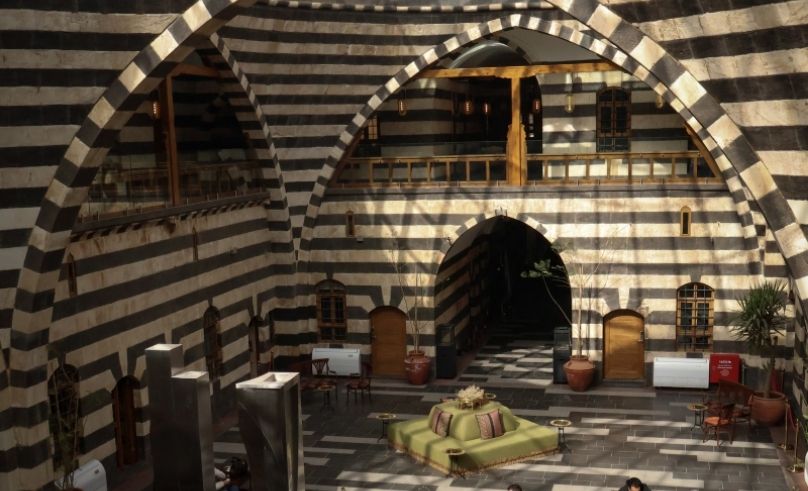
One such waystation endures in Damascus. Built as Khan Suleyman Pasha in 1736 during Ottoman rule, it now stands reborn as Khan Wahoud, after six long years of restoration. What was once a transit stop has transformed into a boutique hotel and cultural hub, where contemporary travellers walk courtyards once traversed by Silk Road merchants—history lingering in stone, arches, and the quiet rhythm of passage.
In 2020, Wahoud Group’s AbdulNasser Amairy, Ayham Aragi, and Ghalia Wahoud breathed new life into Damascus’s bustling streets. Long discarded and used as landfill during turbulent political eras, the Khan had suffered from neglect: differential settlements in the floors, deterioration of many stones, bulging in its western wall, and collapse of the brick domes that once covered its courtyard. Today, Khan Suleyman Pasha stands as “an example of how things can turn around, in terms of architectural renovations and investment—especially in Damascus,” they tell SceneTraveller and SceneHome.
But for those involved, the project was never just about bricks and mortar. “Given the great historical importance of the Khan and its being part of the historical fabric of the city of Damascus, inscribed on the UNESCO World Heritage List in Danger, I felt a double responsibility, not only towards the building itself but towards the identity of the city and its urban memory,” explains Amairy, an architectural restorer with 40 years of experience.
The immense time and meticulous care invested in its renovation aren’t just visible; they are a palpable presence, dripping from its ancient walls. It’s not so much about “noticing” the craftsmanship as it is about feeling it radiate from every surface. “You know, guests can just tell it is well made,” Wahoud explains. “They can’t necessarily see the small details, but they can feel it.” This philosophy of felt authenticity guided their hand. “We wanted to keep its welcoming character and simply provide the same service for the distressed people of Syria and travellers from all over the world who are ready to see Damascus in its true light.”
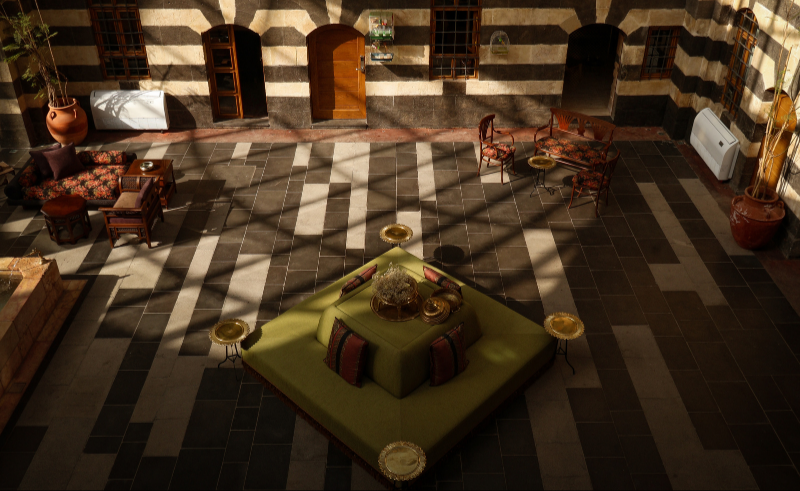
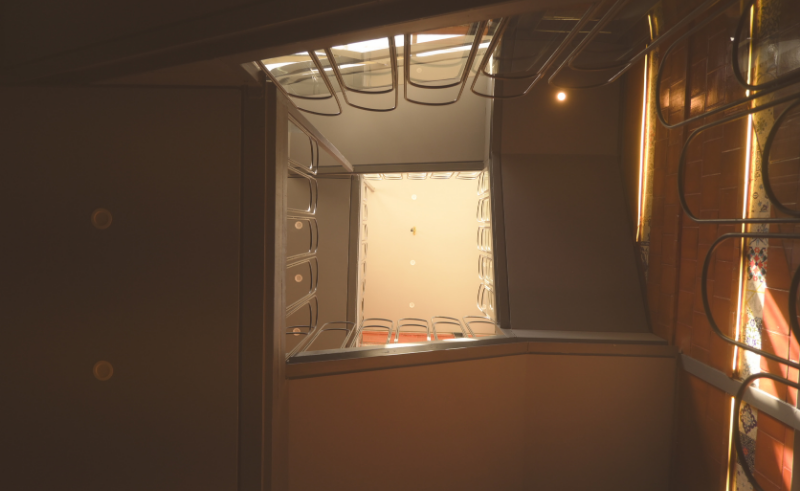
The doors open up to a spacious courtyard (the architects’ favourite spot) made of traditional Damascene stone arches and the distinctive ablaq masonry work, featuring alternating light and dark stone courses. Above, modernist glass domes rise, replacing the brick domes that fell with an earthquake in the 19th Century—a contemporary contrast that fits just right—letting sunlight spill in, shadows dancing across stone in ever-changing patterns. “They even have openings for passive ventilation, but it’s really about the light—it makes you feel like you’re sitting outside, and the space changes with the hour and the season,” Aragi says.
For Amairy, the glass domes are more than design, they are a philosophical choice. “They create a dialogue between the modern and the historic,” he explains. “They evoke and remember the domes of the past without pretending to be original. We deliberately avoided using traditional materials so that these additions wouldn’t ever be mistaken as historic.” He adds, “All modern interventions are reversible.” This principle, ensuring today’s additions can be removed tomorrow without harming the original structure, remains the foundation of responsible conservation.
The courtyard nudges people to confidently step out of their shadows of comfort, and into the world of light to gather and converse. The steady drip of the water fountain maintains a gentle hum in the background, made to calm nerves and ease the tension that stubbornly made a home between shoulder blades. “The whole spectacle makes this a pilgrimage as holy as many,” Wahoud adds. “So we really didn’t want to force interventions more than was necessary; we just wanted to emphasise its commanding presence.”
For locals, the courtyard also bridges a connection between Damascus’s architectural past and present. “People here are used to houses with courtyards and fountains that welcome guests. It’s an essential space in historic homes,” Wahoud notes. Here, that intimacy is extended to a public arena, where visitors from across the world feel the quiet pulse of a city that has always prized hospitality and openness.

Encircling the enchanted courtyard on multiple levels are 20 guest rooms, all decorated with Damascene art and each holding its own personality. “We didn’t want to just multiply a beige design like a regular hotel would, the Damascene theme is seen and felt everywhere, with different fabrics showcasing the richness of the textiles,” Aragi explains.
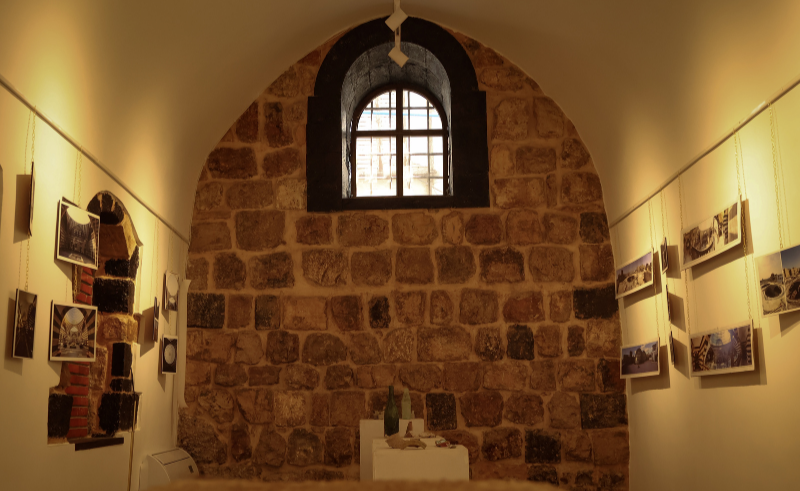
But Khan Wahoud is more than just a “resting bubble”; it thrives as a cultural hub, continuing its centuries-old legacy of exchanging ideas, cultures, and languages. The Khan hosts galleries, currently exhibiting its own story of renovation—documented images, techniques, and the very materials, fabrics, and finishes that brought the design to life. Visitors can wander through these displays, tracing the careful hand of restoration while soaking in the history embedded in the walls.
The Khan offers more spaces to linger, a pause between the visual: a serene tea room inviting first-class gossip and restaurants that serve as vibrant extensions of Damascus’s culinary heritage, where Teta’s flavours meet thoughtful, contemporary presentation.
Its most unique room, however, is The Roman Lounge, a multipurpose space dominated by a Roman column uncovered during the restorations—a discovery that prompted a complete reimagining of their initial plans. “It became evident to us that the archaeological level within the Khan contained structural remains older than previously thought,” Amairy recounts. “Uncovering this archaeological level and linking it to the general site revealed its connection to the Roman Theatre site, a discovery that had a significant impact on changing the design during the execution phase. All archaeological elements were revealed, including columns, bases, and foundations dating back to the Byzantine and Roman periods.”
“We could’ve kept it as a guest room, as we had initially planned,” Wahoud states, “but we cared more about giving everyone the chance to experience the same surprise we felt than about monetising it.” Here, history stands literally at the centre, a reminder of the layers of time threaded through the Khan, where every corner tells a story waiting to be experienced.
The project unfolded over six years, against extraordinary odds, through political upheaval, economic crisis, and uncertainty in Syria. “Our first challenge was simply securing imported materials and modern technologies,” Amairy recalls. “Given the economic conditions and sanctions, we decided early on to rely on traditional local materials and heritage construction techniques. It wasn’t just a practical choice, it reflected the very philosophy of conservation we wanted to uphold.”
Perhaps the greatest hurdle, however, was the vanishing of skilled craftsmanship. “There was a severe shortage of artisans trained in traditional techniques, due to migration and the hardships of the times. At first, it seemed like an obstacle, but I saw it as an opportunity. We trained a new generation of craftsmen, teaching them both the techniques of traditional construction and the values of historical architecture. The project became more than the restoration of a building in Damascus, it became a process of knowledge transfer and capacity building.”
“In the end,” he reflects, “working under such conditions taught me that restoration is not just a technical practice, but an act of cultural resilience.”
With the idea of rebuilding Damascus as a whole in mind, after the toppling of the Assad regime, Wahoud decided to skip building the Turkish bath within the Khan, urging visitors to instead take a stroll through the streets to discover the historical hammams within the vicinity. “Visitors will immediately bump into Souq Medhat Pasha when they step out of the Khan,” Aragi explained. “They should speak to the vendors, buy spices, and see what the city has to offer.”
Stepping out of Khan Wahoud, the city unfolds like a living tapestry—streets echoing with centuries of stories, spices perfuming the air, and the pulse of Damascus carried in every stone and tile. Inside the Khan, light and shadow continue their quiet dance, fountains murmur their timeless rhythm, and the layers of history, from Roman columns to Ottoman arches, linger in every corner. It is more than a boutique hotel; it is a bridge between past and present, a space where travellers can feel the heartbeat of a city that has endured, adapted, and quietly thrived.
“In a way, the Khan is a reminder,” Wahoud says, “that beauty and resilience exist even after the hardest years. That history can be restored, and life, in all its richness, can be shared.”
“We wanted visitors to not just see Damascus, but to experience it, to sense its depth, its light, and its humanity,” Aragi adds.
Khan Wahoud stands as a quiet testament: that places, like people, carry memory in their walls, wisdom in their shadows, and generosity in the spaces they open to the world. Here, heritage is not preserved behind glass—it is lived, breathed, tasted, and felt, waiting for every traveller willing to step in and discover it.
Related Articles
Trending This Week
-
-
 Oct 15, 2026
 -
-