




The Arab World's Most Hauntingly Beautiful Cemeteries
From Cairo's City of the Dead to Iraq's vast Wadi Al Salaam, these cemeteries offer a haunting journey through architecture, belief, empire, and the stories left behind by centuries.

For most travellers, centuries-old tombstones, crumbling mausoleums, and the faint possibility of encountering a ghost with unresolved issues might seem like compelling reasons to…not go somewhere. But for those of us raised on a steady diet of The Vampire Diaries, gothic romances, and the conviction that every unexplained creak at 2 AM was definitely paranormal, cemeteries have always held a certain allure. Not because we're expecting supernatural encounters, but because few places tell stories quite like the cities of the dead.
Fortunately, the Middle East and North Africa have plenty worth wandering through and having nightmares about. Far from being simply places of burial, many of the region's historic graveyards double as open-air archives, preserving centuries of craftsmanship, architecture, faith, and haunting folklore. Behind their walls are dynastic histories carved into stone, intricate Islamic monuments, and stories that reveal how different communities imagined memory, legacy, and the afterlife. They’re peaceful, haunting, and occasionally just unsettling enough to make you glance over your shoulder.
Whether you're chasing gothic atmosphere, hunting local legends, or simply adding a touch of dark tourism to your itinerary, these graveyards make a compelling case that some of the most captivating places to visit are the ones where history is resting in peace.
Wadi Al Salaam — Najaf, Iraq
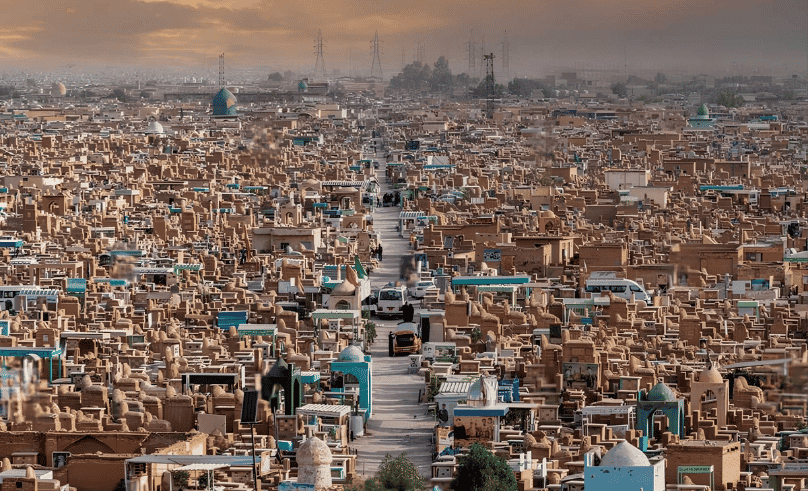
-a09c4fcb-9887-4e65-80a4-4f986fb20450.png) The Valley of Peace, as its name translates, holds over six million souls, making it the largest cemetery on earth. From above, it sprawls like an unplanned city, one that grew organically across millennia, from the Parthian and Sassanid eras through to the present day. Islamic domes crown room-sized family crypts; graves dug in the 1940s push upwards beside them, competing for sky. There’s no unified design vocabulary here, no master plan, only the accumulated weight of centuries of Islamic funerary tradition layered over itself, anchored by the nearby shrine of Ali Ibn Abi Talib, the fourth Caliph and first Shia Imam. To walk through it is to move through an archive that was never meant to be read in a single visit.
Bab Al Saghir — Damascus, Syria
The Valley of Peace, as its name translates, holds over six million souls, making it the largest cemetery on earth. From above, it sprawls like an unplanned city, one that grew organically across millennia, from the Parthian and Sassanid eras through to the present day. Islamic domes crown room-sized family crypts; graves dug in the 1940s push upwards beside them, competing for sky. There’s no unified design vocabulary here, no master plan, only the accumulated weight of centuries of Islamic funerary tradition layered over itself, anchored by the nearby shrine of Ali Ibn Abi Talib, the fourth Caliph and first Shia Imam. To walk through it is to move through an archive that was never meant to be read in a single visit.
Bab Al Saghir — Damascus, Syria
-ca15db3c-5e25-4a51-b3a4-7e15e53f2541.png) Just beyond one of Damascus's seven ancient gates, burial grounds cluster quietly together with simple stone markers rising beside emerald domes that signal the presence of holy personages. It’s that contrast, the humble and the sacred shoulder to shoulder, that gives Bab Al Saghir its visual identity and its gravity. Even the soil here makes unlikely neighbours: companions of the Prophet, the Umayyad caliph Al Walid I, and the poet Nizar Qabbani all share what was never intended as common ground.
The City of the Dead (Al Qarafa) — Cairo, Egypt
Just beyond one of Damascus's seven ancient gates, burial grounds cluster quietly together with simple stone markers rising beside emerald domes that signal the presence of holy personages. It’s that contrast, the humble and the sacred shoulder to shoulder, that gives Bab Al Saghir its visual identity and its gravity. Even the soil here makes unlikely neighbours: companions of the Prophet, the Umayyad caliph Al Walid I, and the poet Nizar Qabbani all share what was never intended as common ground.
The City of the Dead (Al Qarafa) — Cairo, Egypt
-16f7959d-76be-4743-807b-f68ac63c6e8b.png) Al Qarafa has existed since Cairo was still called Al Fustat, and it expanded with every dynasty that shaped the capital. The Fatimids built elaborate mausoleums and madrassas as declarations of power; and yet Mamluks and Ottomans raised domes higher still. What earned it UNESCO World Heritage status is the way the city grew so relentlessly that the living moved alongside structures like the 15th-century funerary complex of Sultan Qaitbay and the mausoleums of Imam Shafi and Sultaniyya—and the dead. Today, over half a million people call Al Qarafa home. As far cemeteries go, it is uniquely, stubbornly alive.
Al Baqi — Medina, Saudi Arabia
Al Qarafa has existed since Cairo was still called Al Fustat, and it expanded with every dynasty that shaped the capital. The Fatimids built elaborate mausoleums and madrassas as declarations of power; and yet Mamluks and Ottomans raised domes higher still. What earned it UNESCO World Heritage status is the way the city grew so relentlessly that the living moved alongside structures like the 15th-century funerary complex of Sultan Qaitbay and the mausoleums of Imam Shafi and Sultaniyya—and the dead. Today, over half a million people call Al Qarafa home. As far cemeteries go, it is uniquely, stubbornly alive.
Al Baqi — Medina, Saudi Arabia
-f2e883ca-819d-43bf-bd4a-5634a267cfbf.png) To arrive at Al Baqi is to confront an almost startling absence. No domes, no monuments, no grand gestures of stone. Just flat earth and unadorned markers stretching across what is reportedly the oldest cemetery in Medina, said to be founded at the Prophet's direction for the holy city's inhabitants. What once stood here—mosques, mausoleums, elaborate shrines—has been built, rebuilt, and demolished twice over, caught in centuries of theological debate about the proper form of commemoration. The emptiness is not neglect. It’s a design position, contested and deliberate, and one that continues to provoke conversation across nations.
Italian Cemetery — Tripoli, Libya
To arrive at Al Baqi is to confront an almost startling absence. No domes, no monuments, no grand gestures of stone. Just flat earth and unadorned markers stretching across what is reportedly the oldest cemetery in Medina, said to be founded at the Prophet's direction for the holy city's inhabitants. What once stood here—mosques, mausoleums, elaborate shrines—has been built, rebuilt, and demolished twice over, caught in centuries of theological debate about the proper form of commemoration. The emptiness is not neglect. It’s a design position, contested and deliberate, and one that continues to provoke conversation across nations.
Italian Cemetery — Tripoli, Libya
-d1d36666-2335-40b2-b72d-766ee161e87d.png) This is a graveyard housing its dead and the empire that commissioned it. Art nouveau flourished and neoclassical monuments stood—the full fantasy of early twentieth-century European ambition—now quietly surrendered to the North African soil they were never meant to occupy. Few find their way here. Fewer linger. In its desolation the cemetery has become an eerie tale of grandeur crumbling gently, the land reclaiming what was always its own.
Chellah — Rabat, Morocco
This is a graveyard housing its dead and the empire that commissioned it. Art nouveau flourished and neoclassical monuments stood—the full fantasy of early twentieth-century European ambition—now quietly surrendered to the North African soil they were never meant to occupy. Few find their way here. Fewer linger. In its desolation the cemetery has become an eerie tale of grandeur crumbling gently, the land reclaiming what was always its own.
Chellah — Rabat, Morocco
-0300f592-e43e-4682-bb7b-e47da38b2af4.png) Chellah houses three civilisations that chose the same ground to declare sacred. Ochre walls circle a Phoenician trading post, ruins of the Roman city of Sala Colonia, and a 14th-century Marinid necropolis; with Bab Chellah's twin octagonal towers—that symbolise heaven in Islamic architectural tradition—leading the way through.
The Mediterranean ghosts refused to surrender their land even after they became one, weaving Roman stonework with minarets and mausoleums that can’t decide on a single era to stick to. It’s no wonder that UNESCO was quick to crown it a World Heritage Site.
Miaara Cemetery — Marrakech, Morocco
Chellah houses three civilisations that chose the same ground to declare sacred. Ochre walls circle a Phoenician trading post, ruins of the Roman city of Sala Colonia, and a 14th-century Marinid necropolis; with Bab Chellah's twin octagonal towers—that symbolise heaven in Islamic architectural tradition—leading the way through.
The Mediterranean ghosts refused to surrender their land even after they became one, weaving Roman stonework with minarets and mausoleums that can’t decide on a single era to stick to. It’s no wonder that UNESCO was quick to crown it a World Heritage Site.
Miaara Cemetery — Marrakech, Morocco
-77098efa-573d-4640-9e5e-68d64482cce8.png) Behind walls the colour of dried earth, in the depths of the medina, lies one of the most layered burial grounds in the Arab world. Miaara is a Sephardic Jewish cemetery dotted with sun-bleached, rounded tombstones inscribed in Hebrew, that are surrounded by Kohanim tombs painted blue for Jewish priests at its entrance. Many of whom are buried here fled the Inquisition with their traditions packed safely with them. The design language of the cemetery reflects that history of displacement: grief shaped by migration, faith adapted under pressure, memory made permanent in stone.
Behind walls the colour of dried earth, in the depths of the medina, lies one of the most layered burial grounds in the Arab world. Miaara is a Sephardic Jewish cemetery dotted with sun-bleached, rounded tombstones inscribed in Hebrew, that are surrounded by Kohanim tombs painted blue for Jewish priests at its entrance. Many of whom are buried here fled the Inquisition with their traditions packed safely with them. The design language of the cemetery reflects that history of displacement: grief shaped by migration, faith adapted under pressure, memory made permanent in stone.
- Previous Article SceneNoise x Amsterdam Dance Event Present CROSSFADE: Egypt
- Next Article Egypt's Annual Urban Inflation Slows to 14.6% in May
Related Articles

Trending This Week
-
-
 Sep 10, 2026
 -
 Sep 10, 2026
 -