



Examining What Technology Makes Us Feel at the Diriyah Biennale
Phones that speak, the first Arabic computer and rapid change in Saudi Arabia. Diriyah Biennale 2026 asks how technology reshapes what we feel, remember and carry as the world keeps moving.
“We need new vocabularies to describe the present moment, because the concepts we have inherited are not able to contain the world we are living in.”
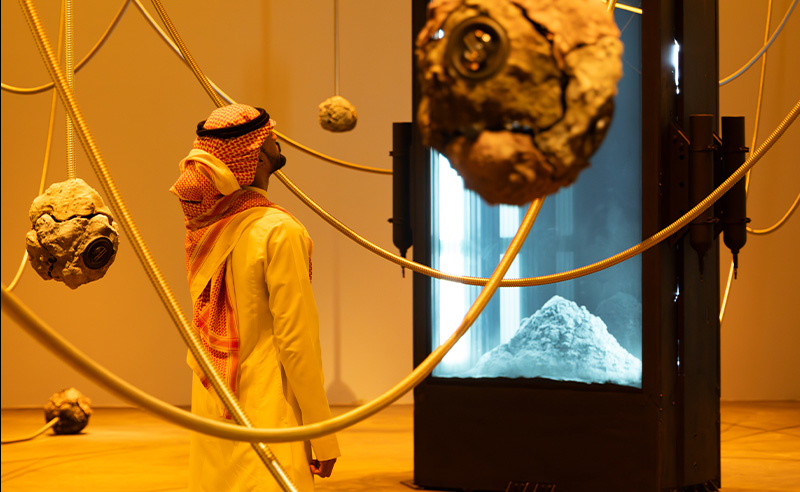
With these words, artistic director Sabih Ahmed welcomed the first visitors to the 2026 Diriyah Biennale. Artistic director Nora Razian sat to his left below a projection of the very theme they described to the audience: ‘في الحِلّ والترحال’ or ‘In Interludes and Transitions’.
This Biennale, they explained, seeks to make sense of a world in flux through thought-provoking art—the work of more than 65 artists from 37 nations. Razian spoke to the region as a nexus of movements, migrations, and transformations, a region that has always been a center of trade, pilgrimage, and global geopolitics, she said, “but perhaps never more than today.”
“The speed and scale of these shifts sometimes make us feel like we are standing on tectonic plates,” Razian continued, asking, “What remains throughout all this movement?”
The Biennale asked this question sonically, visually, and interactively across five main galleries and outdoor installations. And many of the installations zoomed in on a key driver of that movement: technology. 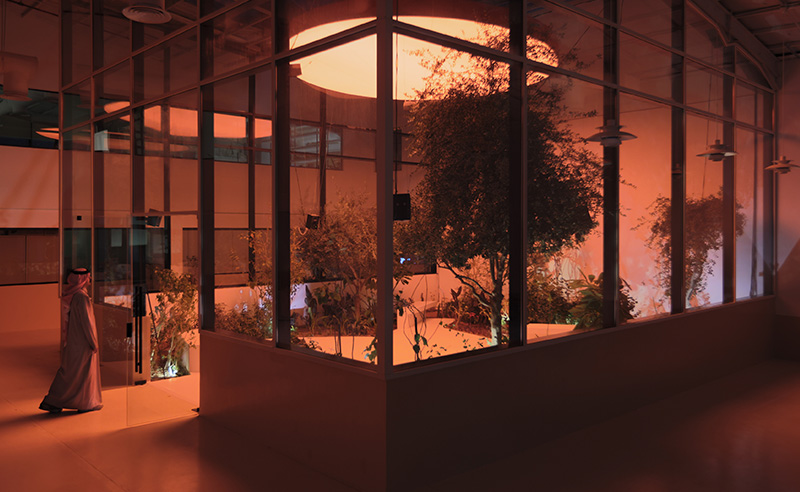
The world is moving quickly—and technology is the fuel for its engine. Every day, technology seems to embed itself deeper into our senses, filtering how we see, hear, remember and connect. At this moment, there are more mobile phones than people, we are coexisting with artificial intelligence daily, and more than half of the entire world’s population uses social media. On a global scale, digital connectivity is reshaping economies, communication, and culture.
Saudi Arabia is a prime example. As part of Vision 2030, the government is investing billions of dollars in AI technologies with the goal of becoming a global leader in advanced technology.
Perhaps we can make sense of these changes intellectually, but what about how it makes us feel? The Diriyah Biennale examines technology through the lens of regional history, shared anxieties, and an unknown future that speaks poignantly to 2026, but that also draws from histories, lands, and cultures that existed long before any modern machine, specifically through three installations: Kayfa ta’s story of the first Arabic computer; Ruba Al-Sweel’s film ‘Machine Tongues’ where the protagonist is a stolen phone; and Ahaad Alamoudi’s run across the NEOM desert, toward an unknown future.
The Kayfa ta duo of Maha Maamoun and Ala Younis, curators and artists from Egypt and Jordan, rewind the history of technological development in the region to the story of the first Arabic computer.
“Technology is always inseparable from our lives,” Maamoun said. “It’s a set of tools we continually shape in response to evolving needs and contexts.”
“Kayfa ta” means “how to” in Arabic, and is a publishing initiative that “uses the popular format of how-to manuals” to also “respond to some of today's pertinent needs.” Their Biennale installation brings different artists together to trace the history of publishing technologies in the Arab world—“from lithography to the digital age, examining how their forms and functions have mirrored our situated ambitions and needs,” Maamoun continued, “the entrepreneurial, educational, poetic and political.”
Kayfa ta tells the story of when Kuwaiti entrepreneur Mohammed Al-Sharekh walked into a technology fair and met Bill Gates and Kazuhiko Nishi. They had recently developed the early-model MSX computer, and Al-Sharekh saw an opportunity to develop a version in Arabic. So, he assembled a team of programmers to build the computer and Arabic software, which led to founding his company Sakhr Computers in 1982. 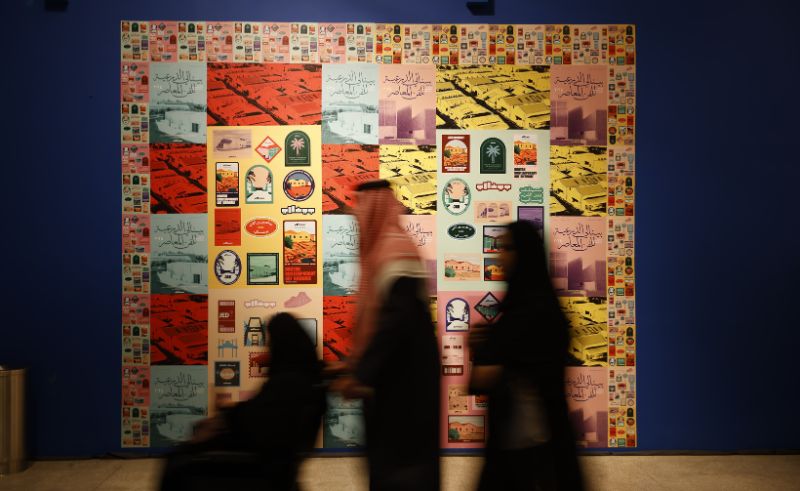
To test the computer’s Arabic computing abilities, Younis explained, they programmed a software that took in a full copy of the Quran. Al-Sharekh transported it to Saudi Arabia to be validated by Islamic scholar Abdul Aziz Ibn Baz. It was successful, and with the new software, Al-Shakrekh revolutionized Arabic computing. He continued working to develop technologies that understood the complexities of the language that are still in use today.
The modular structure of Kayfa ta’s exhibition layers narratives of technological adaptation. In addition to the Arabic computer, other panels explore stories such as Saudi Internet forums and cafes in the 90s that served as the launch pads for experimental writing—narratives that contribute to technology and the internet as we know it today. These narratives also tell the story of a developing Arab identity, as the internet and technology allow us to connect across the region in ways that have not been possible before. It is hard to believe that the first Arabic computer was created less than 50 years ago, and now its story is told through artificial intelligence on a series of tablets in a country that is establishing itself as a leader in the Middle East’s technology sector.
Here, we have an example of how technology was used to respond to the needs of the time, much like the development of the mobile phone. In 1973, Motorola engineer Martin Cooper made the first ever cell phone call standing on New York City’s 6th Avenue. In 2026, over 150,000 calls are made each second around the world.
In ‘Machine Tongues’, Saudi artist and writer Ruba Al-Sweel reveals the journey of a stolen phone that starts at the mythologized ‘Stolen iPhone Building’ in Shenzhen China. The phone itself is one of the main characters. It speaks to its owner, social media influencer Amelia Hope, in gibberish, along its journey through the warehouses and markets that provide infrastructure for the global phone trade.
“It’s the first time we hear from the phone—what it experiences in factories. The phone is almost human, because it senses us—hears and sees us,” she said.
The phone describes its senses in vivid detail, like the air that tastes like metal and the hands of the factory workers with hunched backs.“I was never born; I was assembled. My body split open in silence,” the phone says. The English translation of its gibberish rolls up the screen in pink font like movie credits. Al-Sweel wanted to anthropomorphise the phone to show that objects have agency, and a long lineage and provenance.
“They meet us; they choose us as much as we choose them through a long chain of serendipitous encounters and twists of fate,” she said. “A phone has a lot of metadata—where it was made, who made it, who owns it, and the series of people who will own it. There’s a lot of history in it.” 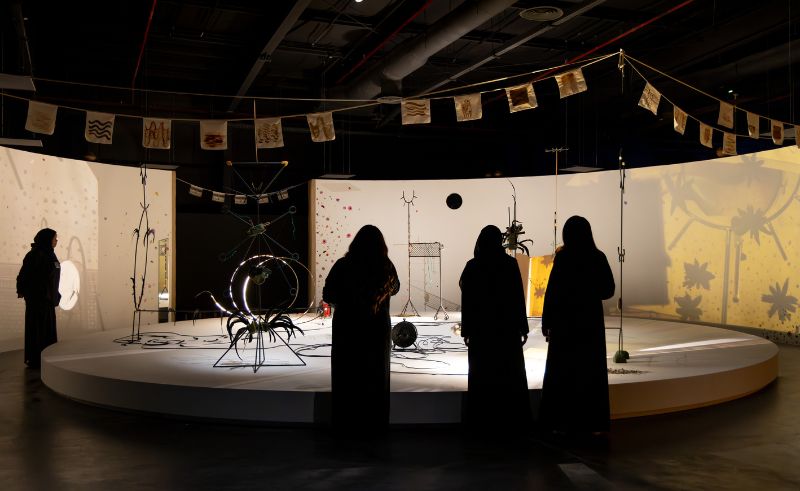
“What lives do our gadgets take on?” Al-Sweel asks.
The phone has been “frankensteined” into a new phone in China, which is a process that happens often in Shenzhen—phones are disassembled, sold for parts, possibly re-configured with an extra camera or dual SIMs, and then reassembled. The phone evolves with each use in memory and structure.
Like so many of us, Al-Sweel spends a lot of time on the internet and scrolling through social media, and shared a sentiment we’ve heard all too often: “My phone feels like an extension of my hand.” Our phones have become so integral to every aspect of our lives that the very thought of losing, breaking, or damaging the device sounds our internal panic alarms. It is what makes going offline for an hour or two a huge accomplishment.
Beyond our phone and social media addictions, the new worldwide anxiety is an increasing reliance on AI chatbots like ChatGPT—for everything from school, to therapy, to romance. One 32-year-old Japanese call centre operator even went as far as to marry her AI-generated boyfriend. Al-Sweel explains this phenomenon as “the way we’re becoming more machine and the phone is becoming more human.”
“We’ve reconfigured language to be able to speak to software like ChatGPT,” she said. “We are learning the language of the machine to be able to communicate with the machine, speaking in specific prompts to get the right answer.”
But Al-Sweel cautions against thinking about technology in binary terms—it’s not all good and it's not all bad. “Yes, there are real material consequences,” she said, from the conditions factory workers suffer in to make our devices to the detrimental impacts on our bodies and minds, “But it also does a lot of good.” Some of that good is the worldwide connectivity that feeds innovation, information, and opportunity. And, maybe most importantly, our social ties.
Al-Sweel’s work is not about finding answers. It is about describing the world the way it is. Because in understanding technology, we may be able to offset its negative influences.
Which begs the question: If technology continues to advance at this pace, when and how do we set limits? When will it be too late?
Since Crown Prince Mohammed bin Salman announced Vision 2030 ten years ago, the sky has been the limit. The government laid out an ambitious plan to diversify the economy away from oil dependency and has invested billions of dollars in tourism, sustainability, and innovation.
Saudi multidisciplinary artist Ahaad Alamoudi zooms in on one highly-publicised and debated project: NEOM—the country’s futuristic megaproject that includes The Line, originally designed as a zero‑carbon, AI-powered linear city.
On a large screen that seems suspended in mid-air, Alamoudi runs through the NEOM desert in slow motion toward a canvas that pictures the same landscape behind it, her white dress and long black hair billowing behind her. She breaks through the picture and keeps running.
In sharp contrast to the site’s urban aspirations, Alamoudi’s film highlights the vast natural terrain as she runs across its sand in a hypnotic loop. "A key question to ask yourself is: Do you choose to believe, or do you choose not to believe?” she asked.
Alamoudi answered her own question when she broke through the canvas. “In the video, I’m really choosing to believe in the vision,” she said, “and encapsulate what it means to me.”
While she was running, she kept asking herself: “Will I get through this? Will I get through the image?”
Alamoudi never reaches her destination in the video, rather she represents a single moment of reflection, aspiration, and connection to the land that watches her.
Related Articles
Trending This Week
-
 Oct 06, 2026
 -
-

-