





Palestinian Researcher Ahmad Nabil is Hunting the Jinn of Jerusalem
For Ahmad Nabil, paranormal encounters are real. If they weren’t, the entire Arab world would have to be insane.

There is a word in Arabic -al-hātif- that means the telephone. It also means a disembodied voice, and it can refer to the unseen caller: the jinn who summons you from somewhere beyond sight. It could be that Arabs named their phones after a supernatural entity, and almost nobody finds this strange.
Luckily, Ahmad Nabil finds it extraordinary.
"The root of jinn," he tells CairoScene, speaking across a bad phone line from Jerusalem to Alexandria, "means to hide, to be concealed from the senses. From that root you get majnūn: madness, being overtaken, possessed. You get janna, paradise. You get janīn, the embryo, that which is still hidden inside. And you also get the genie - English borrowed that one from us."
Ahmad Nabil studies the supernatural in our region, pulling back the surface of the Arabic-speaking world to reveal what runs beneath it. And once you lift a stone in that garden, an entire ecosystem waits.
He is 37 years old and lives and works in Beit Safafa, a Palestinian town southwest of Jerusalem. In his telling, it has always felt slightly outside of everywhere: isolated enough in the 1990s that the roads were dirt, children eventually manufactured their own entertainment, and jinn had plenty of room to roam.
Nabil is a visual artist, researcher, and educator, and the founder of Majlis al-Khayal, The Fiction Council, a Palestinian nonprofit dedicated to preserving and reviving Palestinian and Arab mythology and paranormal folklore. Since 2015, he has been collecting these stories, illustrating them, and insisting that imagination is not a luxury.
"Without imagination," he says, "we can't build better societies for ourselves. And we end up with others building them for us."
Nabil's childhood was not one of comfortable distance from the world. It was shaped by occupation, constant constraint, and the particular texture of Palestinian life in Jerusalem. But it was also expansive in the imagination.
"The lack of entertainment made us create our own," he says. "We had self-generating input. We didn't have as much external influence as kids do these days."
As an adult, after studying design and applied arts in Jordan and later throwing himself into art training in Jerusalem, he kept encountering children with unusually vivid and imaginative minds.
"You know the one," Nabil laughs. "The child in every classroom who talks about black holes and space-time, who has their own theories about mythical creatures at seven years old. The kid who gets either revered or relentlessly bullied depending on which room they're in."
Those were his people.
In 2015, he founded Majlis al-Khayal from a small studio, and one of its main projects was gathering exactly those children. Twelve of them eventually joined, each one arriving in a familiar way: a mother calling, exasperated, saying her son wouldn't stop talking about things nobody understood, that his imagination was out of control, that she didn't know what to do with him.
"I would meet the child and tell him: you're not alone. I knew you'd bring your monsters with you."
Those 12 are young adults now, university students: artists, designers, developers, scientists. But Nabil tended their imaginations for as long as he could.
In 2019, through The Fiction Council, Ahmad Nabil launched Darb al-Ghilan, 'Road of the Ghūls'. The project maps ghoul folklore village by village across Palestine and documents encounters with jinn.
Its first field trip took place in early 2020, in Rahat in the Naqab desert of southern Palestine.
"Every Palestinian village has its own ghoul," Nabil explains. "And the creature's characteristics vary according to the topography, geography, and the relationship between that community and its land. The ghoul of a coastal village is not the ghoul of a hilltop village. The ghoul of a farming community is not the ghoul of a shepherding one."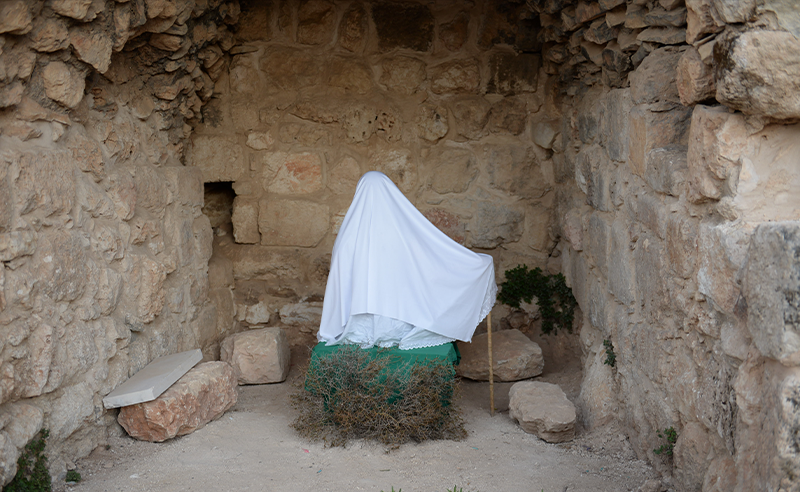 The ghoul (ghūl) in Arabic folklore is a malevolent, flesh-eating jinn-like creature classically associated with luring travellers to their deaths in the desert. It also helped shape the Western idea of the zombie, particularly through American pop culture and Antoine Galland's 18th-century French translation of 'One Thousand and One Nights', which added cemetery-roaming and cannibalistic elements that were less emphasised in the Arabic original.
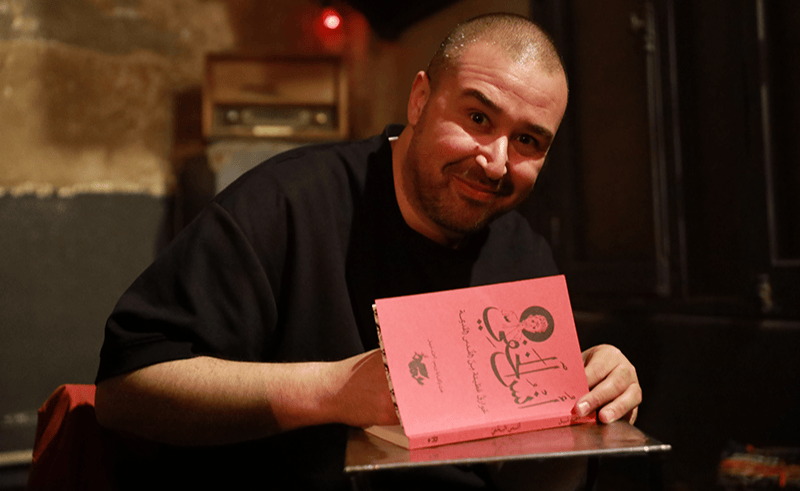
So far, 'Uns al-Khafi' is the first published output of Road of the Ghūls. 'Uns al-Khafi', or 'Hidden Companions: Paranormals from the Old City of Jerusalem', was published in August 2022. It was researched, written, and illustrated by Ahmad Nabil, designed by Omaima Dajani, and edited by Nairouze Khaldy. The book draws on interviews with 60 people and more than 35 hours of recorded testimony.
It sold out in less than 10 months. A second edition appeared in 2024 and is nearly gone. An English translation is now underway, and Nabil himself no longer owns a copy of the first edition.
"I titled the book 'Uns al-Khafi' because during my fieldwork I noticed that people in the Old City were profoundly at ease with the idea of jinn," Nabil says. "They greet them in the morning and the evening."
The book documents white-clad faceless figures, righteous jinn performing wudu at dawn, mischievous presences, and ghostly encounters linked to Mamluk-era houses with subterranean caves beneath them.
"People don't want to be judged," Nabil says. "They don't want to be thought of as fabricating stories. They have to trust you first, and trust that you believe them."
Interestingly, Nabil does not classify these encounters as mythology.
"I do not consider these legends," he says. "I do not consider them khurafat, superstition. I consider them khawāriq, supernatural occurrences. Whether you believe in them or not is entirely your business."
For Muslims, jinn are not mythological at all; they are theological. An entire surah of the Qur'an is named after them.
"They are accountable creatures, as humans are," Nabil says. "There are doctors among them. Engineers. Pilots. And the sayyi'in, the delinquents, just as we have delinquents."
Sorcerers might deal with those delinquents. Poets might receive inspiration from jinn poets whispering lines in the night.
"The Bible, on the other hand, has no jinn," Nabil says. "Christian Palestinians might use the word spirits, but their framework is good versus evil. There's no room for the specific, intimate social world of the jinn, who live among us with their own behaviours, hierarchies, and reasons for appearing or disappearing."
It is this world, its textures, its site-specific stories, the particular jinn of a particular well in a particular village, that Nabil guides people into on foot.
One October evening at dusk, in the village of Qalandia north of Jerusalem, he gathered a group and began walking.
Qalandia is not, on the surface, an obvious setting for a supernatural tour. Today it is best known for one of the most heavily militarised crossing points in the West Bank, a daily humiliation that has grotesquely become shorthand for the occupation itself.
But Qalandia also once had maqamat: shrines of holy men and women scattered across the Jerusalem rural side.
The tour, Dastour ya Ahl al-Maqam ('Permission, O Residents of the Shrine'), was a collaboration with Riwaq, the Centre for Architectural Conservation. The walk moved through the village's memory: the byar, the wells, and the stories attached to them. They touch on the paranormal encounters said to have happened there, the relationships between women and the wells, men and the harvest, and the lament tradition known as tenwih, which Nabil describes as "wounds the heart."
The destination was Sittna al-Mabrouka, Our Blessed Lady, a maqam that, at the time of the walk, existed only as a playground for children, with a pile of stones beside it.
In one story connected to the site, the Blessed Lady appears to someone who has wronged her and walks toward them without speaking, her back always turned, until the moment of confrontation.
Nabil placed a performer along the route, standing with her back to the walkers at a particular corner, waiting.
"When you bring the experience as close to the participants as possible," he tells me, "it lingers in their minds."
The tour ends at the candlelit stones of Sittna al-Mabrouka.
"You know your stories matter," Nabil says, "because when Israeli forces first raided Qalandia in 1967, soldiers came to a local man with a map and asked him to point out the location of this maqam. It's the first thing they always do. Strike the sacred."
The English translation of Uns al-Khafi is nearly complete, with a New York book tour planned for May through June 2026.
After that, Nabil hopes to renovate his family home in Beit Safafa, a building more than 130 years old, into a full research and documentation center for Palestinian mythology, imagination, and the paranormal.
"I do this because an empty place is a vulnerable place," he says. "If we are not present there, in that density of life and story, others move in. In fact, many of our old stone reservoirs, settlers have started swimming in them."