





Dana El Masri Crafts Scents Blending Sound, Memory, Anti-Orientalism
Dana El Masri challenges how perfume is named and understood, blending sound and culture and pushing back on “oriental”.
Originally published on May 17th, 2026
Your skin is a living system, with its own temperature, chemistry, and context. It interprets fragrance under conditions you cannot control. The perfume you wear is not fixed but unfolds over time, with a beginning, a middle, and an end. Rubbing your wrists together disrupts that structure. “If you rub your wrists together, you are fast-forwarding a song,” Dana El Masri tells SceneStyled. “Glide. Never rub.”
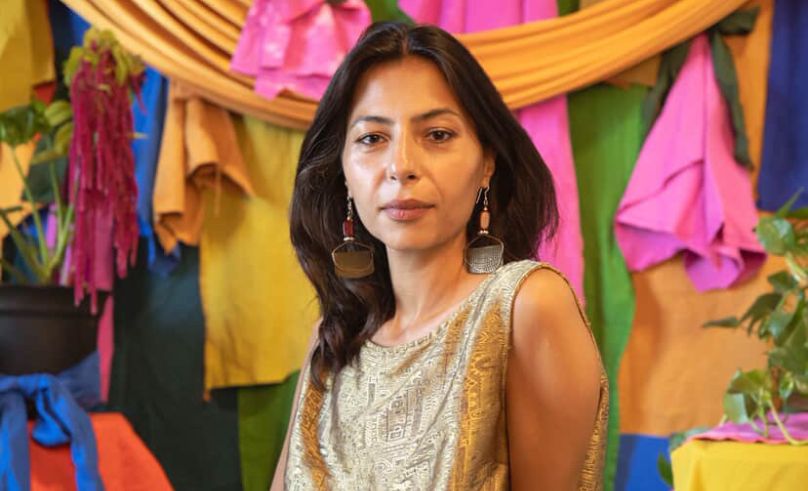
El Masri has been making perfume under the name Jazmin Saraï since 2014, in small batches and entirely by hand—first in Montreal, now in Los Angeles. She is a classically trained perfumer, an interdisciplinary artist, a synesthete, and a published fragrance writer. Her work has earned a Jasmine Award in the UK and a Perfumed Plume in the US; she has also served as a five-time judge for the Art and Olfaction Awards and co-founded the Diverse Talent in Perfumery database.
She is Egyptian-Lebanese, born in Budapest to a Lebanese father and an Egyptian mother, and raised in Dubai. Her perspective is shaped by a region that has long been misrepresented in mainstream perfumery, a point she addresses directly.
“The word ‘oriental’ entered the fragrance industry’s vocabulary in the 1920s, around the time classification systems were first being formalised,” El Masri explains. “It was a catch-all term, covering everything from sandalwood to spices to oud to amber—anything that was not, essentially, Western.” The term drew from a broader tendency to treat the East as a single, interchangeable category.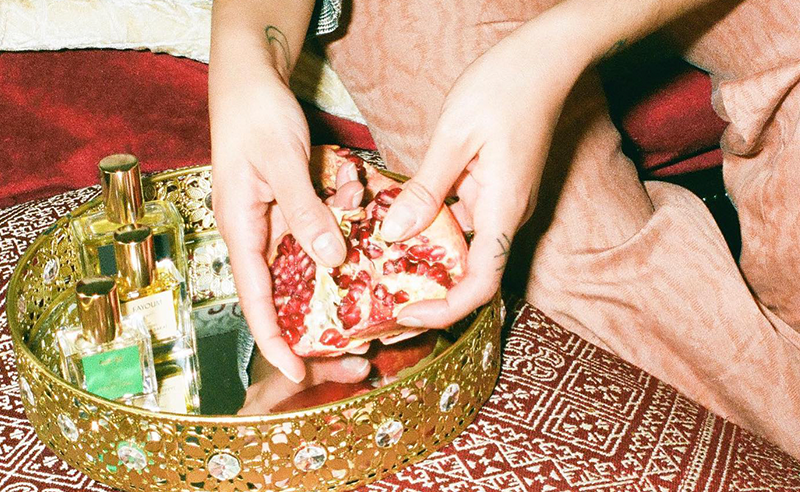 “They started classifying from around 1920 to 2021,” she says. “Oriental was meant to include sandalwood, spices, everything—but really, it just lumps everything together. That’s unfair. In my own culture alone, there are multiple distinct elements.” In Arabic, she notes, the word often translated as “oriental,” sharqi, simply means “Eastern.”
In recent years, the terminology has begun to shift. “Most major fragrance houses now favour ‘ambery,’ a term that points to a more specific material rather than an entire region,” El Masri says. “‘Oriental’ now sits under categories like balsamic, gourmand, ambery, or powdery. If you say ‘spicy ambery,’ it’s clearer—you’re describing actual materials.”
Modern perfumery traces its lineage to Grasse in southern France, where the industry formalised in the nineteenth century. The knowledge it built on—distillation, extraction, and aromatic medicine—has earlier origins. “The idea of distillation was from Ibn Sina,” she says, referring to the eleventh-century polymath. “Perfumery itself is an ancient Mesopotamian art.”
“The chypre family of fragrances takes its name from Cyprus. Guerlain’s vanilla-led orientals drew from references like the Taj Mahal. The sources were rarely credited, and the cultures even less so.”
Most Egyptologists writing on ancient Egyptian scent, she notes, are not from within the culture. “It is a different experience and a different level of knowledge. -0e8cb990-7631-4979-b752-86ab9d10540e.jpg) The closer you are to the culture, the better the fragrance. When you have nuance because you grew up with it, we need to give people from the region a chance to try.”El Masri grew up in Dubai, where scent was embedded in daily life: bukhour, oud wood chips burned at home and at weddings, and jasmine grown in her grandfather’s garden. “In the Gulf, people are very much about strong scents. When it comes to their sillage, the stronger the better.”
The closer you are to the culture, the better the fragrance. When you have nuance because you grew up with it, we need to give people from the region a chance to try.”El Masri grew up in Dubai, where scent was embedded in daily life: bukhour, oud wood chips burned at home and at weddings, and jasmine grown in her grandfather’s garden. “In the Gulf, people are very much about strong scents. When it comes to their sillage, the stronger the better.”
Her first perfume was a gift from her mother in France, a small bottle of Soleil by Fragonard. “I used perfume to soothe me,” she says.
She eventually found her way to the Grasse Institute of Perfumery, where she formally trained in the craft of perfumery. instead of Years of research led her to the Grasse Institute of Perfumery.
She applied, interviewed with perfumer Clément Gavarry, and was accepted. “It was one of the most rewarding years of my life.”
The name Jazmin Saraï reflects the brand’s approach: jasmine, jazz, and saraï, an inner palace—linking scent, sound, and interior space.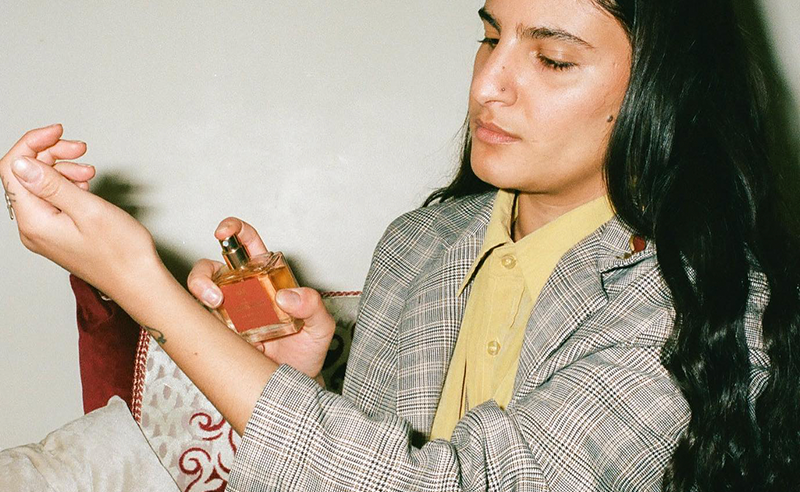 For El Masri, the relationship between music and fragrance is literal. She has synesthesia, experiencing sound and colour as scent. Drawing on the work of nineteenth-century perfumer Septimus Piesse, she approaches fragrance as a structured composition. “Jazmin Saraï fragrance is an olfactory reinterpretation of sound.”
“If I am making something for the Jazmin Saraï collection, I usually have a gut instinct as to which song I want to encapsulate in scent,” she explains.
Her early fragrances were, in her words, “very classic.” She later shifted toward Arabic music as a reference point, partly as a response to orientalist framing.
This led to the Tarab Duet in 2018, two fragrances inspired by Fairuz and Abdel Halim Hafez. Ma’ré draws from “Shayef El Bahr,” while Nar references “Hobak Nar,” from the 1959 film Hikayat Hob.
There is also a personal connection. “Abdel Halim Hafez sang at my grandparents’ wedding,” she says. “‘Hobak Nar’ was the song my grandmother chose.”
Fayoum, released in 2020, is among her most personal fragrances. Named after the oasis southwest of Cairo, it combines Egyptian clay, fig, violet, mimosa, and date.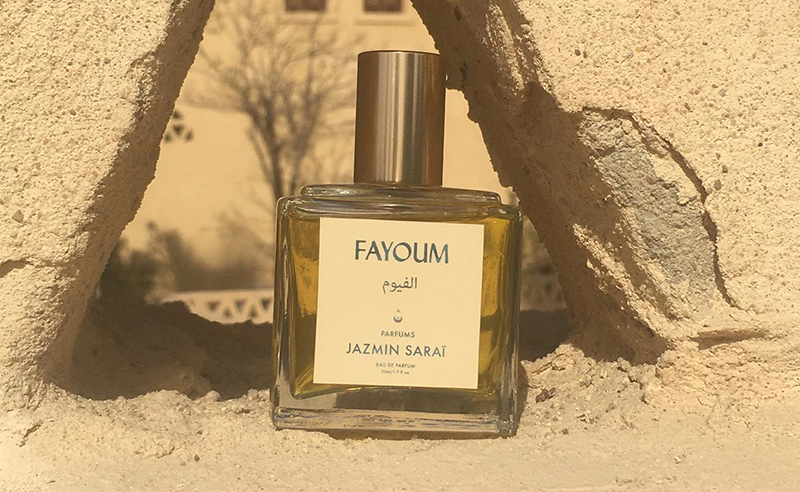 On principle, she avoids oud. “It is expensive, ever-changing, and it doesn’t originate from Arab cultures. It comes through South Asian trade routes. Frankincense is Omani, but oud isn’t.”
She is currently developing what she calls the “olfactory imprint theory,” exploring how scent relates to memory, identity, and diaspora.
There is scientific grounding for this: the olfactory system connects directly to the limbic system, which processes memory and emotion. Smell can trigger memory with unusual immediacy.
Her fragrance Jaz, a jasmine soliflore, is positioned as a diaspora scent. “For those living away from home, jasmine carries dreams and memories that bring us back.”
El Masri’s recommendations remain straightforward. “If someone wants something warm, I suggest Nar. If they want something lighter, Ma’ré.”
Everything at Jazmin Saraï is handmade. The perfumes rest for four to six weeks during maceration before being filtered and bottled.
- Previous Article SceneNoise x Amsterdam Dance Event Present CROSSFADE: Egypt
- Next Article The Abandoned Architecture of Villa Badran by Gamal Bakry