





Theatre is Making a Comeback in Cairo—But Where are All the Originals?
To understand why and how Egypt’s theatres are adapting international plays, we spoke to three theatre companies across Cairo.
It’s possible to say, with some hope and some caution, that theatre is making a comeback in Cairo. Though still far from its 20th century golden age that produced such stars of the stage as Adel Imam and Fouad el-Mohandes, many theatres around Cairo have been putting on sold-out productions and bringing them back for equally successful re-runs. In the final few months of 2025 alone, a playgoer in Cairo could catch all of the following adaptations around town: Charles Dickens’s 'Oliver Twist', Agatha Christie’s 'The Mousetrap', and the classic American work, 'One Flew Over the Cuckoo’s Nest'. But this raises the question: where are all the originals?
They do exist—they’re just not as popular (yet). Besides the obvious appeal to audiences of watching a familiar, well-known title (and the added appeal of seeing it play out in your own culture and context), the theatre moment in Cairo right now is one that is characterised by separate, decentralised spores, and the challenges facing each theatre company are unique. As they navigate their separate challenges, they seem to arrive at the same answer: spinning new plays out of global classics.
To better understand the rise of international adaptations in Cairo’s theatre scene, CairoScene spoke to Kenoma Theatre Company’s Ahmed El-Shamaa ('El Moristan'), Fabrica Musical Theatre’s Dr. Neveen Allouba ('Oliver'), and Ahmed Hani, the co-adapter behind ACT Theatre Group’s 'El Masyada'.
Ahmed Hani, who adapted Agatha Christie’s 'The Mousetrap' into 'El Masyada' for ACT Theatre Group with fellow writer Ahmad Alhamzawey, comes from a background of performance rather than playwriting. He was an actor in the hit YouTube miniseries Nesr El Scene, as well as El-Shamaa’s 2021 'Reservoir Dogs' production. But whereas El-Shamaa approaches adaptations with huge creative freedom, Hani preferred to stick much more closely to the original script in his adaptation of Agatha Christie’s beloved murder mystery.
“Mainly I enjoy directing and acting,” Hani says. “Of course I also enjoy writing, but I wouldn’t call myself a writer. The reason I chose to adapt 'The Mousetrap' is because I actually auditioned for it many years ago in the United States. Even though I didn’t get the part, the play stuck with me. I thought it would be very interesting to see it on stage here in Egypt, and see if the audience could figure out who the murderer was before the reveal.”
As a producer of the play, Hani also had to take into consideration how the play would perform commercially. “It was part of the draw for audiences to see Agatha Christie in Arabic,” he says. “Sometimes the audience comes because they know the actors or they know the director. This time we were lucky to have a famous actress like Dalia Shawky, but when this is not the case, you have to ask yourself as a producer, what will attract people? So that’s where you might think Agatha Christie.”
Sometimes, however, the choice of what performance to stage is not about the writer or the audience, but about the cast. Dr. Neveen Allouba, the renowned Egyptian soprano and vocal pedagogue who in 2023 was awarded France’s Order of Arts and Letters for her achievements in opera, founded Fabrica Musical Theatre in 2013 with the aim of giving a platform to her students.
“We’re the only independent musical theatre in Egypt,” says Dr. Allouba. “Generally, there has been no musical theatre happening in Egypt for decades, and over the past 30 years as a teacher I’ve seen so many talented people who don’t have an outlet for what they want to do.” To bridge this gap, Dr. Allouba decided to form a theatre company. Their performances began attracting even more interest from people who wanted to further their talents, and so, shortly after the founding of Fabrica, Dr. Allouba created the Neveen Allouba Vocal Academy.
“The academy has over 70 students, and those who do well in our program join us in the company. It’s helped make Fabrica self-sufficient.”
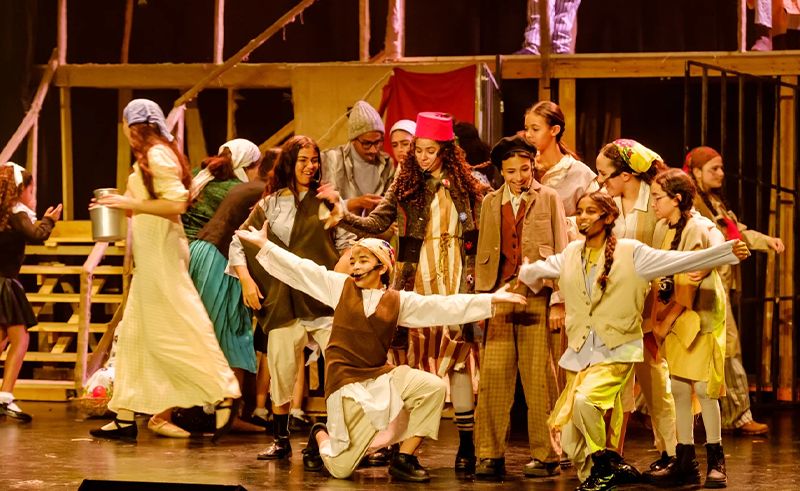
Fabrica has previously adapted Egyptian classics like 'El Leila El Kebira', but their most recent play was 'Oliver', an Arabic language adaptation of the beloved play based on Charles Dicken’s 'Oliver Twist'. “We chose 'Oliver' partly for variety, but also because we have many young performers aged 8 to 15 who have been with us for years, and whom we wanted to give a chance to work in a professional production,” says Dr. Allouba. “In 'Oliver', we have a main cast of more than 18 people.”
Compared to conventional theatre, the challenges that come with adapting a musical are unique. “We never change the music in our adaptations. As a result, it becomes very technically challenging to put Arabic words to the original music. There’s letters in Arabic that do not exist in English and are difficult to sing at certain pitches, so we have to make the words simpler and adapt it so that the singer can sing them in a way that is understandable to the audience, while keeping the same rhythm, cadence, and meaning. It’s a process that takes months.”
To Dr. Allouba, it is this process that is the most difficult part of adapting a musical. And yet, to write an original—something Fabrica have not yet done—would be even more challenging, because they would need to find a composer. “It takes a lot of time and work to write a musical play, and we don’t have the financial means to compensate a composer for that.”
At the other end of the spectrum lies Ahmed El-Shamaa, the playwright behind Kenoma Theatre Company’s adaptation of the classic American novel and play, 'One Flew Over the Cuckoo’s Nest'. El-Shamaa has been with Kenoma for five years, but before that he was an independent filmmaker who wrote and directed several award-winning short films, and worked as well in Egypt’s TV industry as an assistant director and screenwriter.
“When you adapt something that already exists but make it your own, you still put your soul into it,” says El-Shamaa. “At the end of the day, writing is writing, and creating an adapted screenplay is a form of writing.”
In 'One Flew Over the Cuckoo’s Nest', which is set in 1960s Oregon, a convict named Randle is admitted to a psychiatric hospital and rebels against the cruel authority of Head Nurse Ratched. In Kenoma’s 'El Moristan', set in Cairo in 2010 and starring Yosra El Lozy, an ex-convict named Mamdouh admits himself to a psychiatric hospital and rebels against the cruel authority of Head Nurse Rashida.
“Sometimes, it’s even more difficult to write an adaptation than an original,” he says. “You have so much material to work with, and so you have to pick and choose only what fits your country, your environment, your time.”
However, Kenoma does not exclusively stage adaptations; as recently as 2024, they produced an original play in English and in Arabic, titled 'Insomnia'. When they do adapt a foreign title, it’s often at the behest of Kenoma’s founder and director, Moustafa Khalil. However, 'El Moristan', which was performed from December 7th to 15th at AUC’s Falaki Theatre and may soon be coming back for a re-run, was entirely El-Shamaa’s idea.
“In the 90s my mother was the deputy director of a psychiatric hospital in El-Abassiya, and I would go with her sometimes. I would watch the dynamic between the patients and the nurses and the doctors. It’s why I chose to make this adaptation. I wanted to use my experience from within a public psychiatric hospital in Egypt to adapt something that is essentially universal. There’s so many things from what I saw in the hospital that have been incorporated into the play in the form of characters, dialogue, and actions, and I think those personal experiences allowed me to write a much stronger work.”
What El-Shamaa has created uses the structure of 'One Flew Over the Cuckoo’s Nest' to create a very Egyptian play to comment on issues surrounding mental health here at home. He wants the audience to leave the theatre with that message in mind, and for that reason, the distinction between original and adapted plays to him isn’t much of a question at all. His main concern, as with Dr. Neveen Allouba and Ahmed Hany, is to put on a good performance that audiences will enjoy. With time, the originals will come.
Related Articles
Trending This Week
-
 Oct 15, 2026
 -

-
-