


Art Week Syria Opens Damascus's Unfinished Massar Rose to the Public
Massar Rose's raw concrete frame became part of Art Week Syria itself, as daylight moved through the unfinished building around work by 47 Syrian artists.
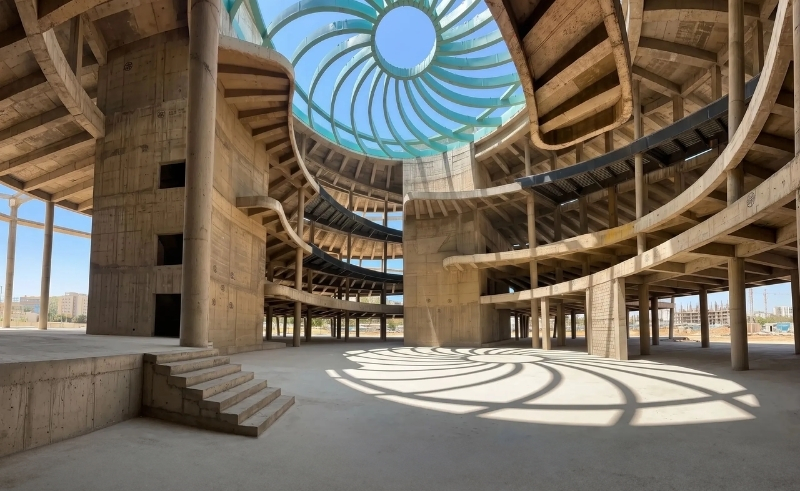
In the heart of Damascus, on the banks of the Barada River, stands Massar Rose, a vast skeleton of concrete and open space, shaped after the Damascene rose.
Its bare frame lets daylight move freely through the unfinished structure, seeping in between its architectural petals and casting slow, shifting patterns across the floors and walls with the passing hours.
Massar Rose reopened in September after years with its doors closed, becoming home to the inaugural Art Week Syria.
The exhibition gathered 47 Syrian artists across generations and disciplines from September 11 to 18, opening with an invitation-only ceremony and a private preview for collectors before welcoming the public from September 13.
Line Kouwatli is the Paris-born Syrian founder and director of Art Week Syria, which has Artopia UAE as its patron.
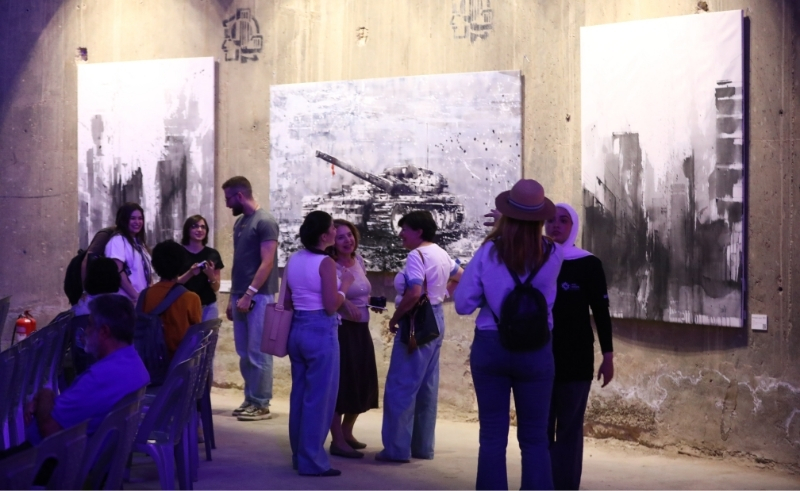 A curator and collector, she spent the past two years travelling between Dubai and Damascus, trying to understand the state of Syria's art scene. What she found was a cultural landscape that she describes as largely dormant: “There's no space or platform for the artists to expose their work to an audience, and at the same time, what I've been witnessing is the growing interest around the Syrian artists outside of Syria,” she says.
On Shukri Al Quwatli Street, in the middle of the city, stood Massar Rose, a building she passed again and again, but it remained inaccessible to the public.
“I always pass by this place, and I'm attracted to its incredible architecture. It's stunning. It has a very special architecture. It's inspired by the Damascene Rose. So it looks like a flower from the inside and from the outside,” she says.
It was meant to be a discovery and education centre for children, developed with the support of former first lady Asma Al-Assad under the Massar programme, an initiative of the Syria Trust for Development.
The building was designed in 2008 by the Danish firm Henning Larsen Architects; its form was drawn from one of the city's best-known emblems, turned into contemporary architecture. Construction stopped after war began in 2011, leaving the building incomplete and closed.
-2d341e6c-e621-4348-9757-c00ed2d8bbed.jpg) Kouwatli secured approval from the Ministry of Culture to use Massar Rose for Art Week Syria, with the Syrian Development Organization serving as host partner.
Project records identify the Damascus Governorate as the building's owner, while the Ministry of Culture has been involved in discussions over its future use. SDO says it is working to keep the site open for art, culture and community activity.
“This beautiful building, no one can access it inside. So we made this building accessible,” she says.
Kouwatli describes opening it as a way “to reclaim it from the old regime”. Her ambition for Art Week Syria was to “wake” what she describes as a largely dormant art scene and create a platform for local artists.
Kouwatli kept the bare concrete, open framework and raw surfaces visible, making the unfinished structure part of the exhibition itself.
“It's still under construction. So we made a point to make it in this rigid, raw, under-construction building to show that even Syria, being currently out of war and destroyed, we can still build something beautiful in it. And this is what we did. We built something beautiful in this space. So this is the reason why it was chosen. Everything was chosen for a reason in this exhibition.”
When Kouwatli and her team first stepped inside, they found it in deep disrepair.
“It was a catastrophe inside,” she says. “It took us a week to clean it, literally.” They cleared the rubble and readied the place for visitors while keeping the qualities that had drawn her to it.
With no finished windows or conventional interiors, daylight moved through the structure at will, changing the mood of the rooms hour by hour.
“Having it as such, and with the lighting, was truly magical,” she says. “Even the artwork felt part of the space. And the lighting, because, as you saw, it’s still unfinished, so there are no windows, nothing. The reflection of the lighting inside is an artwork by itself during the day, and it changes. So it’s a moving artwork.”
Kouwatli and co-curator Marwan Tayara kept asking how the exhibition might unfold within such unusual architecture.
“We mapped and re-mapped and re-mapped maybe a hundred times on how the artworks need to be placed,” she says.
The exhibition moved through generations of Syrian artistic practice, with its route following the building's rose-like plan.
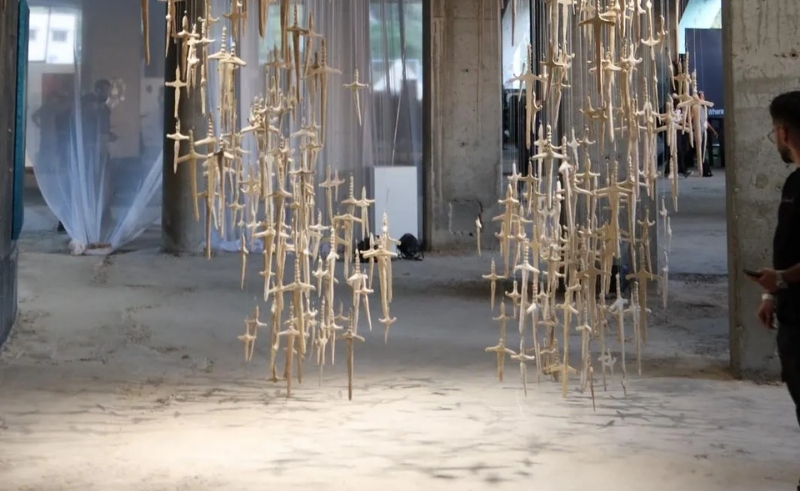 “You start with young artists and then you continue. And the more you move around the flower, the Massar Rose, the more you go towards the pioneer artists. And it ends with the pioneer artists and the photography exhibition.”
Paintings, sculptures, digital works, installations and photography filled the unfinished building, reflecting different generations and approaches within contemporary Syrian art.
Participating artists included Abdullah Murad, Asma Fayoumi, Fadi Yazigi, Omran Younis, Salah Hreeb, Stephany Sanossian, Shaza Midani, Shahd Al Rez and Rawan Oudeh.
A separate photography exhibition curated by French-Syrian photographer Ammar Abd Rabbo documented aspects of Syria's history and cultural identity.
The programme also extended into film and music, with European Union support for a selection of contemporary Syrian films curated by filmmaker George Achkar, alongside performances by local choirs and orchestras led by conductor Dulama Shehab.
“We made sure to include different mediums to show the richness of Syrian art,” Kouwatli says.
The reopening drew artists, collectors, diplomats and cultural figures from Syria and abroad.
Anne-Claire Legendre, president of the Institut du Monde Arabe in Paris, was among those attending.
Art Week Syria had temporary access to Massar Rose, with no permanent cultural designation announced for the building.
Kouwatli hopes it will remain a cultural space. “What I'm trying to do is to take it for culture. This is what I was trying to ask the authorities, the Ministry of Culture, to keep it as a cultural space. We don't want it to be transformed into a mall or, I don't know, a place where people do weddings. No, we want it to be kept as a place for culture.”
For Kouwatli, the opening of Massar Rose was deeply moving, marking a milestone for the initiative and the cultural community it brought together.
“The opening night was actually magic,” she says. “The feedback that I received was really extremely positive. People were telling me it was a magic night, it was a dream, it gave us hope. With the lighting, the music, the people all gathered for the first time in Syria under this platform, it was truly a dream coming true. It was really a milestone.”
“The name was Art Week Syria. It was already a commitment and a responsibility to make an exhibition and to raise the bar. We wanted to show the world, and even Syrians, what Syrian artists can do and what the art scene can do. So that’s why we made sure to choose a building that has a character, that has this grandiose effect.”
Art Week Syria closed on September 18.
Massar Rose remained in cultural use: a separate exhibition by the Wa Youth Forum opened there on October 15, bringing together 50 Syrian artists under 35 in a programme organised by the Ministry of Culture's Fine Arts Directorate with the Madad Visual Arts Collective.
The exhibition runs through October 25, even as the building's permanent role remains unsettled.
- Previous Article Turuq Innovations Secures Seed Investment From Den VC