





Ghyda Kanaan Builds Everything in Lebanon No Matter Where She is Based
While interior designer Ghyda Kanaan relocated to Madrid in 2025, nothing she designs is produced there. Everything still gets made with Lebanese craftsmanship.
At Villa Audi, during We Design Beirut's second edition, interior designer Ghyda Kanaan exhibited her first collectible piece. Berytus is a column-shaped cabinet fused to a metal base made of hand-carved Egyptian alabaster.
Kanaan explains that it was the first time that kind of stone had been carved by hand rather than polished. Aiming for rough, uneven edges, the alabaster was cut into strips and then deliberately broken in places, left looking excavated rather than finished. Its final look was closer to a Roman ruin than a piece of furniture.
The piece was not received without pushback. Some viewers read the metal base as a separate element entirely.
"I wanted to show that two completely different materials, two different worlds, can carry the same message," she explains.
Pairing materials people assume should not sit together runs through everything Kanaan has made since. It's also the throughline of a career that has moved from Beirut to Milan to Boston and now to Madrid, with production remaining in Lebanon the entire time.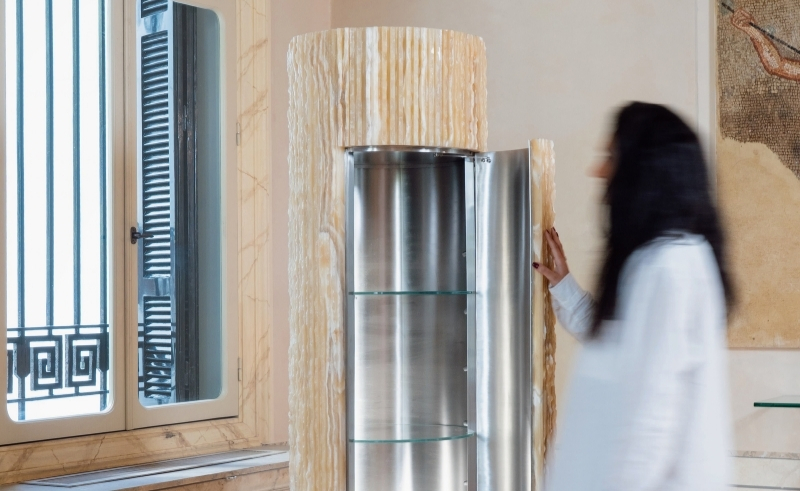
Kanaan says she had a strong creative instinct from childhood, which drew her to the Académie Libanaise des Beaux-Arts, where she studied product design for three years under practising Lebanese designers she admired.
After graduating, she spent four years working with several of those designers in Beirut, then interned at Zarifi Studio in Boston, an experience that pulled her to the more technical side of interiors.
That shift led her to a master's programme in interior design in Milan, where she graduated in 2022. Zarifi Studio invited her back afterward, this time as a freelance collaborator, where she worked on large-scale projects with the studio before striking out fully on her own. Ghyda Kanaan Studio opened in Beirut at the beginning of 2024.
 The alabaster column at Villa Audi came together while Kanaan was already packing to leave the country. The war that escalated in late summer 2024 had stalled her projects and made staying untenable. She relocated to Madrid in April 2025, midway through building the collectible piece that would become her breakout moment.
She still consults with suppliers in Lebanon on every project and leans on trusted contacts to oversee production when she can't be on-site herself. She returns to Beirut every two to three months. "I consider myself based in Beirut, because this is where 50% or more of my inspiration comes from," Kanaan said.
Kanaan's most recently completed project puts her instinct for mixing materials on full display. The client, a creative studio called Mensa, wanted a Beirut workspace that felt more like a home than an office.
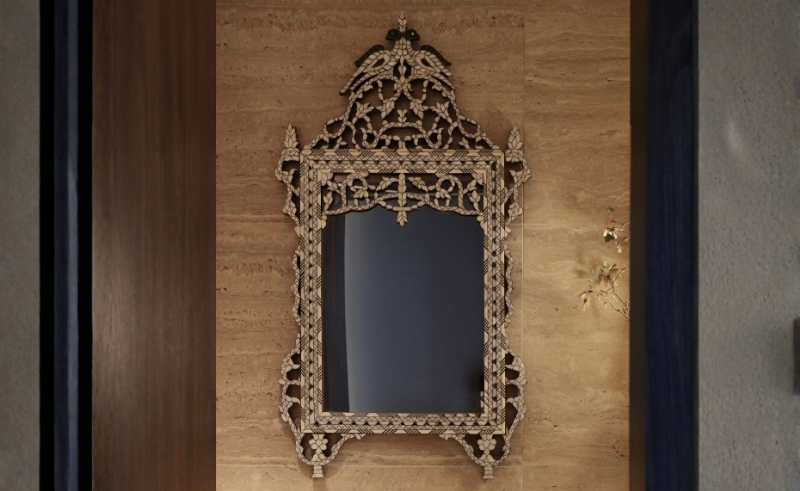
Dark walnut paneling covers the walls. Mother-of-pearl mirrors catch the light against it. A storage room that could have been a plain wall instead got clad in stainless melamine, chosen specifically because it throws soft shadows rather than a hard shine as people move through the space. A vintage Venini Murano chandelier hangs over the dining table. Other furniture came from flea markets in Beirut and Spain.
The detail Kanaan keeps returning to is a red onyx portal connecting the reception area to the main living and work space, a threshold built to feel like a passage rather than a doorway. Three types of onyx run through the project overall, red, beige, and a rainbow onyx used in the bathroom.
 Marble remains her favourite material, but metal, especially brass and chromed stainless steel, has become just as central to her recent work. Dark woods, walnut and burl in particular, round out a palette she traces back to the Italian design of the 1970s and the years she spent absorbing it in Milan.
Her mid-century leanings sit alongside a strong pull towards Orientalism and Middle Eastern craft, rooted in a lifetime spent in Beirut. Every piece, wherever it ends up, gets made there. "I would never think of producing a piece outside Lebanon. Even if I'm shipping a piece to the States, I'd still produce it in Lebanon and ship it all the way there, because of the very intricate work, the soul in what they produce and how they produce it, and the richness of materials," she says.
Madrid has added its own layer to this thinking, though Kanaan is careful not to overstate it. Her inspiration comes more from travel in general than any one city. "Since I live in Madrid now it's a big inspiration, especially because Spanish culture was really inspired by Arab culture such as the Alhambra and the cities in the south, where there's so much Arab influence," Kanaan explains.
Not every risk has paid off. A planned showing at Forma, an exhibition in Spain, fell through last year when the war delayed shipping and forced Kanaan to withdraw.
Her next project is already underway. Kanaan is getting ready to participate in the second edition of Fragmenta in Beirut this November to showcase her second collectible piece.