





How Egypt and China's Relationship Has Changed in a Decade
Xi Jinping is in Cairo for his first Egypt visit since 2016. Egypt still buys around 24 times what it sells to China, though its exports tripled in the first half of this year. Will that change?

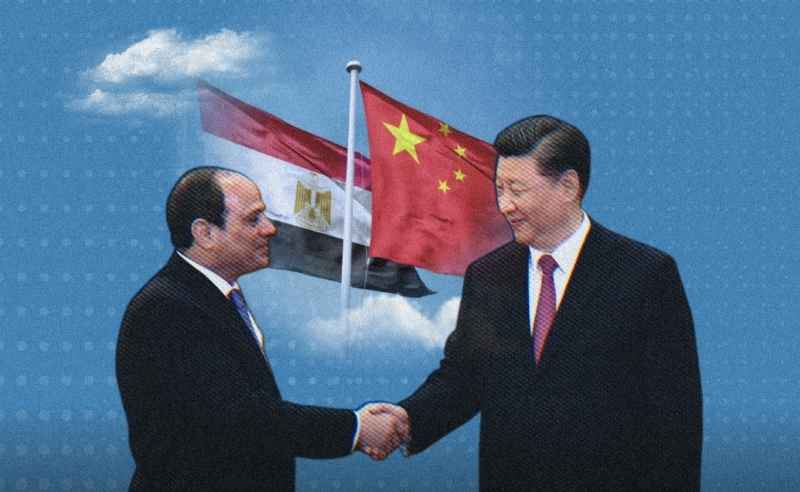
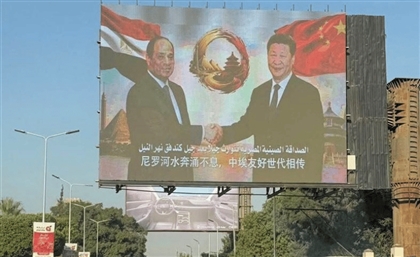
Chinese President Xi Jinping's visit to Cairo this week coincides with 70 years of diplomatic relations between Egypt and China, and a decade since his last visit to Egypt in 2016. Official statements have emphasised friendship and cooperation, but the more concrete picture of change over the past ten years is visible in trade figures, investment data, tourism numbers and education statistics.
Xi arrived in Cairo on Tuesday evening accompanied by his wife, Peng Liyuan, with President Abdel Fattah El-Sisi receiving him on the tarmac. Xi is in Egypt for a three-day state visit, with talks with El-Sisi taking place today and a visit to the Grand Egyptian Museum also on the programme. His arrival has also brought the usual logistical choreography to Cairo, with major roads closed or restricted around the president's movements in a city of more than 20 million people.
The visit comes as the United States is six months into a war with Iran, while the Suez Canal, the route through which much of China's trade with Europe passes, is exposed to the regional conflict. Days before Xi landed, Chinese J-16 fighters, tankers and early-warning aircraft flew more than 6,000 kilometres to Egypt for the second Eagles of Civilization exercise. Sisi also used an article published in Al-Ahram on Monday to restate Egypt's position that Taiwan is part of China.
Trade has grown substantially. Chinese investment has reshaped parts of Egypt's industrial and urban landscape. Hundreds of thousands of Chinese tourists have returned to the country each year, and Chinese-language education has expanded into universities and public schools.
The same figures also point to an imbalance. Egyptian imports from China far exceed Egyptian exports to China, a gap that has increasingly been identified by officials on both sides as a problem requiring attention.
What follows is an account of the past decade of Egypt-China relations, told through the numbers behind it.
How much has trade grown?
In 2014, the year Egypt and China established their Comprehensive Strategic Partnership, bilateral trade reached $11.6 billion. By the end of 2025, it had reached $20.78 billion, up from $17.37 billion in 2024. That represents growth of roughly 79% over the 11-year period.
The imbalance embedded in that growth has persisted. Egyptian imports from China reached around $19.9 billion in 2025, compared with Egyptian exports to China of approximately $819 million. The gap is not new: in 2014, imports from China already exceeded exports to China by more than 24 times.
What has changed more recently is the composition of Egyptian exports, and the effort to alter it further.
What is actually traded?
The two countries trade in different kinds of goods. During the first half of 2026, Egypt's leading exports to China included $494 million in fuels and mineral oils, $150.6 million in vegetables and fruit, $76.4 million in cotton and vegetable textile fibres, $31 million in natural calcium phosphates and $21 million in organic and inorganic chemicals.
Imports from China were dominated by manufactured and industrial goods. In the same period, Egyptian imports from China included $4.1 billion in electrical and mechanical machinery and equipment, $1.2 billion in vehicles and related transport equipment, $930.7 million in iron and steel, $524 million in plastics and $423.7 million in chemicals.
This contrast helps explain the persistence of the trade deficit. Machinery, electronics, vehicles and industrial inputs from China have been exchanged largely for commodities, agricultural products and raw materials from Egypt.
Recent figures suggest some movement. Egyptian exports to China rose 199.8% year-on-year in the first half of 2026, reaching $840.8 million, while imports from China rose 14.3% to $10.4 billion. Total bilateral trade in the period reached $11.3 billion, up 21.5% from the first half of 2025.
The trade relationship remains heavily weighted towards China. The scale of the export increase, however, points to a shift in emphasis: from importing Chinese goods, towards placing more Egyptian products in the Chinese market.
Beyond trade: investment and manufacturing
Chinese companies have taken part in some of the most visible infrastructure and industrial projects built in Egypt over the past decade, including the Central Business District in the New Administrative Capital, the electric train linking Cairo and the New Administrative Capital, the China-Egypt TEDA Industrial Zone in the Suez Canal Economic Zone, and the EgyptSat-2 satellite.
The clearest example is in Ain Sokhna, where the China-Egypt TEDA Suez Economic and Trade Cooperation Zone has grown from an industrial-zone project into a large manufacturing cluster. According to TEDA's latest figures, the zone has attracted about 200 enterprises, around $3.8 billion in investment, more than $6.6 billion in sales, and more than 10,000 local jobs.
The significance lies in the model rather than in any single project: production has increasingly taken place inside Egypt, rather than being limited to the import of finished Chinese goods. Industrial localisation and technology transfer were named as priorities in the 2024 five-year cooperation programme between the two governments, which pointed to potential cooperation in electric vehicles, electronics, solar panels, chemicals, building materials and agricultural technology.
One example has since taken shape. In December 2024, the Chinese solar manufacturer Elite Solar broke ground on a $150 million photovoltaic cell and panel factory in the Ain Sokhna industrial zone, with a production capacity of 2 gigawatts of solar cells and 3 gigawatts of modules. The facility was commissioned in January 2026 and is expected to create around 600 jobs, most of them for Egyptians.
Tourism
Tourism between the two countries has grown steadily, interrupted only by the pandemic. Around 65,000 Chinese tourists visited Egypt in 2014, according to the Egyptian embassy in Beijing. That figure climbed in subsequent years, reaching the hundreds of thousands before international travel came to a halt.
By 2024, Chinese tourist arrivals had recovered, with a reported 63% increase over 2023 and 30 direct flights operating between the two countries each week. Chinese-language signage at major attractions, Chinese-speaking guides and hotels offering Chinese cuisine have since become more common as tourism infrastructure has adjusted to the market.
Air connectivity has expanded alongside tourist numbers. A Beijing-Cairo route operating three times a week was announced by Air China in 2025.
Education
Some of the clearest changes in the relationship are unrelated to trade. Chinese-language education has expanded steadily in Egypt: according to the Chinese Embassy, 36 Chinese-language majors had been established across Egyptian universities by 2026, and 41 public middle schools had introduced Chinese as an elective second foreign language.
The Egyptian Chinese University, established in Cairo in 2016 with 50 students in a single faculty, had grown to nine faculties and around 12,000 students by 2025. Three Confucius Institutes and two Confucius Classrooms are also operating in Egypt, according to Chinese Embassy figures reported in 2025.
This expansion points to a relationship increasingly conducted outside government and corporate channels, through classrooms, scholarships, cultural programmes and language competitions.
Cultural exchange
The cultural relationship is visible in China as well. In July 2024, the Shanghai Museum opened an exhibition titled "On Top of the Pyramid: The Civilization of Ancient Egypt," featuring 788 Egyptian artifacts. Before the exhibition opened, 250,000 tickets had reportedly been sold, and nearly 70,000 visitors attended in its first week.
By the time the exhibition closed in August 2025, it had drawn 2.77 million visitors, according to Egypt's State Information Service.
Exchange has taken place in the other direction as well. Three Chinese archaeological missions are currently active in Egypt, involved in excavation, restoration and documentation, including work at the Karnak Temple complex and the documentation of coffins discovered at Saqqara.
Closing the trade gap
Efforts to reduce the trade imbalance have become more concrete in 2026. In May, a policy was activated granting 100% tariff exemptions on imports from African countries that maintain diplomatic relations with China, giving Egyptian exporters preferential access to the Chinese market.
In August 2026, 17 export contracts worth approximately $168 million were signed by Egyptian companies, covering agricultural products, textiles, leather goods and engineering products destined for China. The contracts followed a near-tripling of Egyptian exports to China earlier in the year.
The gap remains wide. Even after that growth, Egyptian exports to China in the first half of 2026 amounted to less than one-tenth of Egyptian imports from China in the same period. Greater balance in trade, wider access for Egyptian products in the Chinese market, and greater use of Chinese inputs in Egyptian manufacturing were named as goals in the two governments' 2024 joint statement.
What has changed?
Bilateral trade rose from $11.6 billion in 2014 to $20.78 billion in 2025, an increase of roughly 79%. Chinese investment has moved further into Egyptian infrastructure and manufacturing, with the TEDA industrial zone alone accounting for around $3.8 billion in investment and about 200 enterprises. Chinese tourism has recovered into a significant market, and Chinese-language education has spread through Egyptian universities and schools. In China, the exhibition of Egyptian artifacts at the Shanghai Museum drew 2.77 million visitors.
- Previous Article Rabeh Raises $8.5 Million to Build Saudi Investment Platform
- Next Article The Iconic Dome of Sakakini Palace Has Been Illuminated