




The Dahabeya That's Giving Egypt Back Its Own Narrative
BENNU is a 2027 dahabeya sailing the Nile, where Pharaonic, Ottoman, and contemporary Egypt converge through artisan craft, curated interiors, and the river's timeless rhythm.
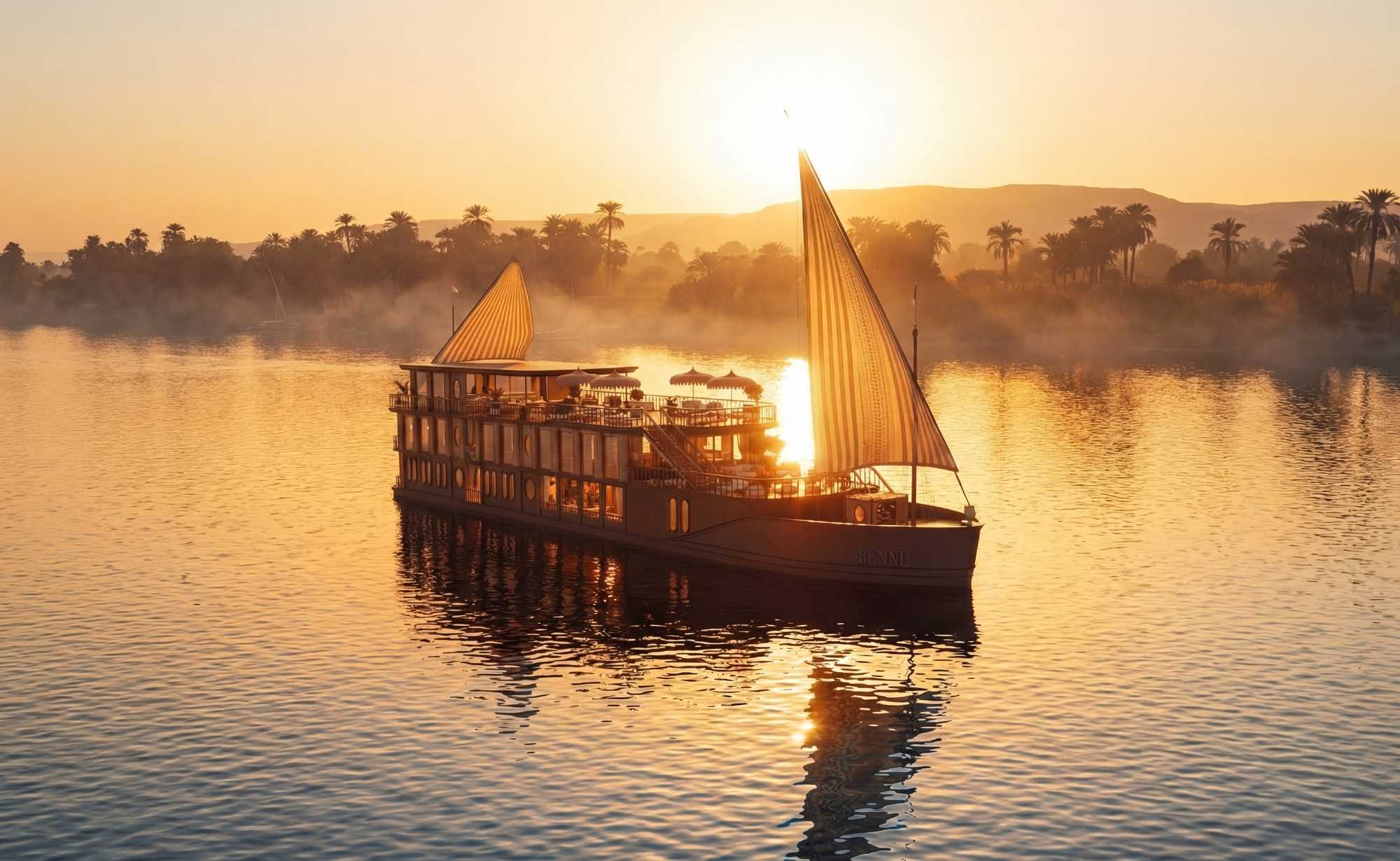
The most important checkpoints of our lives always happen on the threshold of permanence and impermanence, stillness and movement—moments reminiscent of a Bennu bird flying high into renewal, heralding the beginning of yet another lifecycle. Ancient Egyptians believed the sacred bird emerged at the dawn of creation itself, perched above the primordial waters before the world had fully taken shape. Neither entirely of the Earth nor the heavens, the Bennu came to symbolise cyclical return: the certainty that endings begrudgingly contain the very architecture of beginnings.
Perhaps that is why the Nile continues to endure so powerfully within the Egyptian imagination as a living metaphor for recurrence. Along its banks, civilisations have risen and collapsed, villages have expanded and disappeared, and generations have drifted between departure and return with the current itself. Like the bird, the river remembers movement a lot more than it does permanence.
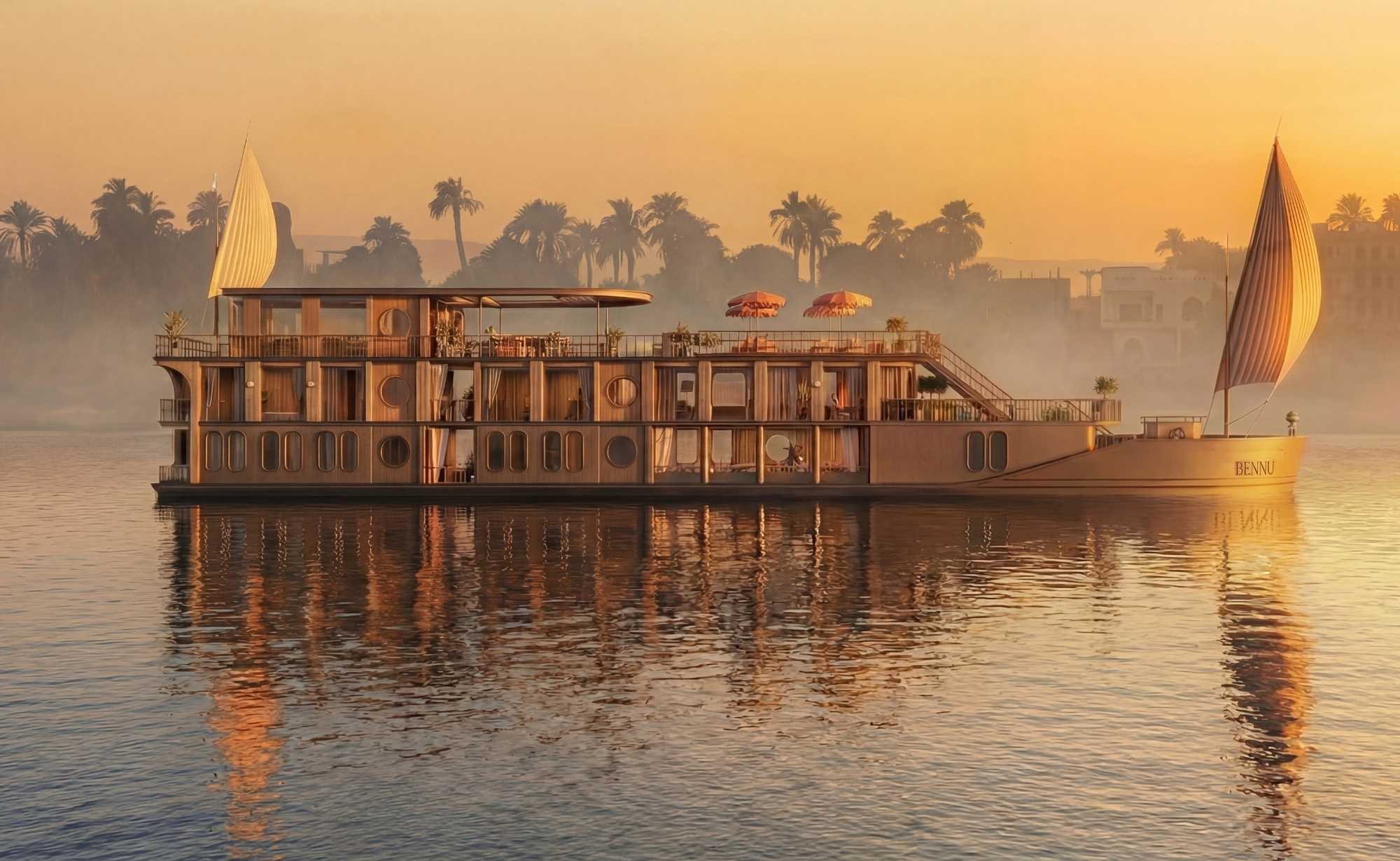 Set to sail in early 2027, BENNU arrives within this lineage as a monument to nostalgia and exploration of revival. Owned and operated by Fady Fala and managed by Palms Hospitality, the new dahabeya draws from the textures, craftsmanship, and quieter rhythms of the life that once defined slow travel along the Nile: hand-finished woodwork, collected artifacts, and interiors shaped by memory. The vessel’s identity extends to its branding, shaped by I'm Branding Experience, whose work anchors the visual language to the same principles of heritage and intentionality that run through every design decision on board. “We wanted the dahabeya to constantly carry an indirect narration, happening from the outside to the inside,” Fares, co-founder of Alchemy Studio and founder MF&Associates, begins telling SceneTraveller and SceneHome.
When Alchemy Studio and MF&Associates first embarked on this project, the team knew they wanted the vessel to tell the land’s tale, guiding guests through a journey that began with the first Egyptian God Atum, followed by resistance of empires and the succession of rival Ottoman rulers, and now, into a more contemporary, globalised dynamic in constant dialogue with heritage and progress. “We want to showcase the multilayered Egyptian culture that’s been touched by the Pharaohs, Greeks, Copts, Italians, French, and Victorian influences that people usually miss,” he starts. “I want guests to feel like they were in an Agatha Christie novel in the way that it’s always so very complete.”
Set to sail in early 2027, BENNU arrives within this lineage as a monument to nostalgia and exploration of revival. Owned and operated by Fady Fala and managed by Palms Hospitality, the new dahabeya draws from the textures, craftsmanship, and quieter rhythms of the life that once defined slow travel along the Nile: hand-finished woodwork, collected artifacts, and interiors shaped by memory. The vessel’s identity extends to its branding, shaped by I'm Branding Experience, whose work anchors the visual language to the same principles of heritage and intentionality that run through every design decision on board. “We wanted the dahabeya to constantly carry an indirect narration, happening from the outside to the inside,” Fares, co-founder of Alchemy Studio and founder MF&Associates, begins telling SceneTraveller and SceneHome.
When Alchemy Studio and MF&Associates first embarked on this project, the team knew they wanted the vessel to tell the land’s tale, guiding guests through a journey that began with the first Egyptian God Atum, followed by resistance of empires and the succession of rival Ottoman rulers, and now, into a more contemporary, globalised dynamic in constant dialogue with heritage and progress. “We want to showcase the multilayered Egyptian culture that’s been touched by the Pharaohs, Greeks, Copts, Italians, French, and Victorian influences that people usually miss,” he starts. “I want guests to feel like they were in an Agatha Christie novel in the way that it’s always so very complete.”
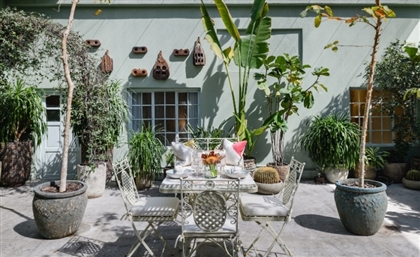
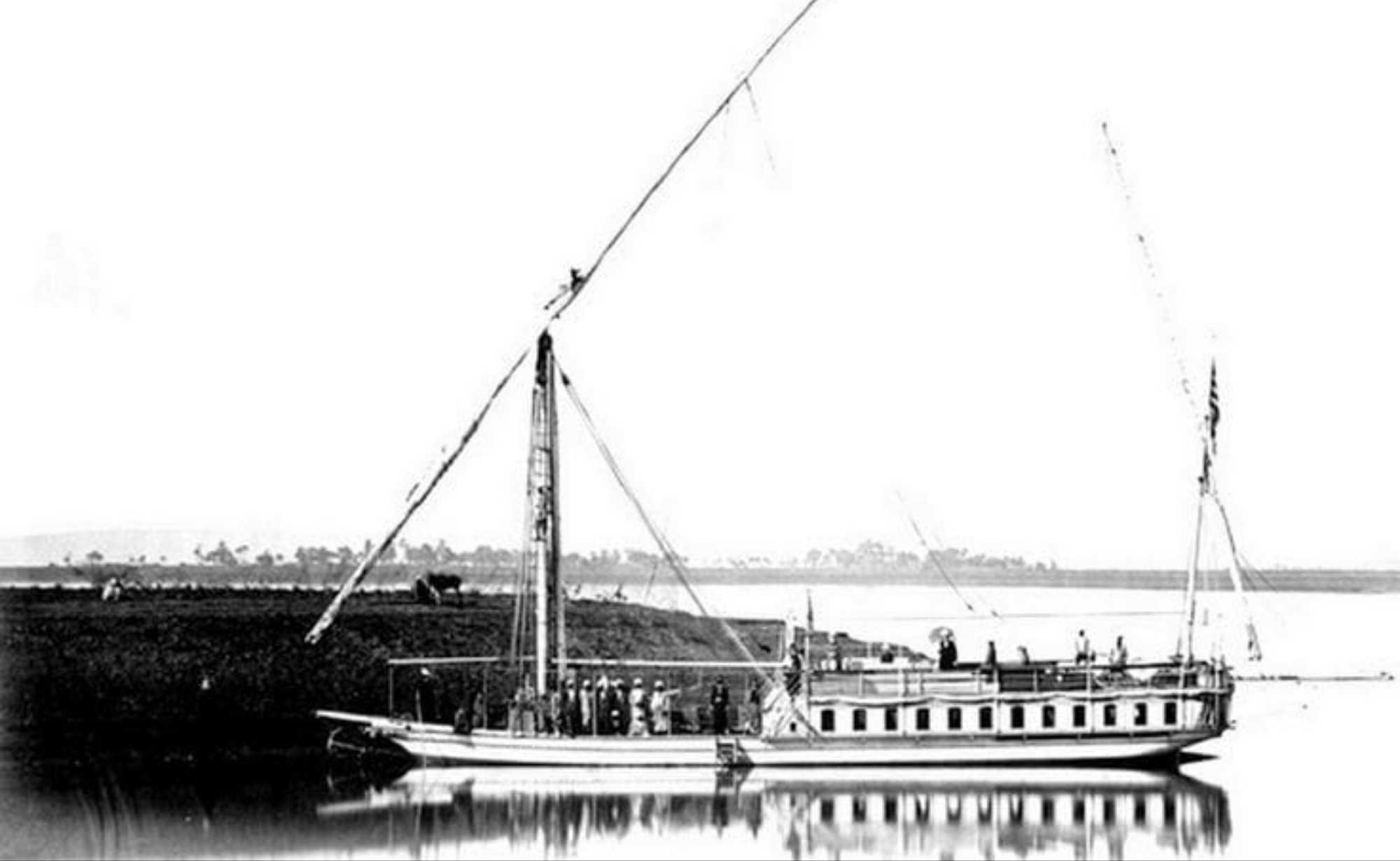
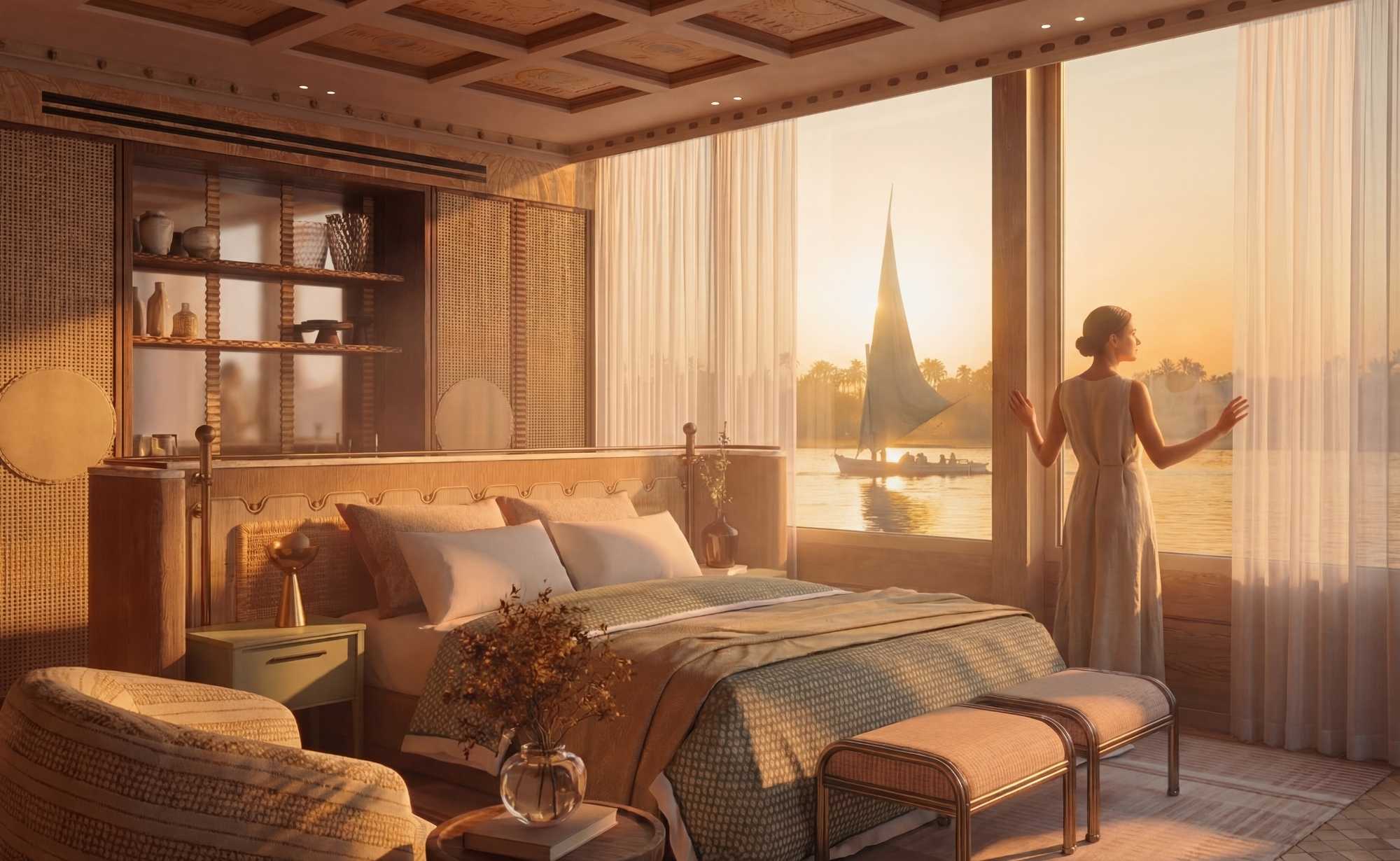 BENNU features four rooms and four suites, each one unfolding a different chapter of the same story. The interiors shift between Pharaonic, Ottoman, and contemporary expressions of luxury—and Fares reminds us that recurring guests can ask for different rooms each time, to relive the same comforts in a different tongue. Some suites open onto private terraces, a quiet homage to the first dahabeyas of the Nile, where the boundaries between room and river were never fully fixed. “We drew much inspiration from the first dahabeyas of the 1850s, beginning with Thomas Cook’s Kingfisher—the boat that quietly set the standard for Nile travel as we’ve come to romanticise it—and from King Farouk’s Dahabeya,invoking a kind of nostalgia with a fresh intake and a modern language.”
The restaurant carries that same commitment, as Fares couldn’t reconcile with the idea of the Nile being a still backdrop, “it was very difficult to execute terraces throughout the restaurant and rooms, but we really couldn’t settle for panoramic views,” he insists. “The view is art work we could only surrender to.” Guests can enjoy full day dining, but the restaurant promises a lot more than gastronomical excellence: different activities and experiences are hosted throughout. “We want everyone to have fun on board—whether you arrive alone, with your family or friends, whether you’re older or in your twenties. We want it to be the perfect sanctuary for everyone,” he continues.
These are details that can only be caught by someone so dedicated to his craft, both within and outside of the professional realm. As an architect, Fares tells me that placing himself on the receiving end—to travel and discover—ignites a fire in him to get better at his trade. “I travel a lot and it’s a constant source of inspiration to create new experiences and understand what it is a guest is truly looking for all year when planning a trip,” he reflects. “It dictates you to do things out of emotion, which is how all art stems in the first place.”
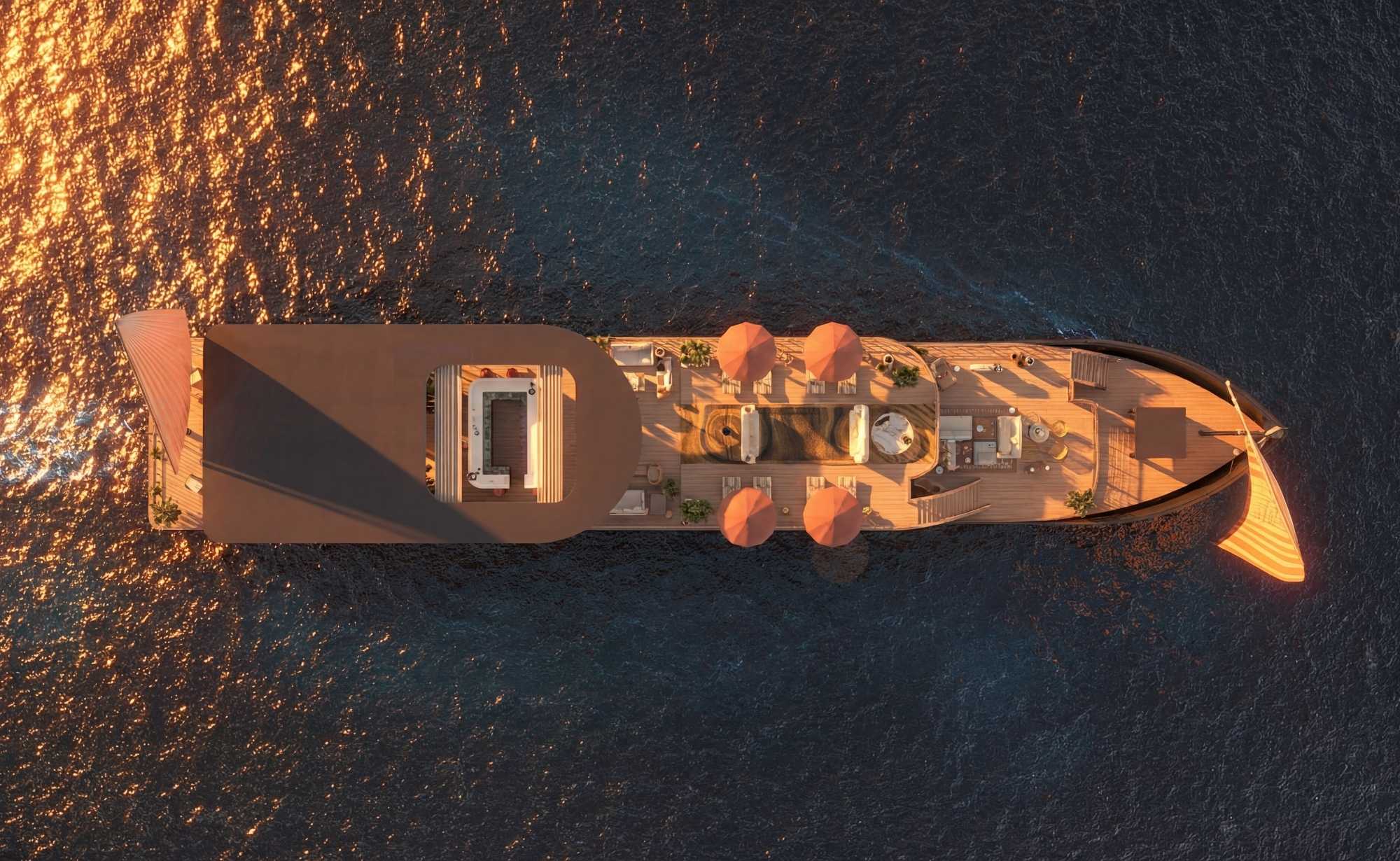
A flight of stairs leads you to the centre of a long revered painting of the Nile flowing north between dark soil and swaying palms. The deck features a partially covered lounge that knows when to offer refuge, alongside a fully equipped bar where something warming or cooling is always within reach, and a plunge pool that earns its place under the Egyptian sky.
BENNU features four rooms and four suites, each one unfolding a different chapter of the same story. The interiors shift between Pharaonic, Ottoman, and contemporary expressions of luxury—and Fares reminds us that recurring guests can ask for different rooms each time, to relive the same comforts in a different tongue. Some suites open onto private terraces, a quiet homage to the first dahabeyas of the Nile, where the boundaries between room and river were never fully fixed. “We drew much inspiration from the first dahabeyas of the 1850s, beginning with Thomas Cook’s Kingfisher—the boat that quietly set the standard for Nile travel as we’ve come to romanticise it—and from King Farouk’s Dahabeya,invoking a kind of nostalgia with a fresh intake and a modern language.”
The restaurant carries that same commitment, as Fares couldn’t reconcile with the idea of the Nile being a still backdrop, “it was very difficult to execute terraces throughout the restaurant and rooms, but we really couldn’t settle for panoramic views,” he insists. “The view is art work we could only surrender to.” Guests can enjoy full day dining, but the restaurant promises a lot more than gastronomical excellence: different activities and experiences are hosted throughout. “We want everyone to have fun on board—whether you arrive alone, with your family or friends, whether you’re older or in your twenties. We want it to be the perfect sanctuary for everyone,” he continues.
These are details that can only be caught by someone so dedicated to his craft, both within and outside of the professional realm. As an architect, Fares tells me that placing himself on the receiving end—to travel and discover—ignites a fire in him to get better at his trade. “I travel a lot and it’s a constant source of inspiration to create new experiences and understand what it is a guest is truly looking for all year when planning a trip,” he reflects. “It dictates you to do things out of emotion, which is how all art stems in the first place.”
A flight of stairs leads you to the centre of a long revered painting of the Nile flowing north between dark soil and swaying palms. The deck features a partially covered lounge that knows when to offer refuge, alongside a fully equipped bar where something warming or cooling is always within reach, and a plunge pool that earns its place under the Egyptian sky.
 The start of your journey with BENNU begins in Luxor, threading its way through the riverside cities rich in temples and tales of Pharaohs and Goddesses of Esna, Edfu, and Kom Ombo until it docks in Aswan. Guests can choose between three-night and five-night sailings—the latter offering the complete journey—or extend their experience to seven nights, returning to their original point of departure. For those reserving the entire vessel with family and friends, a fully personalised itinerary can be tailored for the group.
Beneath all these polished surfaces lies an ecosystem of storytellers and makers whose work has become increasingly rare in contemporary hospitality design, where speed and uniformity often eclipse craftsmanship. Nearly every object and detail onboard was designed specifically for BENNU through close collaborations with carpenters, blacksmiths, textile artisans, potters, and craftspeople whose work preserves the intimacy and subtle irregularities of the human hand. “We curated collectible items that hum like a running symphony throughout the whole boat. We felt a need to revive this sector and industry that has been disappearing in the midst of all the mass production that strips spaces of their memory and human touch,” Fares states.
The start of your journey with BENNU begins in Luxor, threading its way through the riverside cities rich in temples and tales of Pharaohs and Goddesses of Esna, Edfu, and Kom Ombo until it docks in Aswan. Guests can choose between three-night and five-night sailings—the latter offering the complete journey—or extend their experience to seven nights, returning to their original point of departure. For those reserving the entire vessel with family and friends, a fully personalised itinerary can be tailored for the group.
Beneath all these polished surfaces lies an ecosystem of storytellers and makers whose work has become increasingly rare in contemporary hospitality design, where speed and uniformity often eclipse craftsmanship. Nearly every object and detail onboard was designed specifically for BENNU through close collaborations with carpenters, blacksmiths, textile artisans, potters, and craftspeople whose work preserves the intimacy and subtle irregularities of the human hand. “We curated collectible items that hum like a running symphony throughout the whole boat. We felt a need to revive this sector and industry that has been disappearing in the midst of all the mass production that strips spaces of their memory and human touch,” Fares states.
 This custom detailing carries traces of a layered Egypt, offering a condensed narrative of the country’s identity even to those encountering it for the first time. “The main question we were constantly trying to answer is, if a tourist comes on this cruise and doesn’t see anything else, how can we tell them about Egypt’s full history on the boat?” he says. Rather than treating craftsmanship as ornamentation, BENNU positions it as preservation. Artisans are central to the vessel’s creation, reviving trades that once shaped everyday Egyptian life but have gradually receded under industrial repetition and contemporary homogenisation.
For Fares, the process is rooted in a long-standing relationship with Egypt’s landscapes, particularly the Nile, and BENNU sharpened that connection. “I’m always inspired by ancient Egypt. The name Alchemy comes from the ‘black land,’ Egypt,” he explains. “Working on BENNU didn’t change my relationship with the Nile so much as deepening and refining it.” What emerged was a more attentive way of seeing. “I began to see the Nile as a living palette—the textures, greenery, banks, movement of water, and shifting light all became part of my design language,” he adds. It remains an evolving reference point that continues to shape his creative thinking.
If BENNU’s design language is drawn from observation, its emotional intent lies in what lingers after departure. Fares hopes travellers leave with care and continuity, “the memories and moments of being taken care of,” he says, pointing to the experience’s quieter register. There’s also a wider ambition for movement beyond the vessel, encouraging guests to carry the journey into Egypt itself—beyond the river route into the capital and other bustling cities.
The story on board is intended to remain open-ended. “We want to collect mementos of the people who have stayed; we want them to be part of the story,” he suggests a form of hospitality not fixed in time, but cumulative, shaped by each encounter and departure.
Looking ahead to BENNU’s 2027 sailing, its purpose is framed as closer to authorship than product. The intention is a fully Egyptian expression, built and told from within. “It has to be a true Egyptian experience—owners, designers, artisans, the culinary experience, the generous Arab hospitality, and artefacts. We have all this in one complete project,” he beams.
“It’s not just about luxury or design, but about how we tell our own story, in our own voice,” Fares finishes off.
This custom detailing carries traces of a layered Egypt, offering a condensed narrative of the country’s identity even to those encountering it for the first time. “The main question we were constantly trying to answer is, if a tourist comes on this cruise and doesn’t see anything else, how can we tell them about Egypt’s full history on the boat?” he says. Rather than treating craftsmanship as ornamentation, BENNU positions it as preservation. Artisans are central to the vessel’s creation, reviving trades that once shaped everyday Egyptian life but have gradually receded under industrial repetition and contemporary homogenisation.
For Fares, the process is rooted in a long-standing relationship with Egypt’s landscapes, particularly the Nile, and BENNU sharpened that connection. “I’m always inspired by ancient Egypt. The name Alchemy comes from the ‘black land,’ Egypt,” he explains. “Working on BENNU didn’t change my relationship with the Nile so much as deepening and refining it.” What emerged was a more attentive way of seeing. “I began to see the Nile as a living palette—the textures, greenery, banks, movement of water, and shifting light all became part of my design language,” he adds. It remains an evolving reference point that continues to shape his creative thinking.
If BENNU’s design language is drawn from observation, its emotional intent lies in what lingers after departure. Fares hopes travellers leave with care and continuity, “the memories and moments of being taken care of,” he says, pointing to the experience’s quieter register. There’s also a wider ambition for movement beyond the vessel, encouraging guests to carry the journey into Egypt itself—beyond the river route into the capital and other bustling cities.
The story on board is intended to remain open-ended. “We want to collect mementos of the people who have stayed; we want them to be part of the story,” he suggests a form of hospitality not fixed in time, but cumulative, shaped by each encounter and departure.
Looking ahead to BENNU’s 2027 sailing, its purpose is framed as closer to authorship than product. The intention is a fully Egyptian expression, built and told from within. “It has to be a true Egyptian experience—owners, designers, artisans, the culinary experience, the generous Arab hospitality, and artefacts. We have all this in one complete project,” he beams.
“It’s not just about luxury or design, but about how we tell our own story, in our own voice,” Fares finishes off.
- Previous Article SceneNoise x Amsterdam Dance Event Present CROSSFADE: Egypt
- Next Article Egypt's Tourism Income Reached Highest Share of GDP in a Decade