





The Lebanese Family Guesthouse That Refuses to Stop Becoming
What began as a summer home in Chouf slowly became Bouyouti: a guesthouse built through memory, heritage, and a family’s quiet devotion to land, hospitality, and Lebanon.

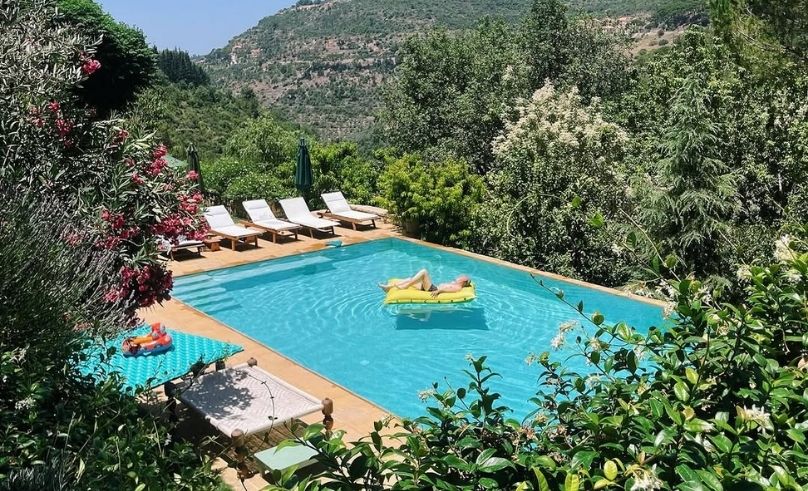
Between Deir el Amar and Maaser Beit ed-Dine in Lebanon, the land folds into itself under darkness. Trees turn into silhouettes, terraces dissolve, and the openness of day collapses into a depth with no visible edges. There are no streetlights, no billboards, no passing cars, and no distant glow to suggest that life continues somewhere beyond the hills. Standing on the terrace of family guesthouse Bouyouti, you could believe you are alone on earth. Rawan Bazerji—the owner, the daughter—remembers standing there one night with her father. “Papa, I love it here,” she told him. “But we’re alone in a valley. It makes me nervous because everything is so dark when you look outside.”
Two weeks later, the valley was lit.
In much of the Arab world, love is rarely verbalised. It is embedded instead in gestures, in walls, in courtyards, in the shaping of land so that the people we love feel safe within it. We build to reassure; our spaces are rarely just inhabited, for we turn them into homes. Lebanon has always carried a particular legacy of this kind of love. And although this valley now glows at night because of it, the country beyond has never felt more fragile, shaped by displacement, mourning, uncertainty. It would be dishonest to ignore that reality. But to speak of Lebanon only through its brokenness is to miss another, quieter narrative unfolding here: that of a family who continued to build, plant, host, and light their land despite it.
-7f36f195-4d6b-494e-902e-266cd6ae88af.jpg) “My grandfather, Gabriel Bazerji, was very attached to this land,” Rawan shares with SceneTraveller. “He used it as a farm, but he also started building a house to bring us all together. For him, it wasn’t about building something new. It was about preserving something old—heritage and connection to the land.”
“My grandfather, Gabriel Bazerji, was very attached to this land,” Rawan shares with SceneTraveller. “He used it as a farm, but he also started building a house to bring us all together. For him, it wasn’t about building something new. It was about preserving something old—heritage and connection to the land.”
-327f8399-366c-49ff-97b8-cebd6454e389.jpg) When her grandfather passed away, he left it to his son, Rafic Bazerji, and in his memory he built a small church on the land and continued laying the stones of the beit in Chouf as an act of remembrance. The vision grew with every stone laid; one beit became six bouyout and what began as a family house slowly, almost accidentally, opened its doors to those who were curious enough to wander across the terrain. “It was never meant to be a guesthouse,” Rawan explains. “It was just supposed to be our summer house. A place where we felt close to our family and to the land.”
When her grandfather passed away, he left it to his son, Rafic Bazerji, and in his memory he built a small church on the land and continued laying the stones of the beit in Chouf as an act of remembrance. The vision grew with every stone laid; one beit became six bouyout and what began as a family house slowly, almost accidentally, opened its doors to those who were curious enough to wander across the terrain. “It was never meant to be a guesthouse,” Rawan explains. “It was just supposed to be our summer house. A place where we felt close to our family and to the land.”
-076b71f6-0a47-43a7-85a8-c8e704534ee0.jpg) A friend suggested they list the property online, but Rawan’s mother, Roula Bazerji, hesitated at the idea of strangers sleeping in what felt like an extension of her own home. Over time, the Arabic philosophy of hospitality quickly outgrew that initial hesitation, and they agreed to try it “just for fun.”
A friend suggested they list the property online, but Rawan’s mother, Roula Bazerji, hesitated at the idea of strangers sleeping in what felt like an extension of her own home. Over time, the Arabic philosophy of hospitality quickly outgrew that initial hesitation, and they agreed to try it “just for fun.”
-9f422d81-c258-4b87-8c40-7d24be900ff6.jpg) The first guests arrived through Google Maps, at a time when few Lebanese even used it. Then came the second, and the third. Those first few guests played a role in shaping Bouyouti—if even in a small way—as Roula started taking notes and began perfecting small details: adding soaps, adjusting linens, rearranging objects in the rooms. “We were playing what we called ‘Better Bouyouti’. Every guest made us improve something,” Rawan laughs.
The first guests arrived through Google Maps, at a time when few Lebanese even used it. Then came the second, and the third. Those first few guests played a role in shaping Bouyouti—if even in a small way—as Roula started taking notes and began perfecting small details: adding soaps, adjusting linens, rearranging objects in the rooms. “We were playing what we called ‘Better Bouyouti’. Every guest made us improve something,” Rawan laughs.-c41c5de5-0c9a-4ccc-bd1a-f69cdd81efa5.jpg) Today, Bouyouti has twenty houses scattered across Chouf, each one placed with a quiet sense of intention depending on how it meets the landscape. The Villa sits closer to the heart of the estate, larger in scale and designed for shared living, with generous interiors that open onto terraces where the valley feels close enough to touch. Higher up, The Hilltop houses are more secluded, positioned to take in wide, uninterrupted views, their orientation shaped by light and elevation so the horizon becomes part of the interior. The Valley houses are more embedded in the terrain itself, grounded in stone and greenery, where you become one with nature. Elsewhere, The Valley View houses—as their name suggests—are set to frame the landscape like a living painting, with openings that draw the eye outward and dissolve the boundary between inside and out, each beit responding differently to its position while remaining part of the same language of place.
Today, Bouyouti has twenty houses scattered across Chouf, each one placed with a quiet sense of intention depending on how it meets the landscape. The Villa sits closer to the heart of the estate, larger in scale and designed for shared living, with generous interiors that open onto terraces where the valley feels close enough to touch. Higher up, The Hilltop houses are more secluded, positioned to take in wide, uninterrupted views, their orientation shaped by light and elevation so the horizon becomes part of the interior. The Valley houses are more embedded in the terrain itself, grounded in stone and greenery, where you become one with nature. Elsewhere, The Valley View houses—as their name suggests—are set to frame the landscape like a living painting, with openings that draw the eye outward and dissolve the boundary between inside and out, each beit responding differently to its position while remaining part of the same language of place.
-eb180958-63e8-4b8b-aa20-c9cfb1062cde.jpg) They all evoke the same feeling of nostalgia, an intentional choice Rafic made as he built them from reclaimed stone shaped in the language of traditional Lebanese architecture. The green roofs are not aesthetic gestures but historical ones. “They used to plant on the roof to keep the house fresh. My father wanted to be in harmony with the area,” Rawan explains.
Much of that atmosphere comes from her parents, the “power couple” that couldn’t stop expanding: Rafic built, and Roula, an artist with a love for antiques and souq discoveries, decorated. They would return from trips with the car piled high with objects—old doors, textiles, ceramics, furniture with stories embedded in their wear—strapped to the roof. They were meticulous about comfort too, insisting on the best mattresses and sheets, a refinement that comes from genuine care rather than design trends.
They all evoke the same feeling of nostalgia, an intentional choice Rafic made as he built them from reclaimed stone shaped in the language of traditional Lebanese architecture. The green roofs are not aesthetic gestures but historical ones. “They used to plant on the roof to keep the house fresh. My father wanted to be in harmony with the area,” Rawan explains.
Much of that atmosphere comes from her parents, the “power couple” that couldn’t stop expanding: Rafic built, and Roula, an artist with a love for antiques and souq discoveries, decorated. They would return from trips with the car piled high with objects—old doors, textiles, ceramics, furniture with stories embedded in their wear—strapped to the roof. They were meticulous about comfort too, insisting on the best mattresses and sheets, a refinement that comes from genuine care rather than design trends.
Even breakfast carries the same intimacy. “The eggs are from our hens. The vegetables are from the garden. It’s how we used to live,” she says. When Roula is present, she still bakes the breakfast cake herself. When she’s not, the team prepares it exactly as she taught them. Many of the staff live on the land with their families, and some have been there for years, their presence woven so deeply into the land that service and belonging start to blur. -f47b262c-786e-4ff9-84b0-e446de48a92f.jpg) Lunch and dinner are shaped through careful collaborations, including Bouyouti by Cat & Mouth, a culinary residency that brings a chef-led approach to the land. The menus shift with the seasons and are rooted in Lebanese produce, while the homemade arak carries memory with it, once made by Rawan’s grandfather in the estate. Meals are served in a way that feels communal and grounded, echoing the same philosophy that runs through the rest of Bouyouti.
Lunch and dinner are shaped through careful collaborations, including Bouyouti by Cat & Mouth, a culinary residency that brings a chef-led approach to the land. The menus shift with the seasons and are rooted in Lebanese produce, while the homemade arak carries memory with it, once made by Rawan’s grandfather in the estate. Meals are served in a way that feels communal and grounded, echoing the same philosophy that runs through the rest of Bouyouti.-7fef4d0b-f900-4287-96af-517fb6f79e28.jpg) Another surprise tucked within is an ancient-ruin-turned-spa, gently reimagined with stone, water, and natural textures that keep it in conversation with the valley. A local legend is woven into its identity: “there’s an ancient tale that this used to be a house built by an Amir for his daughter so she could receive her lovers. You can really feel the history there,” Rawan says with a smile, adding another layer of memory to a place already shaped by inheritance.
Another surprise tucked within is an ancient-ruin-turned-spa, gently reimagined with stone, water, and natural textures that keep it in conversation with the valley. A local legend is woven into its identity: “there’s an ancient tale that this used to be a house built by an Amir for his daughter so she could receive her lovers. You can really feel the history there,” Rawan says with a smile, adding another layer of memory to a place already shaped by inheritance.
-c41567b8-f212-4b9b-9835-4fb35f2c2e29.jpg) What Bouyouti never had, however, was a marketing plan. “We didn’t even have a name at the beginning. There was a kind of hysteria. People kept calling, asking what this place was.” Rawan handled the Instagram page cautiously. “Everyone told me to post more because it’s supposed to be a business. But I felt like it was something precious. I didn’t want it to become a trend and then die.”
What Bouyouti never had, however, was a marketing plan. “We didn’t even have a name at the beginning. There was a kind of hysteria. People kept calling, asking what this place was.” Rawan handled the Instagram page cautiously. “Everyone told me to post more because it’s supposed to be a business. But I felt like it was something precious. I didn’t want it to become a trend and then die.”
-b4e51e3b-abb9-484d-bebd-809e2fa2f1cd.jpg) Even now, she struggles to describe it as a business at all. “To honour what my parents did, it feels more like a passion project and a mission. When people come here, we still think they’re coming to our home. We never think about how to make more money. We think about how to make them as happy as possible.”
Even now, she struggles to describe it as a business at all. “To honour what my parents did, it feels more like a passion project and a mission. When people come here, we still think they’re coming to our home. We never think about how to make more money. We think about how to make them as happy as possible.”
-c30c46cd-a6f1-4d9a-bdfd-d8b92e83561d.jpg) That mission is inseparable from her feelings about Lebanon itself.
“We’re torn, because we love our country and you can never replace your country. You can’t cut your roots,” she says. “Sometimes I feel like my parents created a perfect bubble here, and I’m afraid to open my eyes and see that Lebanon is not this bubble. But I still believe my country can thrive. It’s a miracle of creation.”
For the Bazerji family, Bouyouti is a small example of what Lebanon is capable of being when care, hospitality, and attachment to land guide the way. A place where design is not expressed through architectural statements or curated aesthetics. It is expressed through inherited rooms, remembered objects, and the quiet, persistent act of tending the land so others may feel at home within it.
“When guests leave, I hope they take the peace, the love, the richness of nature, the warmth, and the hug of the Lebanese breakfast with them.”
That mission is inseparable from her feelings about Lebanon itself.
“We’re torn, because we love our country and you can never replace your country. You can’t cut your roots,” she says. “Sometimes I feel like my parents created a perfect bubble here, and I’m afraid to open my eyes and see that Lebanon is not this bubble. But I still believe my country can thrive. It’s a miracle of creation.”
For the Bazerji family, Bouyouti is a small example of what Lebanon is capable of being when care, hospitality, and attachment to land guide the way. A place where design is not expressed through architectural statements or curated aesthetics. It is expressed through inherited rooms, remembered objects, and the quiet, persistent act of tending the land so others may feel at home within it.
“When guests leave, I hope they take the peace, the love, the richness of nature, the warmth, and the hug of the Lebanese breakfast with them.”