




Climate Storytelling at the Fayoum International Film Festival
At Fayoum’s Environmental Film Festival, desert, lake and gardens become the stage for new stories about climate, care and community.
The first thing you learn at the Fayoum International Film Festival for Environmental Films & Contemporary Arts is to slow down – to look outside and use art as a tool to see the environment in another light.
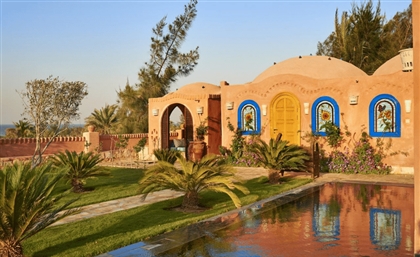
Unlike most festivals in Egypt, where the city is a distant skyline behind a red carpet, Fayoum Festival folds the programme into the land itself: screenings in garden courtyards, panels under palm trees, walks that double as workshops along the lake’s edge. Here the desert traces the water, and the people who live beside them aren’t scenery but co-authors – keepers of stories about what’s already been lost, and what might still be possible.
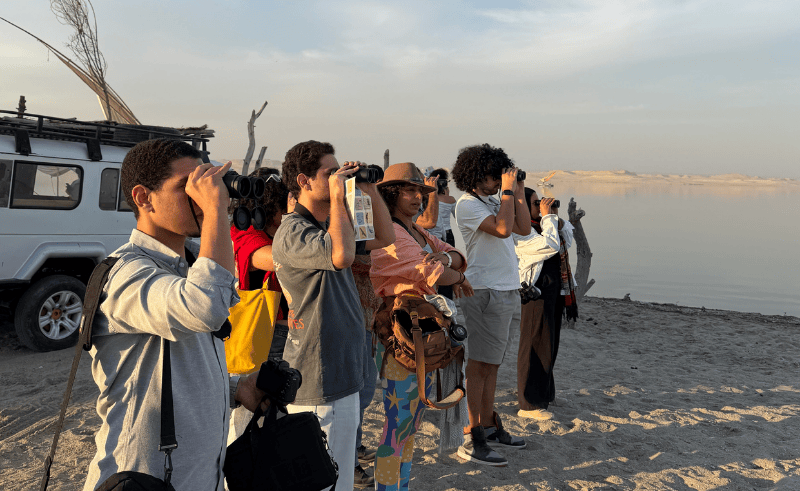
This perspective shift came into sharp focus during a nature walk led by Dayma, an Egyptian eco-experiences organisation. We moved at the pace of whatever crossed our path: a line of ants hauling crumbs across a cracked mud road, bees dancing around sunflowers, the white flash of a bird cutting over Lake Qaroun. We were a small group, told to “just look” – to see what usually goes unnoticed, the seemingly minor details that hold the ecosystem together. With binoculars in hand, a patch of land I would’ve normally just walked past became an entire world of things ending and beginning. When one of the participants nervously asked, “What if there are snakes?”, a local from Fayoum simply replied, “Even if there were, remember you’re entering into their ecosystem.”
That principle of working with existing communities and ecosystems is what the festival is built on. It was founded by Masar Foundation for Culture & Arts, an NGO that has spent over a decade running workshops in Upper Egypt, particularly through the Aswan International Women Film Festival. Their work has been about widening who actually gets to make films, pushing beyond the tight circle of opportunities centered in Cairo. “We’ve seen first hand the impact on ground,” Festival Coordinator Laila Said tells CairoScene. “It’s giving people the voice to tell their own stories.”
Building from their work in Aswan, Masar created a film festival solely centring on the environmental issues and empowering local communities through art. Fayoum as the host location felt inevitable. “First of all it has all the different natural landscapes – the lake, the farmlands, the desert protectorate, as well as a rich artistic history,” Said explains, referencing the Greco-Roman mummy portraits that once made the region famous. But there’s another, harsher reason: “Fayoum is one of Egypt’s highest governorates in irregular youth migration." Organizing a film and contemporary arts festival here can empower young community members to envision a future rooted in Fayoum rather than away from it.
Cinema as a Local Skill, Not an Import
Before any red (or green) carpets, the festival begins inside Fayoum University classrooms, under a parallel platform called Qarun. For a month leading up to the festival, students with no media department are guided through the basics: “From ideation to script writing to production to montage and editing,” Said says. As part of the program, they produced five short films this year, which they later showcased at the film festival. This year, Egyptian director and panelist at the festival, Tamer Mohsen, has even offered to take two of the student films and help develop them further.
The model draws from Masar’s work in Aswan, where the impact has been particularly visible for women. Said recalls the early years when women who wanted to join the workshops had to be accompanied by their husbands. A decade later, wives would travel for screenings and workshops, with their daughters were sitting beside them in class.
Alongside these workshop films, the festival’s main programme spans student, short, and feature competitions, all linked by a broad, holistic understanding of environmental cinema built around three main threads: sustainably produced films, environment-led stories, and climate-focused narratives.
Panels as On-Ground Reports
If the films open up the stories and questions around climate and community, the panels drop us into the work already happening on the ground and the people and organisations leading them.
At one end of the spectrum, the Misr El Kheir panel traces how women in debt are pushed further to the edge when climate shocks hit, while Organic Egypt folds the conversation back into the soil itself, unpacking organic farming and the central role women play in agriculture. From there, Eco Egypt Experiences, joined by actors and festival directors, turns the camera back on the industry: what does it take to make “green cinema” more than a slogan? Together, they sketch a rough manifesto on reducing set waste, rethinking energy consumption and changing habits on shoots.
Nature Conservation Egypt (NCE) widens the frame again, this time to birdwatching and eco-tourism – and the uncomfortable fact that Fayoum is also a node in a global bird-hunting mafia. Migratory birds crossing from Europe are caught, disguised, and traded for “millions of euros,” Said says – even as, on the same day, we stand by the lake watching flamingos wade in the shallows a few metres away.
Stories in Clay and in Bodies
Beyond films and panels, the festival spills into spaces that don’t look like cinema at all. In the local library, workshops run all day for children aged five to ten: tiny hands shaping clay, learning to tell stories with Dr. Dina Kazem.
In another room, the focus shifts from clay to bodies. In her 'I’m Sea and Movement' workshop, facilitator Maha Hafez, who comes from a dance movement therapy background, asks the kids how their bodies feel like an ocean and turns their answers into play.
The next day, Hafez runs a smaller workshop for adults, including me. We stand in a circle and are asked to move like something from the landscape: like reeds, like birds, like waves. It sounds abstract, but it isn’t. Somewhere between embarrassment and laughter, you start to feel what the panels and films have been circling: that climate isn’t an issue “out there” but something you carry with you – how you remain grounded in the land below you and feel yourself as an extension of the surrounding environments.
It’s strangely disarming to leave a festival workshop sweating, with sand on your shoes, and realise you haven’t looked at a screen in hours.
After the Festival
Days after leaving Fayoum, I still catch myself doing what Dayma asked us to do on that first walk: pay attention to seemingly small things. The way a tree leans toward a balcony, the line of dust on a parked car in Cairo’s busy streets. Your eye becomes accustomed to details it once forgot to scan.
The Fayoum International Film Festival for Environmental Films & Contemporary Arts doesn’t pretend art alone can fix collapsing harvests or empty nets. Instead, it offers skills, images, and experiences that let the people most affected – students, farmers’ children, women in debt, kids shaping clay into tiny worlds – see themselves as more than bystanders to the climate crisis.
The festival will change form; the organisers speak about more workshops, stronger partnerships, maybe a year-round course at the university. But even if the programme shifts, the core feels set: walk the land, listen to the people living closest to its fractures, and use film, movement, and storytelling not to escape the climate crisis, but to face it together.
- Previous Article Halfpipes Under Siege: The Skateboarding Scene in Gaza & the West Bank
- Next Article Inside Egypt’s Seven UNESCO World Heritage Sites