





Photo of the Week: Ali Zaraay
“10 years later, I think of this photograph as an archival image. I don’t consider it mine anymore.”

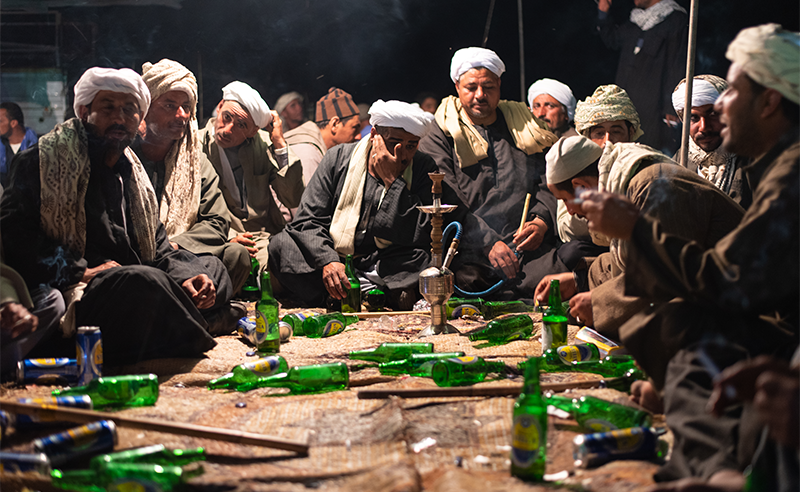
Our Photo of the Week is an image that has escaped its context. An image that moved through screens and sides of the internet, oftentimes without the photographer’s name.
About a dozen men hang out in galabiyyas, pulling exaggerated faces, with a slew of beer cans and bottles scattered in front of them. They look straight into the camera, directly at us today, and at Ali Zaraay ten years ago. The image was captured in August 2016, at a wedding in Belqas, where Zaraay was there as both photographer and friend.
This image was captured in August, 2016. At a wedding in Belqas, Zaraay was there as a photographer and a friend, as part of his long-term project 'Crawling on the Dust'. He saw the men hanging out and thought to himself that they wouldn’t like it if he photographed them. Then, one of the men in the picture actually asked him to take a photo. It is that sentiment that Zaraay remembers today.
Ten years later, Ali says he feels like the photograph isn’t his anymore. In this edition of Photo of the Week, Ali reflects on his bravery then, and the kind of images he wants to create and capture, and beyond those images, what and how he sees.
Zaraay is a Cairo-based documentary photographer and visual artist whose practice spans archives, urban demolition, studio practices and movement. He has worked as a press photographer and has been developing Crawling on the Dust, his long-term project with Egypt’s nomadic Bedouins, since 2015. His work has been recognised by the World Press Photo Joop Swart Masterclass, Foam Talents 2026 and AFAC, and he was selected for our CairoScene 2024 Impact List. He’s also the founder of Safena 7, a collective for critical and multidisciplinary discussions around photography and its practices.
Tell us about the story of this image. When and where was it taken?
I took this picture at a wedding in Belqas, as part of my long-term project Crawling on the Dust, which follows a family from the Nomadic Bedouins in Egypt's Nile Delta, through thinking about their constant movement, spatial memory and their relationship to temporary land.
I initially didn't think the men in the picture would agree if I asked to photograph them, but one of them actually asked me to take it. To me, this is not only an image of a wedding scene, but it is about a long friendship, trust and عشرة.
The picture is now 10 years old. Many things have changed. I did too. Some people in it moved or passed away. I spent my entire 20s moving with them, following them, being a photographer who was also always on the move.
Why did you choose this particular image?
There is something magical about returning to an image a decade later.
I was 22 years old when I took it, and I was much braver. I think bravery is invaluable for young photographers. It's the one thing I advise emerging photographers to hold onto. I’m much more hesitant now that I’m in my early thirties.
10 years later, I think of this photograph as an archival image. I look at it now as an audience member more than a photographer. I don’t consider it my picture anymore. I try to imagine that someone else took it, and I try to enjoy it.
What I try to do in my practice is to care and look beyond the still frame for an image and a narrative. This is what allows us to, even a decade later, imagine a life and a story where the characters are not stuck in a frame.
I try to treat every photograph as if it's a self-portrait and imagine myself in the frame. To me, this is how we can photograph people who aren’t imprisoned in our frames. I want to take photographs that I would like to be portrayed in.
I want to take pictures like this, ones I would like to tell my future daughter about, my mother, or even the taxi driver sometimes.
- Previous Article South Sinai Receives 826 Solar Streetlights Under China Grant
- Next Article Downtown Cairo's 6901 & KimoCono Capture Egypt's 'Masyaf'