






Egyptian Marble is at the Louvre With Marmonil X Pilar Zita Collab
'Mirror Gate II', a sculpture by Pilar Zita and Marmonil, brings Egyptian heritage stones to the Louvre.

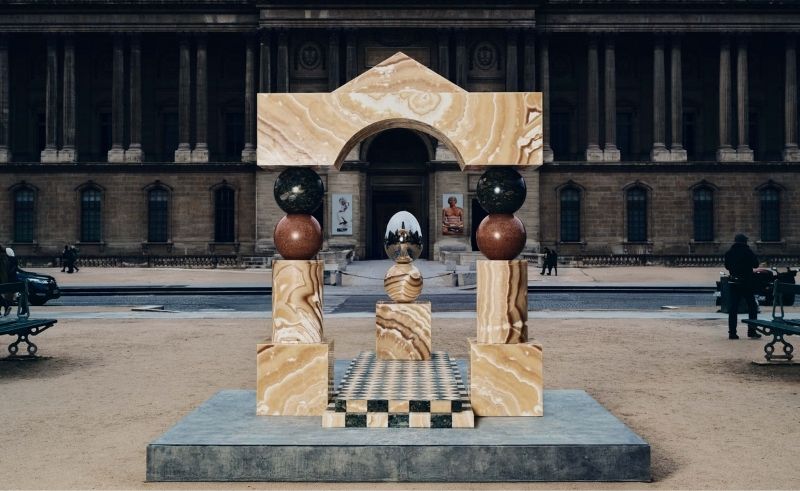
Mirror Gate II, the latest collaboration between multimedia artist Pilar Zita and Egyptian stone house Marmonil, stands at the heart of Paris on the Place du Louvre. After its inauguration on January 20th, 2026, it will remain on display for one month. The monumental sculpture brings Egypt into direct conversation with the city, positioned opposite the museum housing one of the world’s most significant Egyptian collections.
“Placing our stone before the Louvre is for us both an honor and an act of patronage of the arts — a continuation of the timeless dialogue between France and Egypt, reimagined today through Pilar Zeta’s vision and Marmonil,” says Christiane Abdalla, Owner and Board Member of Marmonil.
The project began with a chance meeting in Mexico, when Christiane Abdalla was drawn to a stone work that also caught Pilar Zita’s attention. Their conversation led to the creation of the first Mirror Gate and subsequently to this second iteration, now realised for Paris. Originally installed facing the Pyramids of Giza, the work is framed against one of the oldest built landscapes in human history. Its return to Paris marks a second life within a dense urban and institutional setting, where the gate operates less as spectacle and more as a calibrated threshold between eras, geographies, and modes of seeing.
Carved from Egyptian heritage stones sourced from Marmonil’s quarries, the sculpture draws on yellow Alabaster, imperial red Aswan granite, and Breccia Fawakhir, materials that have shaped Egyptian architecture and sculpture for millennia. At its centre, a linear checkerboard path introduces a sense of order and duality, recalling geometric motifs embedded in Egyptian design. The path leads inward toward a mirrored form that reflects both the viewer and the surrounding space, folding individual perception into the historical setting of the Louvre.
Installed in Paris 190 years after Egypt gifted France the Luxor Obelisk, Mirror Gate II resonates with a long history of cultural exchange. The obelisk, originally from Luxor Temple, still stands at Place de la Concorde while its twin remains in Egypt. The sculpture revisits this gesture through contemporary stone and form, situating Egyptian material presence once again within the urban fabric of Paris.
At the Louvre, the installation establishes a deliberate spatial dialogue with the Egyptian galleries. Positioned directly in front of the collection, it frames views toward ancient artefacts while reflecting the museum’s architecture and its visitors. The work operates as an intermediary layer between the present interior of the Louvre and the deep history contained within its galleries.
Pilar Zita’s work explores geometry, portals, and reflective surfaces, examining how space shapes perception. Mirror Gate II continues this through stone, light, and alignment. Realised by Marmonil, which bridges Italian marble traditions with Egyptian heritage and has supplied stone for the Grand Egyptian Museum and the Pyramids of Giza, the project was realised in partnership with Ora and Cairo Design Week, curated by Stéphane Ruffier Meray, and under the patronage of the Ministry of Culture of Egypt and Paris Centre City Hall.
- Previous Article Nashwa Jewellery’s Winter Drop is a Snowball Made of 925 Silver Magic
- Next Article La Fabrique is a New Space for Artists in Riyadh
Related Articles
Trending This Week
-
 Jan 18, 2026
 -
-
-