





This Couple Went Looking for Fresh Air & Built a Guesthouse in Fayoum
From hand-selected vintage tiles to sun-washed terraces with views of Lake Karoun, Dar Bulbul is a masterclass in slow, thoughtful living.
The "modern Egyptian escape" is a genre typically characterised by a frantic, almost militant pursuit of leisure: a pre-dawn flight to a coastline where one trades the cacophony of Cairo for a curated playlist of deep house, where the only desert experienced is the gap between the sunbed and the infinity pool. It is restorative, in its way, but it is not quiet.
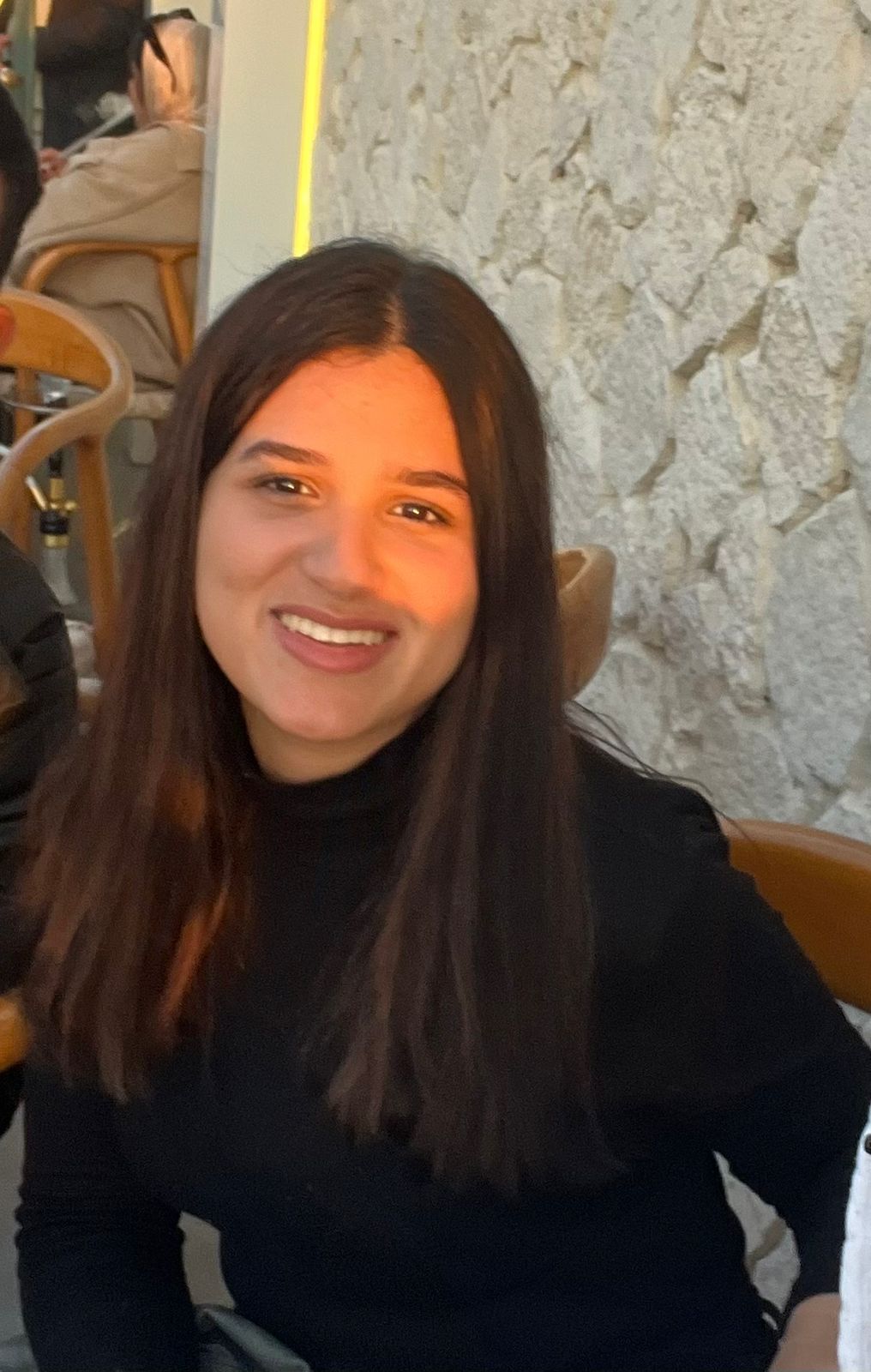
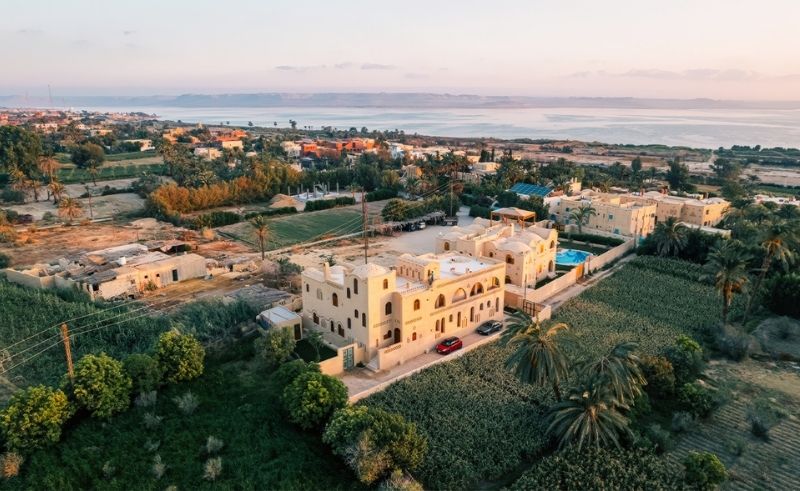
There exists, however, a different syllabus for those seeking a more profound reprieve, one taught by the slow, patient rhythms of the land itself. Its campus is a biscuit-coloured house in Tunis Village, its headmasters are a former swimming coach and teacher, and its core curriculum is the gentle, unassailable art of doing very little at all. This is Dar Bulbul, a six room guesthouse conceived as a pivot—a permanent, beautiful swivel away from the lives its creators, Fady Kaoud and Sarah Rust, once led.
-b75ecfd5-71c4-416b-a27f-35b13a78b979.jpg) Their origin story is now a familiar pandemic fable, though no less remarkable for it. Marooned by lockdown, they fled a Cairo flat for the wide, dusty skies of Fayoum. “We were just looking for fresh air,” Sarah explains, the simplicity of the motive belying the complexity of what followed, “to not be stuck in a flat in Cairo.” They rented a derelict house that had been abandoned for eleven years, planted a garden, and, with the pragmatic grace of those making a lifeboat, opened its doors to others similarly unmoored. What began as a stopgap revealed an unexpected vocation. “We discovered that we really like this kind of life...to create a nice place for people,” says Fady. They liked building a haven. They liked, it turned out, being good at it.
Their origin story is now a familiar pandemic fable, though no less remarkable for it. Marooned by lockdown, they fled a Cairo flat for the wide, dusty skies of Fayoum. “We were just looking for fresh air,” Sarah explains, the simplicity of the motive belying the complexity of what followed, “to not be stuck in a flat in Cairo.” They rented a derelict house that had been abandoned for eleven years, planted a garden, and, with the pragmatic grace of those making a lifeboat, opened its doors to others similarly unmoored. What began as a stopgap revealed an unexpected vocation. “We discovered that we really like this kind of life...to create a nice place for people,” says Fady. They liked building a haven. They liked, it turned out, being good at it.
-23468138-82a3-483c-96fb-be2ed619cc86.jpg) The subsequent commute—a soul-crushing five-hour daily round trip between Fayoum and Cairo for Fady’s coaching work—became the final push they needed to quit their jobs. They bought a plot of land defined chiefly by its two existing palm trees, a promised lake view and a formidable amount of nothing. The following eighteen months were a brutal, beautiful bootcamp in creation. “We didn’t have one day off. I think if we knew how hard it was gonna be, we might not have done it,” Sarah shares with the awe of someone who has survived a natural event. It was a daily siege of decisions, from the foundational to the fantastically minute, a labour that would have broken the spirit of anyone less quietly, ferociously determined. “We made a lot of effort…when choosing the old doors, the tiles. We really were looking for each little thing ourselves.”
The subsequent commute—a soul-crushing five-hour daily round trip between Fayoum and Cairo for Fady’s coaching work—became the final push they needed to quit their jobs. They bought a plot of land defined chiefly by its two existing palm trees, a promised lake view and a formidable amount of nothing. The following eighteen months were a brutal, beautiful bootcamp in creation. “We didn’t have one day off. I think if we knew how hard it was gonna be, we might not have done it,” Sarah shares with the awe of someone who has survived a natural event. It was a daily siege of decisions, from the foundational to the fantastically minute, a labour that would have broken the spirit of anyone less quietly, ferociously determined. “We made a lot of effort…when choosing the old doors, the tiles. We really were looking for each little thing ourselves.”
-b3ae0195-cd50-443d-a947-f35f7d548b26.jpg) The resulting structure is their thesis, beautifully bound. Dar Bulbul is a lesson in vernacular modernism. Its soul is old Fayoum: the vintage wooden doors that sigh on their hinges, the handmade terrazzo tiles cool underfoot. “We have around one thousand tiles in the house,” Fady notes, the thick walls that hold the day’s heat at bay like a secret. “We designed the rooms with a lot of love, choosing natural materials. Old vintage doors and old Egyptian tiles give the place a unique touch.” Its spirit, however, is one of clean-lined, sun-washed clarity. The design is a conversation between past and present. You see it in the way a slice of mid-century modern furniture sits beside a worn rustic table, both united by the grammar of honest materials and the golden-hour light that is the house’s true, most lavish furnishing. “It’s the style of the village. We were very keen on keeping the spirit of the house,” Sarah adds.
The resulting structure is their thesis, beautifully bound. Dar Bulbul is a lesson in vernacular modernism. Its soul is old Fayoum: the vintage wooden doors that sigh on their hinges, the handmade terrazzo tiles cool underfoot. “We have around one thousand tiles in the house,” Fady notes, the thick walls that hold the day’s heat at bay like a secret. “We designed the rooms with a lot of love, choosing natural materials. Old vintage doors and old Egyptian tiles give the place a unique touch.” Its spirit, however, is one of clean-lined, sun-washed clarity. The design is a conversation between past and present. You see it in the way a slice of mid-century modern furniture sits beside a worn rustic table, both united by the grammar of honest materials and the golden-hour light that is the house’s true, most lavish furnishing. “It’s the style of the village. We were very keen on keeping the spirit of the house,” Sarah adds.
-226a4409-222e-4ba1-8752-c859a7efdcbc.jpg) The name itself is a perfect, colloquial poem. ‘Dar’ honours the name of their first house which they decided they wanted to keep. ‘Bulbul’ is the charming, grey-flanked songbird that populates the local reeds. It is a name that grounds the enterprise in its ecology, a nod to the birdwatchers who flock here in winter and to the simple, melodic authenticity the place strives for.
The name itself is a perfect, colloquial poem. ‘Dar’ honours the name of their first house which they decided they wanted to keep. ‘Bulbul’ is the charming, grey-flanked songbird that populates the local reeds. It is a name that grounds the enterprise in its ecology, a nod to the birdwatchers who flock here in winter and to the simple, melodic authenticity the place strives for.
-6a94cfb0-4d48-40f5-a59d-912115656aba.jpg) A stay here is a practical tutorial in decompression. The offering is deliberately, brilliantly simple. There is the garden, a green, murmurous room. There is the rooftop, with its vast, moving masterpiece of a Lake Karoun view. There is the breakfast—a sprawling, generous Egyptian feast of ful, ta’ameya, feteer and herby cheeses. It’s as we like to say in colloquial Egyptian, “فطار ملوكي” which roughly translates to a royal breakfast. The much-celebrated mattresses are, indeed, worthy of their fame, promising a sleep so deep you might forget your own name. The magic is in the orchestration of these elements, in the way the house guides you from social sun-drenched terrace to private, shadowy nook, allowing for both connection and the sacred, solitary stare into the middle distance. “It feels more familiar than a regular stay. We’re usually here ourselves and meet our guests in person.”
A stay here is a practical tutorial in decompression. The offering is deliberately, brilliantly simple. There is the garden, a green, murmurous room. There is the rooftop, with its vast, moving masterpiece of a Lake Karoun view. There is the breakfast—a sprawling, generous Egyptian feast of ful, ta’ameya, feteer and herby cheeses. It’s as we like to say in colloquial Egyptian, “فطار ملوكي” which roughly translates to a royal breakfast. The much-celebrated mattresses are, indeed, worthy of their fame, promising a sleep so deep you might forget your own name. The magic is in the orchestration of these elements, in the way the house guides you from social sun-drenched terrace to private, shadowy nook, allowing for both connection and the sacred, solitary stare into the middle distance. “It feels more familiar than a regular stay. We’re usually here ourselves and meet our guests in person.”
-82a4db9b-e309-4bca-b8e1-8d6d7d0bc6c5.jpg) The clientele, a mix of European expats and Cairene creatives, are unified by a desire to unplug. “They come for the quiet,” Sarah observes. For the energetically restless, they offer field trips: the staggering, paleontological silence of the Valley of the Whales, or a sunset voyage across Lake Karoun. And presiding over it all is Mika, the resident dog and self-appointed (or at least Instagram-anointed) Security Manager, a fluffy, benevolent deity who specialises in soulful looks and strategic sunbathing.
The clientele, a mix of European expats and Cairene creatives, are unified by a desire to unplug. “They come for the quiet,” Sarah observes. For the energetically restless, they offer field trips: the staggering, paleontological silence of the Valley of the Whales, or a sunset voyage across Lake Karoun. And presiding over it all is Mika, the resident dog and self-appointed (or at least Instagram-anointed) Security Manager, a fluffy, benevolent deity who specialises in soulful looks and strategic sunbathing.
To frame Dar El Bulbul merely as a success story feels crass. It is, more accurately, a considered, hard-won response. A response to the noise, to the grind, to the question of what a life could look like if you chose to build its container yourself, by hand, with painstaking care. It offers no wild parties, no themed nights, no forced fun. Its luxury is the luxury of time, measured in the slow arc of a shadow across a wall, in the number of pages read in a single sitting, in the profound relief of a silence that isn’t empty, but full—of birdsong, of breeze, of the quiet, humming certainty that you have, for a moment, escaped the wrong syllabus and finally found the right one.