





Review: The Tyranny of the Unseen in Lebanese Short ‘Saint Rose’
In less than fifteen minutes of runtime, film form and social order collapse into one another.

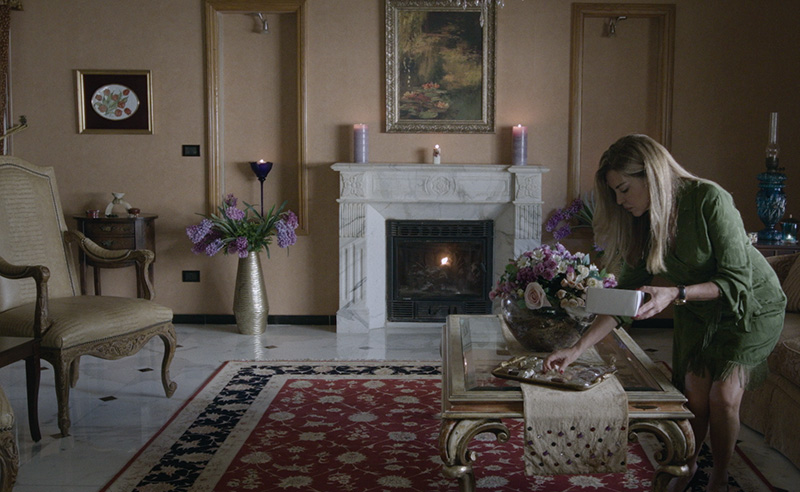
“Saint Rose”, a Lebanese short film written and directed by Zayn Alexandre, opens with Zahra in the salon, lighting candles, straightening the couch, and arranging chocolates neatly on a tray. When one piece slips out of alignment, she returns to correct it, insisting on perfect symmetry. In the background, the sound of Muslim prayer drifts through the space. The scene unfolds less like domestic preparation and more like a rite. The house feels less like a place of comfort and more like a sacred enclosure. Zahra’s gestures resemble the preparatory rituals of a sheikh or a priest before a congregation arrives. The film quietly reframes the everyday as devotional. However, this ritual is not oriented toward the divine, but toward the imminent arrival of the household’s true authority, the husband.
The film then cuts to the maid’s room of an African immigrant. She occupies a visibly different space. On the walls, photographs of her child quietly testify to an absence. It's a subtle detail in the background that perfectly encapsulates the clear emotional distance produced by labor and displacement. Her presence in the household depends on a sacrifice. She sacrifices time with her own family in order to care for another’s. We watch her perform her own morning ritual. She empties a bottle of water and refills it with vodka. If Zahra’s actions sanctify the domestic space, the maid’s ritual suggests a coping mechanism. It's a private act of endurance shaped by exhaustion, isolation, and necessity. Taken together, these parallel sequences evoke what might emerge at the intersection of Ousmane Sembène’s “Black Girl” and Chantal Akerman’s “Jeanne Dielman, 23, quai du Commerce, 1080 Bruxelles”. We witness repetition as both structure and rupture. it becomes clear that here, domestic space is a site of invisible violence.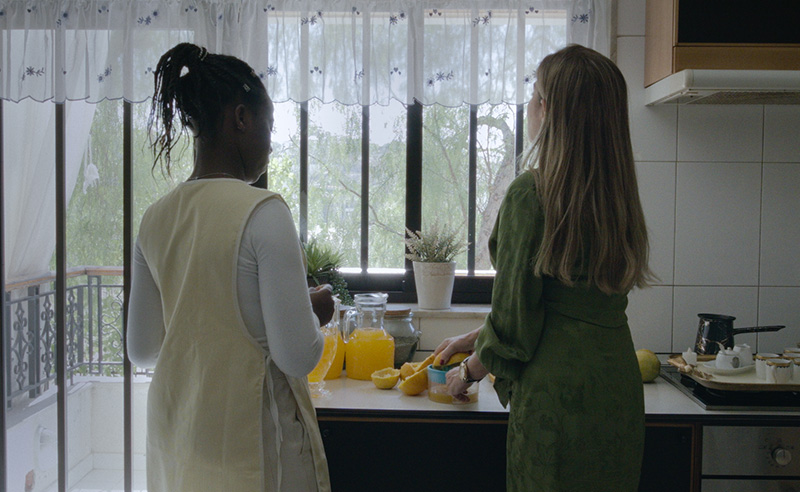 One of the film’s greatest strengths lies in a very deliberate directorial choice. He chooses to keep the husband off-screen. We only hear his voice, erupting over the most trivial domestic details. I’ve always believed since its inception, cinema has been an art form shaped by limitation. In the silent era, filmmakers worked within the absence of sound and colour. Filmmakers like Georges Méliès turned the camera’s technical limitations into a creative playground. Italian Neorealism emerged from the physical and economic devastation of post-war Italy, turning ruined infrastructure and non-professional actors into an aesthetic and ethical stance. Third Cinema developed under political and material restrictions, while Dogma 95 went further by imposing its own strict rules. Across the world, filmmakers have consistently had to negotiate censorship and in doing so, have often produced their most inventive work.
I guess the point I’m trying to make is creativity tends to intensify when it is forced to operate within constraints. What makes this film especially satisfying is that the limitation is not imposed from the outside but chosen. By deliberately withholding the husband’s image, the filmmaker transforms absence into presence. Out of this self-imposed restriction, something unexpectedly powerful and beautiful emerges. It ultimately exposes the deeply gendered logic of power at work within the film. The filmmaker denies him the visual centrality traditionally afforded to male authority in cinema. Stripped of embodiment, the husband functions less as an individual subject than as an abstract system. This system is a disembodied patriarchy that polices, corrects, and disciplines through sound alone.
In contrast, the wife’s presence fills the frame. We witness her labour, her movements, her silences, and her repeated retreats into her private refuge, the bathroom. The film’s emotional and ethical centre of gravity settles firmly around her quiet endurance. By refusing to monumentalise him visually, the film redirects attention toward a shared feminine space. One that is articulated through moments of unspoken solidarity between the wife and the maid. This asymmetry between voice and image is not incidental; it is transformed into a deliberate feminist gesture.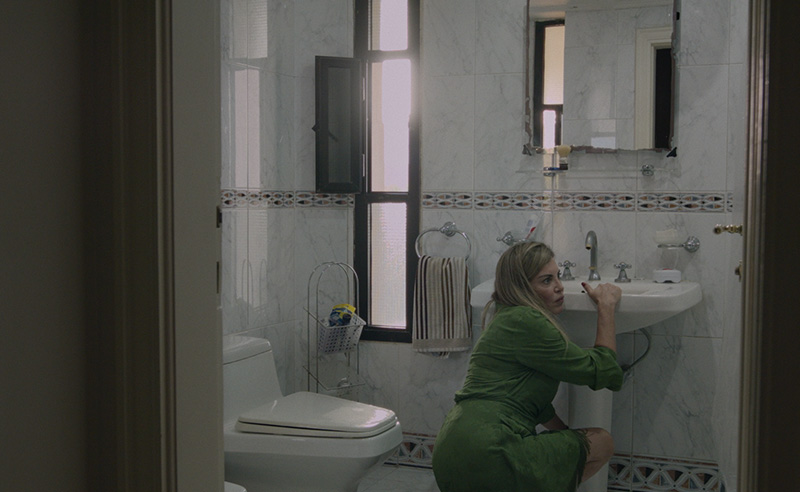 The film relies heavily on repetition. The monotony of household chores, the routine of smoking cigarettes in the bathroom, and her repeated practice of Turkish phrases like “Hello, I am Rose”, which she recites while gazing at a photograph of a coastal town in Turkey. The image evokes a prisoner dreaming of another world from within the confines of a cell. The irony here is striking. As she repeats the words “I am Rose,” she is anything but herself. In fact, her identity is shaped by a patriarchal social structure that denies her autonomy and reduces her to a role rather than a self.
“Saint Rose” is carried by the nuanced performances of Ghada Basma and Sharon Chepkwemoi Watoka, and by its quietly evocative cinematography. Alexandre imposes limits on space, sight, and sound. These formal constraints reflect the social ones. The confinement of the frame mirrors the confinement of the women’s lives. In less than fifteen minutes of runtime, film form and social order collapse into one another. The film’s final moments turn an inevitable psychological breakdown into absurdity. This sudden shift in tone encapsulates the psychic toll that psychological control can exert on an individual.
It is refreshing to see a filmmaker from the region approach such powerful ideas with such restraint and confidence. Alexandre’s reliance on nuance rather than excess is deeply impressive. It leaves a strong sense of anticipation for what he will do next. After all, his cinematic sensibility feels urgently needed in a landscape where subtlety is too often eclipsed by the overly explicit.
“Saint Rose” premiered in competition at the Red Sea International Film Festival. Then it continued its international festival run, including a special screening at Clermont-Ferrand ISFF as part of the Lebanese Shorts 2025 program. The film is currently streaming worldwide on Shasha Movies.
- Previous Article The Turning Point: 15 RiseUp '26 Speakers Defining the Global Economy
- Next Article The Middle Eastern Pulse of Leighton House
Related Articles
Trending This Week
-
 Jan 31, 2026
 -
-
-
 Jan 29, 2026