





This Egyptian Designer Turns Cultural Moments Into ‘Naughty’ Posters
Rooted in collective memory, the visual designer likes to have fun with his craft—and it certainly shows.

What happens when an artist trapped in the corporate world for 12 years—with all its client briefs and endless amends—finally breaks free? For Omar Ayman, the proof is in the posters: a kind of playful, mischievous visual language that combines both popular appeal and technical prowess.
“Since I was young, every community I was in was an artistic one,” Omar Ayman told me over the phone, “so I don’t consider myself an illustrator so much as I am an artist who combines several types of unconnected art forms, from playing music to performing theatre, into one vision.” As I tried to understand what exactly that vision was, one word kept re-appearing in our conversation, like an obnoxious child that refused to go away: ‘naughty’.
The reason Ayman’s work is naughty—or posterat sha’eya, as he puts it—is twofold. First, there is his choice of subject matter, and then, his execution. Whenever Ayman decides to start working on a new poster, he approaches it through a storytelling lens: he always starts with a character, which then triggers a process of research that constructs the rest of the work around it.
“A poster is like a surreal play where every element performs a specific role to convey a specific feeling,” Ayman says. To him, the process is “like making a scenario for a film.”-240f138a-87fd-4ab2-a1ca-781b57ce710b.png) Sourced from everyday Egyptian moments, Ayman’s characters are born from overheard proverbs, conversations with friends at street cafés, or rides on public transportation. Naturally, it’s when the characters or the story have to do with childhood that Ayman’s posters are at their naughtiest.
Sourced from everyday Egyptian moments, Ayman’s characters are born from overheard proverbs, conversations with friends at street cafés, or rides on public transportation. Naturally, it’s when the characters or the story have to do with childhood that Ayman’s posters are at their naughtiest.
For instance, in ‘Lilet El Omr’ (The Night of a Lifetime), Ayman turns the Egyptian wedding night into something like a to-do list, with a beauty salon occupying the bottom and a kosha—the throne where bride and groom sit during the wedding reception—stacked at the very top. Where’s the child, you ask? On the street, peeking through the glass of the beauty salon at the bride inside.
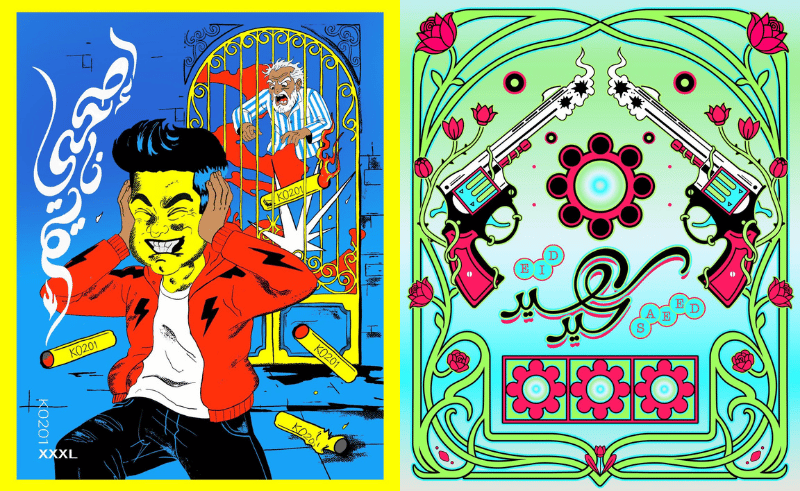
In his ‘Ramadan & Eid Nostalgia’ poster series, Ayman draws upon his own nostalgic memories of the month to depict childhood mischief at its naughtiest, from lighting fireworks in the streets to shooting toy guns in each other’s ears. In ‘Eid on Max’, he draws upon a more recent cultural phenomenon of young men planking on motorcycles as they speed down the highway, a sight now common enough that popular culture has begun terming its young performers ‘arayes el ganna', or grooms of heaven.
“I made this poster before that term even existed,” says Ayman. “It’s something I used to see every Eid since I was young, and for me it was an iconic part of Egypt.”-b68d948e-ebfa-4b69-8565-110442bf067d.png) Beyond the subject matter, the way Ayman ties together his concepts also reflects a seemingly provocative, subversive attitude, as well as a disdain for the segmented corporate world where he was a graphic designer for over a decade. In all of his works, Ayman is behind everything from the lettering art to the animation and music (in the case of digital posters) and the illustrations. Then there’s his signature colour gradient, which makes each poster feel liquid and molten.
Beyond the subject matter, the way Ayman ties together his concepts also reflects a seemingly provocative, subversive attitude, as well as a disdain for the segmented corporate world where he was a graphic designer for over a decade. In all of his works, Ayman is behind everything from the lettering art to the animation and music (in the case of digital posters) and the illustrations. Then there’s his signature colour gradient, which makes each poster feel liquid and molten.
“All of this is part of the fun for me,” explains Ayman. “It’s not about the output but the process itself, a process which can satisfy the different creative urges I have inside me.” While that process takes weeks from conception to realisation for a single poster, Ayman enjoys every part of it—and it shows. For both the mainstream public and professionals with a technical eye for detail, there is enough in Ayman’s work to appeal to both.
And it’s always Ayman’s intention to appeal to a mainstream audience, no matter how technical his work. “Throughout the Arab world, poster design has historically engaged in societal issues and political movements,” Ayman says. As opposed to one-of-a-kind artworks that are almost always beyond the public reach, Ayman believes, as he puts it, “There’s a social dimension to posters that can raise awareness and convey messages in society. A poster leaves its mark on people only if there’s an emotive element to it, not just because it’s visually appealing.”
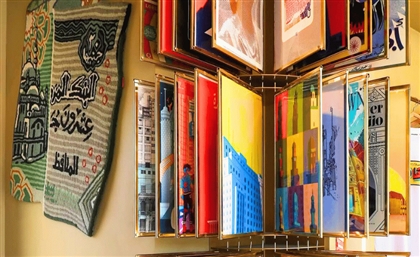
Only a small selection of the posters found on his Instagram page are physically available in stores like Cairopolitan in Downtown Cairo and Gizapolitan by the Pyramids (as well as through their online shops). The bottleneck, Ayman explains, is printing quality.-d831c83f-3bf1-42b5-ae64-69608791e46d.png) “The printing is very critical, and Cairopolitan know how to get the colours just right,” he says. “Not everyone can do this.”
“The printing is very critical, and Cairopolitan know how to get the colours just right,” he says. “Not everyone can do this.”
Nevertheless, Ayman continues showcasing his posters online, where, free from the business decisions that once shaped his art in the corporate world, his work gets naughtier and naughtier.
Related Articles
Trending This Week
-
 Oct 06, 2026
 -
-
-