



Ekhlas Al-Azzah Teaches Arabic From Her Wheelchair in Palestine
Volunteers travel from across the globe to care for Ekhlas Al-Azzah in one of the smallest Palestinian refugee camps in the world. In exchange, she teaches them Arabic and about life in the West Bank.
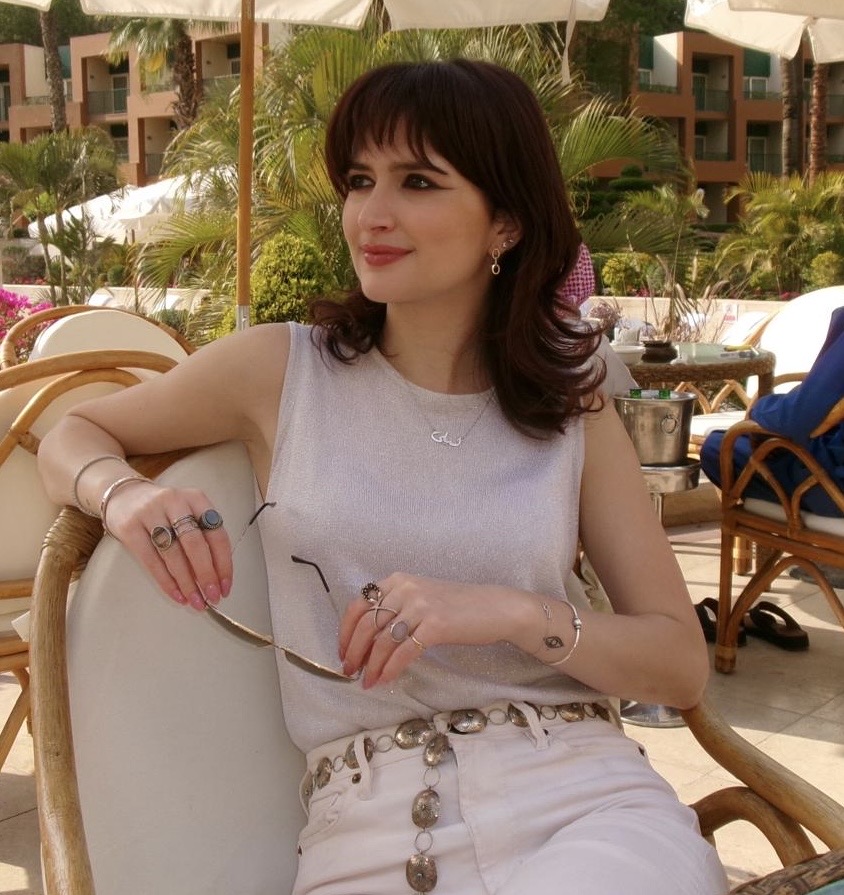
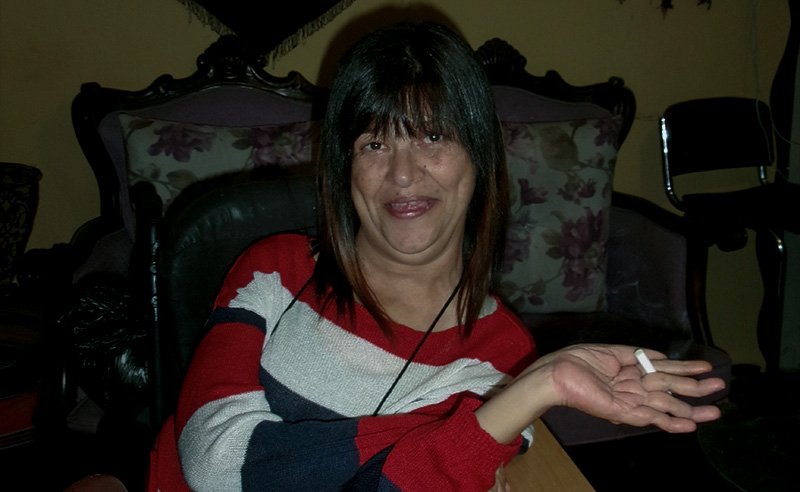
Over 700 women from around the world have learned Arabic from one paralysed teacher living in the smallest Palestinian refugee camp in the world. Her name is Ekhlas Al-Azzah.
Ekhlas was born with muscular atrophy and has spent her entire life in a wheelchair. She lives in Bethlehem’s Al-Azzah camp, named after her family, a refugee camp comprising a singular 250-meter-long street. For over 30 years, Ekhlas has hosted volunteers from all over the world to provide her with the 24-hour care she needs. They help her with daily tasks like getting dressed, showering, and eating. In exchange, she teaches them Arabic, how to cook Palestinian food and, most importantly, what it means to be a disabled woman living in a refugee camp.
I was lucky enough to be one of her students.
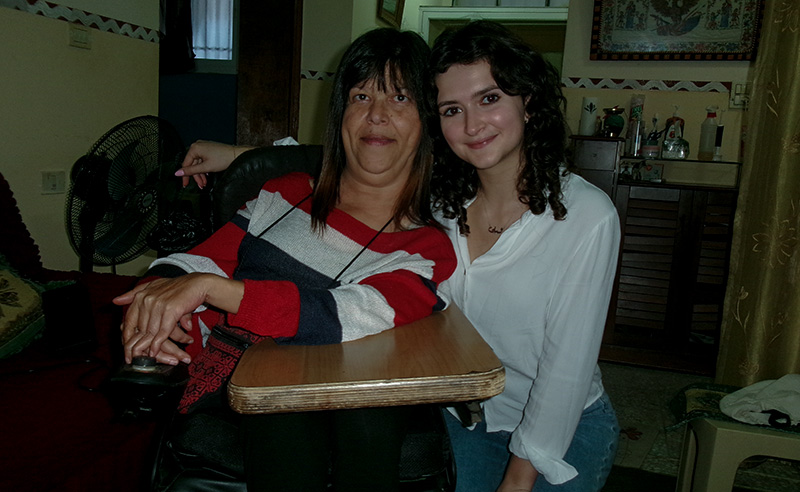 “I feel like an ambassador to my country," Ekhlas told me. "I get to share with volunteers what it means to live in a wheelchair. I get to answer all of their questions about Palestine, religion, politics, and everything I’ve experienced. It’s exciting, it keeps me busy, and that’s exactly what I want. To be active, not just sit and do nothing.”
Ekhlas began her career as an Arabic teacher for the abundance of foreigners in Bethlehem, both online and in person, specifically to teach them the Palestinian dialect. Although she is a teacher, Ekhlas never attended school. Her father tried tirelessly to enrol her, but no school would accommodate her disability. She grew up in a world without accessibility.
Ekhlas’ education was facilitated by a wealth of books from her father and the help of students from the nearby Bethlehem University.
“It doesn't matter what you read, just read. It doesn't matter what you write, just write,” she quoted her father’s instructions.
Today, Ekhlas is trilingual, in Arabic, English, and German. She has no shortage of stories from her travels abroad in the latter country, and across Europe, where she visits friends and holds events to educate people about her life in Palestine. Recently, in the spring of 2025, Ekhlas took a brief trip to Germany, Italy, and Spain.
I met Ekhlas in September 2023 at her home for my first Arabic lesson, which I knew belonged to her because of the tree painted next to her door—its leaves the green handprints of former volunteers. Her house was spacious, with multiple bedrooms and an open living room. But, she said, the camp is one of the most densely populated in the West Bank. So, everyone can hear everything—every conversation in every alley in every home.
Still, Ekhlas finds enough quiet to teach, cook and paint, holding the brush between her teeth since she cannot use her hands. She is also the author of her very own self-illustrated cookbook with vegetarian Palestinian recipes. She especially loves to draw pictures of these dishes and nature.
And, she does it all with style. While she saves makeup for special occasions, she refuses to have a bad hair day.
“I just blow dry my hair after a shower,” Ekhlas flaunted, blowing her bangs out of her eyes. “It doesn’t need a lot of work.” She concocts a special rosemary potion to maintain the shine of her dark, honey-blonde highlighted hair.
“My hair, my dress, whatever I wear is important to me,” she said. “My blouse and trousers have to sit perfectly.” Ekhlas made it clear that her socks always have to match with her shirt—so she has socks of every colour.
To get dressed, shower, and live the independent life that she does, Ekhlas relies on the full-time care of the foreign volunteers who stay with her for anywhere from a week to a year. Her first volunteer arrived in 1992, a German woman upon whom Ekhlas bestowed the name “Polly Al-Azzah”. She began the search for volunteers as her mother got older and it became difficult for her to act as Ekhlas’ main caretaker—her father passed away when she was only 10 years old. Ekhlas did not live completely alone until her mother died of cancer in 2011.
Until 2006, all of her volunteers were from Germany. The one to break the streak was a Spanish woman, followed by a list of countries that span the globe, from Canada to Thailand to Brazil to Poland to the majority of Europe.
Pre-internet, calls for volunteers spread via word of mouth, universities, and churches. Now, Ekhlas posts on social media sites like Facebook and Instagram.
“Young people like to travel and experience the world,” she explained. In exchange for their work, Ekhlas compensates volunteers with lodging, food, and the one-of-a-kind experience of living in a Palestinian refugee camp in the West Bank. All they need to do is buy a round-trip ticket.
Ekhlas depends on foreigners for her income as an Arabic teacher and daily care, and with fewer expats and tourists in the West Bank in the past two years, Ekhlas has depended on help from family, friends, and local, but expensive, caretakers. However, despite regional instability, many volunteers have still travelled from abroad to care for and learn from Ekhlas.
Ekhlas is currently looking for female volunteers from February 15th through April 1st. If you are interested, you can message her on Instagram.