




The Illuminated Worlds of Saudi Artist Maryam Tariq
The Jeddah-based artist turns sacred geometry, cymatics and neon light into immersive worlds on gallery walls and DJ sets.
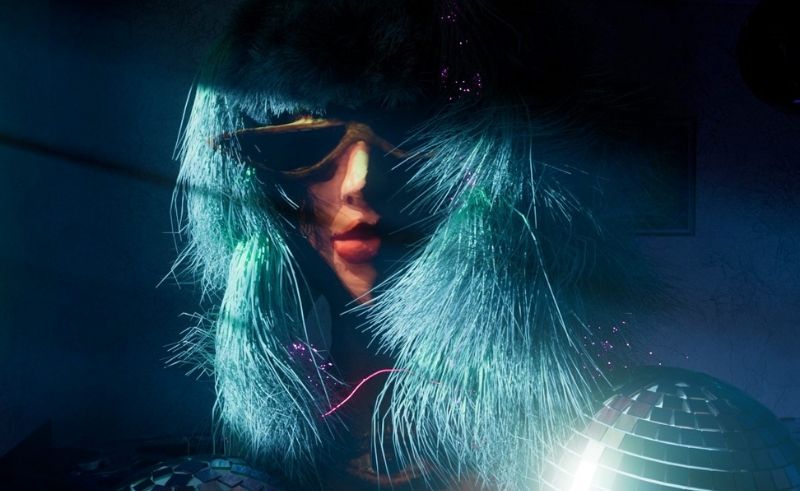
There is a memory that Saudi artist Maryam Tariq returns to often. She is a child, sitting with her father - an engineer and an artist - in front of a metal plate dusted with salt. A frequency generator hums as the salt begins to move, arranging itself into intricate, shifting patterns with each new tone. “My mind was completely blown,” she recalls. At the time, she had no way of knowing that this single moment would quietly thread itself through everything she would one day make.
Tariq, now based in Jeddah, is a light and projection artist whose vivid, technically demanding installations explore memory, consciousness, and the mathematics woven into the natural world. That salt experiment, she says, “planted an early curiosity about frequency, patterns, sound, and the invisible forces that shape what we see.”
Tariq has spent the better part of a decade building an immersive body of work based around this idea: she projects light onto buildings, fills gallery spaces with digital installations, and constructs visual universes in real time behind DJs and musicians. In 2018, she co-founded ‘The Golden Ratio’ alongside Waleed Hassan: a 3D mapping art agency that has exhibited across the Gulf and in Europe. In 2021, she held her debut solo show, ‘Remember the Future,’ at Hafez Gallery in Jeddah, and in the years since, has collaborated with DJ sets across the region. Few artists working in the Gulf today occupy quite the same space as Tariq: somewhere between the gallery wall, a concert, and the night sky.
Born in 1996 and raised on the coast of Yanbu Industrial City, Tariq grew up far removed from the pace of Saudi Arabia's bigger cities. As a teenager, she found it to be boring, yearning for the days to escape to a big life in a big city. But years later, after building her life in Jeddah, Yanbu became her refuge, a place she returned to by choice rather than circumstance.
“I've started seeking that boredom again,” she says, “sitting with uncomfortable feelings and learning to feel comfortable being uncomfortable. That mindset unlocked many things for me.” In a world of relentless stimulation and scrolling, Tariq actively courts stillness. It is where her ideas begin.
Her father was an important presence in shaping that inner life. An engineer with an artistic sensibility, he encouraged his daughter's wild imagination from an early age and shared with her a love of both making things and understanding how they worked. The salt experiment - formally, a Chladni plate demonstration of cymatics - was typical of how they spent time together: finding the poetry inside science. It is an approach seen in every display, event, and show Tariq puts on today.
Yet despite this, the path to a career in the arts was not straightforward. After attempting a degree in business and contemplating architecture, Tariq found that neither spoke to her true passions. “I realised I was trying to fit myself into something more practical while putting aside the creative side of me that always wanted to explore,” she says. Moreover, art, to Tariq, always meant more than drawing, she says: art was something interactive, to be felt, seen, heard; all-surrounding.
When she discovered the Visual and Digital Production program while studying at Effat University in Jeddah, something clicked. “For the first time, I felt like I had found a space where I could fully explore my creativity instead of treating it like a hobby I had to leave behind.” She was already experimenting with her camera, editing visuals, playing with effects at this stage, and here was a discipline that understood art and technology as collaborators rather than opponents. “That was the moment I understood that the two could exist together, and that this was the direction I truly wanted to pursue.”
It was also at university that another obsession took hold: sacred geometry and the Golden Ratio. The mathematical proportion appears with uncanny frequency throughout nature, architecture, and the human body. “I became fascinated by the concept and by the idea that nature seems to speak to us through mathematical equations and patterns. To me, it felt spiritual — almost like a wink from the universe,” Tariq says. Now, the name of both her Instagram handle, @thegolden_ratio1.6_, and her company has become part of her identity - and like the enigmatic appearance of the ratio in the natural world, it reveals itself in much of Tariq’s artwork by its own accord.
“Sometimes these ideas naturally appear in my work, sometimes they don’t. But the philosophy behind their patterns, balance, rhythm, and the hidden structures of nature, is always influencing the way I think and create.”
To stand in front of one of Maryam Tariq's installations is to be pulled in two directions at once. The palette is vivid and loud - electric blues, deep purples, sharp yellows - and the surfaces they illuminate pulse with an energy that feels almost physical. At the same time, the ideas underneath her work are quiet and interior: memory, perception, consciousness, the spiritual life of natural patterns. It would be easy to assume there is a tension here, that the spectacle of the surface is at odds with the depth of the concept - Tariq is quick to dispel this, however.
“Sometimes bright colours and light can attract people into the work first, but once they spend more time with it, they begin to notice the quieter emotional or philosophical layers underneath.” The contrast, she argues, is the point. “I think contrast exists everywhere in life: chaos and silence, technology and nature, external stimulation and inner reflection - and my work naturally moves between those spaces.”
Her inspiration comes from nature, from personal experience, from the stories other people tell her. Sometimes from lucid dreams, other times from boredom. “I think the self holds so many things that want to come out if we learn how to truly listen,” she says. “In many ways, I believe the self heals through art.” Her art, as it happens, takes form with as much imagination as it does technical sophistication - through software, projectors, and geometry. The idea for Tariq’s ‘The Hive Mind’, for example, started by looking at a butterfly egg under a microscope. “What fascinated me was its hexagonal structure, which also appears in beehives. I became very curious about why nature is so drawn to this shape,” she remembers. Through much trial and error and experimentation, Tariq and her team were able to bring this moment of curiosity to life - something that audiences could physically interact with.
Her inspiration comes from nature, from personal experience, from the stories other people tell her. Sometimes from lucid dreams, other times from boredom. “I think the self holds so many things that want to come out if we learn how to truly listen,” she says. “In many ways, I believe the self heals through art.”
Her art, as it happens, takes form with as much imagination as it does technical sophistication - through software, projectors, and geometry. The idea for Tariq’s ‘The Hive Mind’, for example, started by looking at a butterfly egg under a microscope. “What fascinated me was its hexagonal structure, which also appears in beehives. I became very curious about why nature is so drawn to this shape,” she remembers. Through much trial and error and experimentation, Tariq and her team were able to bring this moment of curiosity to life - something that audiences could physically interact with.
Another piece, ‘Remember the Future,’ explores the climate crisis and “a dystopian world where humanity has lost its connection with nature,” Tariq explains. Eyeballs grow off the branches of familiar forms, while trees are surrounded by wires. “I wanted people to reflect on the relationship between technology, modern life, and the natural world around us.”
Alongside these explorative displays, Tariq and her partner Hassan offer 3D projection mapping, immersive installations, light design, workshops, and visual content for musicians and performers through The Golden Ratio.
Like much of their work, the move into live work presented itself naturally. “One thing simply led to another, and over time, it evolved organically into working between the art world and the live music industry. It felt like a natural extension of what I was already doing, rather than a separate direction,” she says.
The two environments demand fundamentally different things from her, and she has grown to love both modes. Gallery work is slow, considered, and conceptually rigorous. “We start developing the work months in advance, and the themes tend to be deeper and more conceptual. There's more time for dialogue, more attention to detail.” Live performance work is fluid, spontaneous, and collaborative in real time. “There is a lot more freedom and improvisation - you can even dance while working, which I really enjoy.” Mistakes in a live set matter less; the energy of a crowd is forgiving and electric. Working with different DJs, each with their own sonic world, she finds herself in a constant creative dialogue, building visual languages to match and deepen the music. “Sound and image complete each other,” she says.
Underpinning nearly every work is a question of permanence - a philosophical dimension to light work and 3D mapping. Light and projection are, by definition, temporary. When the power goes off, the work disappears. There is no object to collect, no canvas to store, no sculpture to inherit.
Tariq, however, is at peace with this. “I also think everything in life is temporary,” she says. “My work might not be collected in a traditional way, but even just giving people an experience and connecting with them stays with them. It lives in their memory, and that's enough for me sometimes.” Memory, after all, is one of her central subjects. To make work that exists solely in the minds of those who witnessed it, in this sense, is the most natural place for her art to live on.
- Previous Article SceneNoise x Amsterdam Dance Event Present CROSSFADE: Egypt
- Next Article SAR 13.3 Billion Awarded for Six Makkah Development Sites